



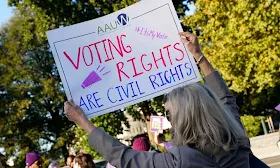
Media Lens: Supreme Court rules against key provision of Voting Rights Act in Louisiana
Supreme Court narrows Voting Rights Act provisions.
The US Supreme Court has narrowed the Voting Rights Act in a Louisiana redistricting case. This ruling limits the ability to challenge electoral maps based on racial discrimination, according to coverage in US and global politics and world news briefing.
What happened
The US Supreme Court has narrowed the Voting Rights Act in a recent Louisiana redistricting case. This ruling could significantly impact the manner in which electoral maps are drawn and how race can be considered in the redistricting process.
The decision has raised concerns about potential discrimination and the representation of minority voters in future elections. It highlights a complex intersection of race and electoral procedures in the United States.
Key facts
- The U.S. Supreme Court has narrowed the Voting Rights Act in a recent ruling.
- The ruling pertains to a redistricting case from Louisiana.
- The decision impacts the interpretation of racial considerations in electoral map drawing.
- Concerns have been raised regarding the limitations imposed by this ruling on voting protections.
Where coverage differs
- Reuters emphasizes the legal implications of the Supreme Court’s decision, while The New York Times focuses on the broader social impact of the ruling.
- SCOTUSblog foregrounds the specifics of the redistricting map challenged in court rather than the political ramifications.
- BBC prioritizes the limitation on racial considerations in electoral maps over the historical context of the Voting Rights Act.
One story, four angles
Reuters – US Supreme Court guts key provision of Voting Rights Act
Publication: Reuters | Primary framing pattern: legal | Tone: neutral | Intensity: 5/10 | Sentiment: mixed | Legal precision: high
Expand
Espresso Shot: The article discusses the Supreme Court’s recent decision which narrows the Voting Rights Act’s reach in Louisiana, emphasizing legal implications and precedents. The decision reflects a significant shift in the judicial interpretation of minority voting protections.
Publication emphasis: The emphasis is on the judicial decision’s legal impact and stakes for future voting rights cases.
Framing analysis: Foregrounded is the Court’s rationale and its implications for future redistricting. Secondary are views from those affected by the decision.
Bias: Selection: Focus on legalities over emotional responses; Language: Uses neutral legal terminology; Omission: Lack of stakeholder perspectives outside legal frameworks.
Assessment: The report provides a clear legal analysis while underrepresenting broader societal consequences.
The New York Times – Live Updates: Supreme Court Strikes Down Louisiana Map in Voting Rights Case
Publication: The New York Times | Primary framing pattern: political | Tone: critical | Intensity: 7/10 | Sentiment: negative | Legal precision: moderate
Expand
Espresso Shot: This live update is framed around political ramifications and public reactions to the Supreme Court’s decision, highlighting concerns regarding disenfranchisement and the undermining of minority rights.
Publication emphasis: The focus is on political impacts and public outcry over the ruling’s implications for voters.
Framing analysis: Foregrounded are the reactions from civil rights organizations and political leaders, while legal details remain a secondary concern.
Bias: Selection: Includes voices expressing dissent and concern; Language: Strong wording hints at injustice; Omission: Limited legal analysis of the ruling.
Assessment: The coverage effectively conveys the emotional stakes connected to the ruling, prioritizing political context over legal nuance.
SCOTUSblog – In major Voting Rights Act case, Supreme Court strikes down redistricting map challenged as racially discriminatory
Publication: SCOTUSblog | Primary framing pattern: legal | Tone: analytical | Intensity: 6/10 | Sentiment: mixed | Legal precision: high
Expand
Espresso Shot: This analysis offers an in-depth look at the Supreme Court’s ruling on Louisiana’s redistricting map, emphasizing its legal foundation and implications for racial equity in voting.
Publication emphasis: The legal reasoning and potential precedent set by the ruling are central to the analysis.
Framing analysis: Foregrounded is the Court’s rationale and history of Voting Rights legislation, while societal repercussions are secondary.
Bias: Selection: Focuses heavily on legal arguments and implications; Language: Formal legal terminology; Omission: Minimal discussion of public or political repercussions.
Assessment: The article is thorough in legal analysis but lacks a broader view on societal and political contexts.
BBC – Supreme Court limits use of race in drawing electoral maps
Publication: BBC | Primary framing pattern: moral | Tone: reflective | Intensity: 6/10 | Sentiment: negative | Legal precision: moderate
Expand
Espresso Shot: The BBC explores the ethical dimensions of the Supreme Court’s decision, raising questions about race and representation in electoral mapping and its implications for minority voters’ rights.
Publication emphasis: Highlights moral concerns surrounding racial equity and representation in voting districts.
Framing analysis: Foregrounded are the ethical and moral implications; secondary are descriptions of the legal arguments.
Bias: Selection: Comprehensive coverage of ethical viewpoints; Language: Emphasizes “race” and “discrimination”; Omission: Less focus on purely legal aspects.
Assessment: This piece provides a valuable moral perspective, yet it still addresses necessary legal elements, fitting well into the larger discourse.
Food for thought
Reuters presents the Supreme Court’s decision to “gut” a provision of the Voting Rights Act with a focus on the aftermath, framing it as a significant blow to voter protections. This stark characterization underscores the increasingly vulnerable position of voting rights in the U.S. Conversely, The New York Times uses a more measured tone, depicting the ruling as a limitation on race in redistricting, emphasizing the technicalities of legal implications rather than the emotional consequences. While Reuters’ framing evokes urgency and crisis, The New York Times prioritizes legal nuance. SCOTUSblog highlights the ruling’s racial implications, striking a balance between detailed analysis and broader social concerns. The facts do not change. What changes is where scrutiny lands.