


Young voters in Hungary back opposition party over Fidesz amid election interference claims
In Hungary’s upcoming election, over 60% of voters under 30 support the opposition Tisza party, while only 15% back Viktor Orbán‘s ruling Fidesz.
More than 60% of voters under 30 support the opposition Tisza party, while Fidesz only gains 15%, indicating a shift in youth political alignment.
“This may be the first election in Hungary where young people will play a decisive role in determining the outcome,” said Andrea Szabó, a leading sociologist.
Key developments
Recent polls indicate that over 60% of voters under 30 support Magyar’s party, in stark contrast to the 15% backing Viktor Orbán’s ruling Fidesz. This demographic shift could alter the election landscape.
Fidesz’s campaign targets older voters with promises such as a 14th month pension, where they enjoy substantial support among citizens over 64. Young voters, meanwhile, are showing increased political engagement, raising the chances of higher turnout.
Hungary’s upcoming election and the effects of the generation gap
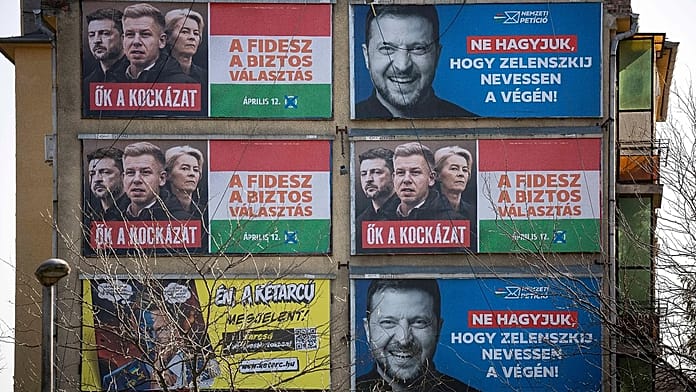
Most independent polls show that more than 60% of voters under 30 support Magyar’s party while only 15% support Viktor Orbán’s ruling Fidesz.
Orbán’s campaign appears to be speaking to older voters. One campaign promise is a 14th month pension, promising security for Hungary’s older citizens where Fidesz has a definite lead among voters over 64.
Based on earlier elections, young voters are harder to mobilise, so the generation issue might become one of the decisivce factors according to one of Hungary’s leading sociologists.
“This may be the first election in Hungary where young people will play a decisive role in determining the outcome. If voter turnout among them is indeed high, this could largely offset the generally higher turnout among older voters,” Andrea Szabó said.
But there are signs that this time younger generations are more interested in politics, as previously apolitical young influencers weight in.
Alleged election interference
This year’s election will determine whether the Fidesz party, which has been in power for 16 years, remains at the top of Hungarian politics or if the opposition Tisza party forms a government.
Critics of Fidesz see it as moving closer to Russia, which, under Vladimir Putin, has been waging a full-scale invasion of Ukraine since 2022.
They also claim that Fidesz is slowly moving away from the European Union, which has led Brussels to withhold trillions of euros of EU funds due to the dismantling of the rule of law.
The report focuses on 12 areas of concern. In a statement, the European Parliament said MEPs condemned the fact that Hungary’s Supreme Court for reviewing EU court rulings before applying them. They also criticised threats to judicial independence and Hungary’s systematic refusal to implement judgments of the European Court of Human Rights.
EU News, citing the investigative portal VSquare and journalist Szabolcs Panyi, wrote that Russian military intelligence agents may be interfering in the election process.
The government has dismissed these claims as fake news but VSquare reports observing patterns of interference comparable to those seen in elections in Georgia, Moldova and Romania, in which Russia was also accused of meddling.
How many young people will vote?
On the day of the 2022 parliamentary elections, 231,000 first-time voters could have gone to the polls, and approximately 90,000 went to vote. In 2026, the number of first-time voters is expected to be between 220-250,000, but there is no reliable data yet.
Young people are an important base for both Tisza and Fidesz and it matters how many of those 220-250,000 they can persuade to vote. Viktor Orbán has repeatedly hinted in his speeches over the past six months that Fidesz needs to convince young people to vote for them.
Some of the founders held responsible public administration positions under right-wing and other left-wing governments during the two decades after the change of regime.
As they write in their introduction, they are “all citizens who consider Hungary’s European development and the preservation of the rule of law to be more important than anything else.”
Seasoned politicians such as Péter Balázs or Géza Jeszenszky, former foreign ministers, Attila Holoda, former deputy state secretary and energy expert, Péter Bárándy, former justice minister, and Ákos Péter Bod, former central bank governor, all support the V21 initiative.
Campaign running on TikTok
The two most important faces of the campaign are Oszkár Kállai, whose TikTok name is “Oszikaaa,” and LázaDóra.
Oszkár Kállai is 21 years old, a first-time voter, and has been waiting for the time to come to vote since he was a child.
“I’ve been interested in politics since I was 10,” he told EU News, adding that he grew up in child protection, where he didn’t have much say in what happened to him.
“The people working in the home talked about politics a lot and I found it very interesting even then.”
Oszkár says he owes a lot to his educators and that he grew up in a good home “in a scandal-free environment,” he sums up, adding that “there were a few mishaps, but not the kind that the media is buzzing about these days.”
Kállai is currently studying social pedagogy and when he graduates he will be a manager in a children’s home and later wants to do a master’s degree. He still works in a children’s home, as a child supervisor.
This is his fifth profile on TikTok and his channel has been blocked on several occasions. “I express my opinion and if anyone doesn’t like it, they report it, and I’ve been blocked a couple of times,” he says.
When asked how long viewers watch the sequences, he says that viewers usually continue to watch his latest, nearly five-minute video beyond the fourth minute.
“After all, I’m not talking about nothing,” he explains.
Oszkár Kállai’s channel features a significant amount of political content but he says his long shifts at work prevent him from attending protests or demonstrations.
A different age group
LázaDóra is from a different age group, has been voting since 2006, and she has never missed an election.
“I was born in 1987 and Viktor Orbán gave his famous speech at the funeral of Imre Nagy in 1989. He has been one of the most influential figures in Hungarian politics for as long as I can remember,” explains Dóra.