



Get you up to speed: Kosovo votes again amid political deadlock, seeking EU and NATO progress
Voters in Kosovo participated in an early parliamentary election in Pristina, the third such election in 18 months, aimed at resolving a political deadlock. The election follows a failure among major political parties to agree on a successor for former President Vjosa Osmani.
The inability of Kosovo’s political parties to form a consensus has contributed to a prolonged institutional vacuum, hindering access to vital EU funding. Analysts anticipate that the outcomes of the current election will remain largely consistent with the results from December.
European Council President Antonio Costa urged Kosovo to resolve its political deadlock and focus on EU integration during a recent visit, emphasising the need for consensus. Analysts anticipate that the early parliamentary elections will likely yield similar results to the December vote, while the institutional vacuum continues to hinder access to EU funding.
What remains unclear — It is uncertain whether the election will successfully break the political deadlock and lead to a stable government in Kosovo.
Kosovo holds early parliamentary elections amid ongoing political deadlock
News|ElectionsKosovo votes again amid political deadlock, seeking EU and NATO progress
Prolonged crisis has negatively affected Kosovo’s economy, already hit hard by the global energy crisis and rising fuel prices.
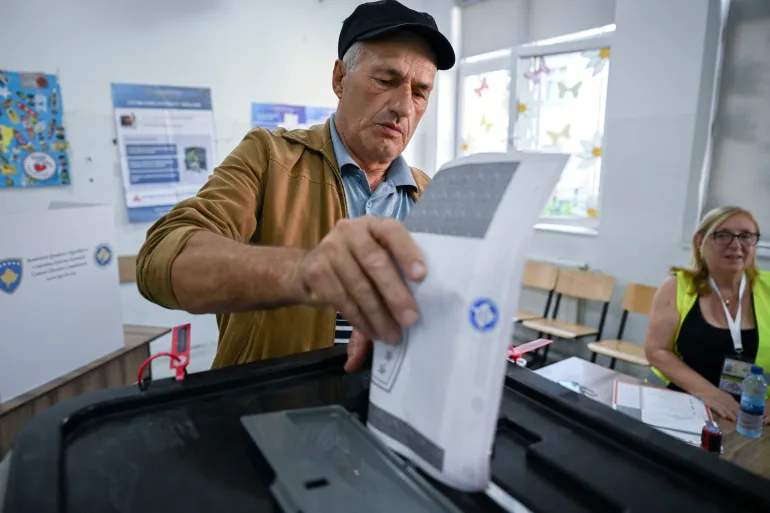 A man casts his ballot at a polling station on the day of general elections in Pristina [AFP]
Voters in Kosovo headed to the polls for an early parliamentary election, the third in 18 months, in an attempt to unlock a political impasse in the small Balkan nation that is striving to join the European Union and NATO.
Sunday’s ballot was scheduled after the main political parties failed to agree by a March deadline on who should replace former President Vjosa Osmani. The first inconclusive election in February 2025 left the country without a functioning government for much of last year, forcing a second election in December.
list of 3 itemslist 1 of 3Who is Roelf Meyer, South Africa’s new ambassador to the US?list 2 of 3Kosovo court jails three Serb separatists over 2023 Banjska attacklist 3 of 3Serbia hosts first joint military exercise with NATOend of list
The prolonged crisis has negatively affected Kosovo’s economy, already hit hard by the global energy crisis and rising fuel prices. One of the youngest and poorest countries in Europe, it declared independence from Serbia in 2008 after a 1998-99 war, which ended in a NATO bombing campaign that forced Serbia to withdraw.
Prime Minister Albin Kurti’s centre-left Vetevendosje party has held a clear parliamentary majority since the early election in December. But Kosovo’s president is elected by at least 80 lawmakers in the 120-member assembly, requiring a broader political consensus.
Kurti is being challenged by the two main opposition parties, the Democratic Party of Kosovo and the Democratic League of Kosovo, which have accused him of seeking to impose full control over all political institutions in the country.
Former President Osmani is running on the opposition LDK list in the election, having turned against Kurti after he refused to back her for a second term in office.
While the key players have blamed each other for the crisis, their inability to reach a compromise has led to disappointment among Kosovo’s about two million voters, who want the government to focus on the economy and living standards instead.
Analysts still do not expect major changes in the election outcome compared to the previous vote in December.
The institutional vacuum, without a stable government, has delayed access to the EU and other international funds available to the country.
European Council President Antonio Costa urged Kosovo during a visit last week to end the political impasse and unite over the goal of EU integration.
Kosovo has been recognised by the United States and most EU countries, but not by Serbia and its allies, Russia and China.
Tensions remain high in Kosovo’s north, where most of the ethnic Serbian minority live, but both Pristina and Belgrade have been told they must mend relations to move forward with their EU membership bids.