



Get you up to speed: Appeals court says Trump lacks authority to build White House ballroom without approval from Congress
A federal appeals court ruled that the Trump White House lacks the authority to unilaterally construct a new ballroom in Washington, D.C., requiring congressional approval for the $400 million project. The court found that the White House “very likely” does not have the authority to demolish and rebuild the East Wing, and that Congress has “full constitutional control over federal property.”
The judges have stayed their decision for 14 days, allowing the government to potentially appeal to the full appeals court or directly to the Supreme Court. The National Trust for Historic Preservation sued last year, arguing that the project failed to comply with federal guidelines and raised concerns over the funding mechanism, which the administration claims is largely sourced from private donations.
A federal appeals court has ruled that the Trump administration needs congressional approval for the proposed $400 million ballroom project at the White House, stating that the President cannot unilaterally make such decisions regarding federal property. The judges have given the government 14 days to consider an appeal, while the National Trust for Historic Preservation continues to challenge the project’s legality.
What remains unclear — It is uncertain whether the Trump administration will seek further legal recourse after the federal appellate panel’s decision.
Appeals court rules Trump cannot build White House ballroom without Congress approval
Washington — A federal appeals court on Friday said the Trump White House lacks the authority to unilaterally construct a new 90,000-square-foot ballroom where the East Wing once stood, finding that the $400 million project requires congressional approval.
In a 2-1 decision, a federal appellate panel in D.C. sided with a lower court in ruling that the White House “very likely” lacked authority to demolish and rebuild the East Wing. The judges said Congress has “full constitutional control over federal property and the funding of its maintenance and development,” and noted an “absence of any express or implied authorization” that grants President Trump the ability to construct the ballroom.
“Each President is a temporary tenant, not the owner, of the White House and its Executive Residence. The President has no — and claims no — constitutionally assigned authority over that property, which is designed and maintained for the use of all Presidents, current and future, and for the American people,” the judges wrote in their opinion.
“We are aware of no instance in American history in which a President unilaterally and using privately collected funds demolished substantial portions of the White House that Congress authorized to be built and American taxpayers paid for,” the judges said. “Until now.”
Kevin Carter / Getty Images 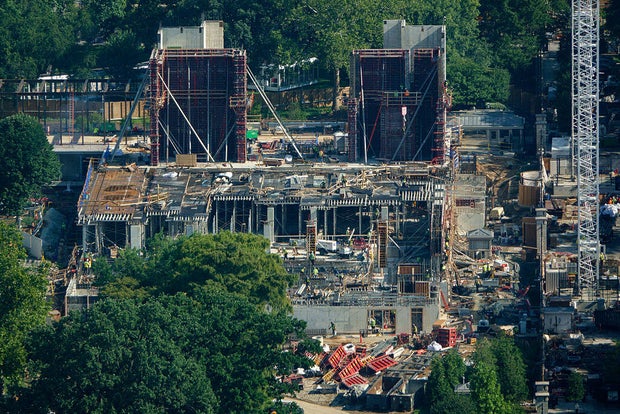
Judges Patricia Millett and Bradley Garcia wrote the majority opinion. Judge Neomi Rao, who was nominated to the federal bench by Mr. Trump, dissented. Millett and Garcia were nominated by Presidents Barack Obama and Joe Biden, respectively.
The judges stayed their decision for 14 days to give the government the chance to appeal. The Justice Department could ask the full appeals court to hear the case or appeal to the Supreme Court directly.
“This holding has nothing at all to do with whether the proposed ballroom is desirable, or not, as a matter of policy,” the majority wrote. “This ruling does not even necessarily mean that the Defendants may not ultimately construct the ballroom. What it does mean is that the Defendants may not do so during the district court’s expeditious litigation without securing Congress’s authorization, as the Constitution and laws require.”
In her dissent, Rao wrote that the National Trust for Historic Preservation, which sued in lower court to block Mr. Trump’s project, did not have proper legal standing to bring the lawsuit. Rao accused the lower court judge that initially blocked the construction, and her colleagues, of “judicial overreach.”
The White House and Justice Department did not immediately respond to requests for comment.
The legal battle over the ballroom
In March, U.S. District Judge Richard Leon ruled that a legal challenge brought by a preservation group that sued to block Mr. Trump’s construction project was likely to succeed on the merits, because “no statute” that the government used to justify the construction “comes close to giving the President the authority he claims to have.” Mr. Trump tore down the East Wing last October and began construction without congressional approval.
The administration contended in court filings that a statute permitting the White House to perform routine maintenance and repairs to the executive mansion provides a legal justification for the project. Acting Attorney General Todd Blanche also argued in court filings that the panel should order the resumption of construction because the recent attempted attack at the White House Correspondents’ Association Dinner in April underscored the need for a secure ballroom on White House grounds.
After the Trump administration appealed the initial ruling, the appellate judges ordered Leon to reconsider the possible national security implications of halting the construction. Weeks later, he amended his ruling, finding that above-ground work on the East Wing must stop, but underground construction on a presidential bunker could continue.
In April, the panel granted an administrative stay sought by the Justice Department that allowed all White House ballroom construction to continue while the court considered briefs and heard arguments last month.
The National Trust for Historic Preservation in the U.S. sued the administration late last year for allegedly failing to adhere to federal guidelines prior to demolishing the East Wing and breaking ground on a ballroom. The Trust also questioned the $400 million project’s funding mechanism, which the president claims is largely from private donations.
The ballroom project came together quickly after Mr. Trump announced it last summer. A panel of the U.S. Commission of Fine Arts, filled with the president’s allies, voted unanimously to approve the ballroom proposal in February. The National Park Service has said construction could wrap up by mid-2028.
The project has drawn scrutiny from congressional Democrats and preservation groups who argue that the Trump administration was making major changes to the White House without enough public input. The administration has defended the project, casting it as a useful addition to the complex and part of a long line of alterations to the White House.