


Italy’s prime minister meloni proposes electoral system overhaul ahead of 2027 election
Italy’s Prime Minister Giorgia Meloni proposes a new law guaranteeing a parliamentary majority for any coalition winning over 40% of the vote in the 2027 election.
Italy’s Democratic Party has vowed to challenge the proposed electoral reform, arguing it lacks transparency and undermines democratic principles.
Lawmakers in both the Chamber of Deputies and the Senate are set to start debating the proposed electoral reform for Italy’s 2027 general election.
Briefing summary
Italy’s Prime Minister Giorgia Meloni has proposed an overhaul of the electoral system aimed at guaranteeing a parliamentary majority for parties winning over 40% of the vote. This move has drawn criticism from the opposition, particularly the centre-left Democratic Party, who accuse the government of manipulating the electoral process.
The proposed reform shifts to a fully proportional system with a majority bonus, retaining a 3% electoral threshold. Experts warn that the changes could lead to inconsistent majorities in the lower and upper chambers, challenging the intended stability of governance.
The proposal, which enters parliamentary debate, faces concerns over the removal of preference votes, limiting voter choice. Critics note that the change contradicts Meloni’s previous stance on individual candidate selection, prompting calls for continued consideration of alternative electoral systems.
Read in Full
Italy’s electoral law: Is Giorgia Meloni reshaping the system to secure re-election?
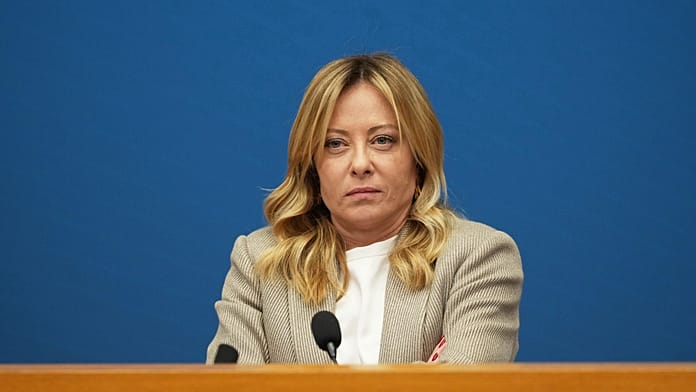
Italy’s Prime Minister Giorgia Meloni has been accused of trying to manipulate Italy’s next general election in 2027 through a controversial overhaul of the electoral system.
Her conservative government wants to introduce a new law that would guarantee a parliamentary majority to any party or coalition winning more than 40% of the vote.
Italy’s main opposition force, the centre-left Democratic Party, says the move is politically motivated, accusing the government of “fearing defeat under the current electoral system” and “changing the rules of the game without any real debate with the opposition”.
EU News‘ fact-checking team, took a look at the proposal to see exactly how it would affect Italy’s elections.
How the current system works
Italy currently uses a mixed electoral system known as the “Rosatellum”, in which about one-third of Italy’s 600 MPs are elected in single-member constituencies, where the candidate with the most votes wins.
The remaining two-thirds of seats are distributed proportionally, based on the share of votes each party receives nationally for the lower Chamber of Deputies and regionally for the Senate, with parties required to pass a 3% threshold to enter parliament.
At the 2022 general election, this system worked to Meloni’s advantage: the main opposition parties — the Democratic Party and the left-wing Five Star Movement — failed to form an electoral alliance, allowing Meloni’s right-wing bloc to secure a clear majority.
What the reform would change
Under the proposed law, Italy would move to a fully proportional system with a majority bonus. Any coalition winning more than 40% of the vote would automatically be guaranteed a parliamentary majority.
If no coalition reaches 40%, a run-off would be held between the top two blocs, provided both exceed 35%. The 3% electoral threshold would remain.
Experts warn the reform could produce unexpected results — including different majorities in the Chamber of Deputies and the Senate.
Nicola Lupo, a public law professor at Luiss Guido Carli University in Rome, told The Cube the law could give a majority bonus to the centre-right in one chamber and the centre-left in the other, undermining its aim of ensuring stable government.
He explained that the reform is tailored to the current political landscape, which limits its effectiveness in the long term.
Other concerns include the removal of preference votes, meaning voters could no longer choose individual candidates.
The prime minister’s name would appear only alongside party lists, rather than separately on the ballot — a change that contradicts Meloni’s previous support for voter choice within party lists.
Since 1993, Italy has used “blocked lists”, where parties determine the order of candidates. The Constitutional Court has flagged this as a potential problem.
Shorter lists or single-member constituencies have been proposed as alternatives. Even in the new system, lists would remain effectively blocked, though lawmakers from Brothers of Italy have indicated they may propose amendments during parliamentary debate.
The proposal has now been presented to both the Chamber of Deputies and the Senate, where lawmakers are set to begin debating the reform.