


Cliff Notes – Eurovision bosses can’t tame the ‘political beast’ of the competition
-
Despite Eurovision’s official stance on non-political neutrality, the event remains deeply intertwined with geopolitical issues, as evidenced by ongoing protests and calls for Israel’s exclusion amid its military actions in Gaza.
-
The introduction of a Code of Conduct aims to maintain a politically neutral environment; however, the blurred lines between art and politics continue to challenge this objective, leading to past controversies over song lyrics and performances.
- Audience protests and the use of technology to suppress dissent highlight the complexities of maintaining a politically neutral platform, raising questions about the feasibility of true political neutrality in international events.
Eurovision bosses can’t tame the ‘political beast’ of the competition
‘The special thing about Eurovision is that it’s the one night of the year where people, in theory, put aside their differences and share that stage.’
That’s what Paul Jordan, also known as ‘Doctor Eurovision’, tells Metro when asked about Eurovision’s non-political nature. Jordan is a lifelong fan and expert on the contest, having worked behind the scenes and served on international juries.
‘But it’s unrealistic to expect it to be seen as a non-political event. It’s important they try to keep it that way, but ultimately, politics comes into it,’ he adds.
This year is no different, with Israel’s inclusion in the competition proving to be highly controversial for the second year in a row, in light of the country’s military campaign against Hamas in Gaza.
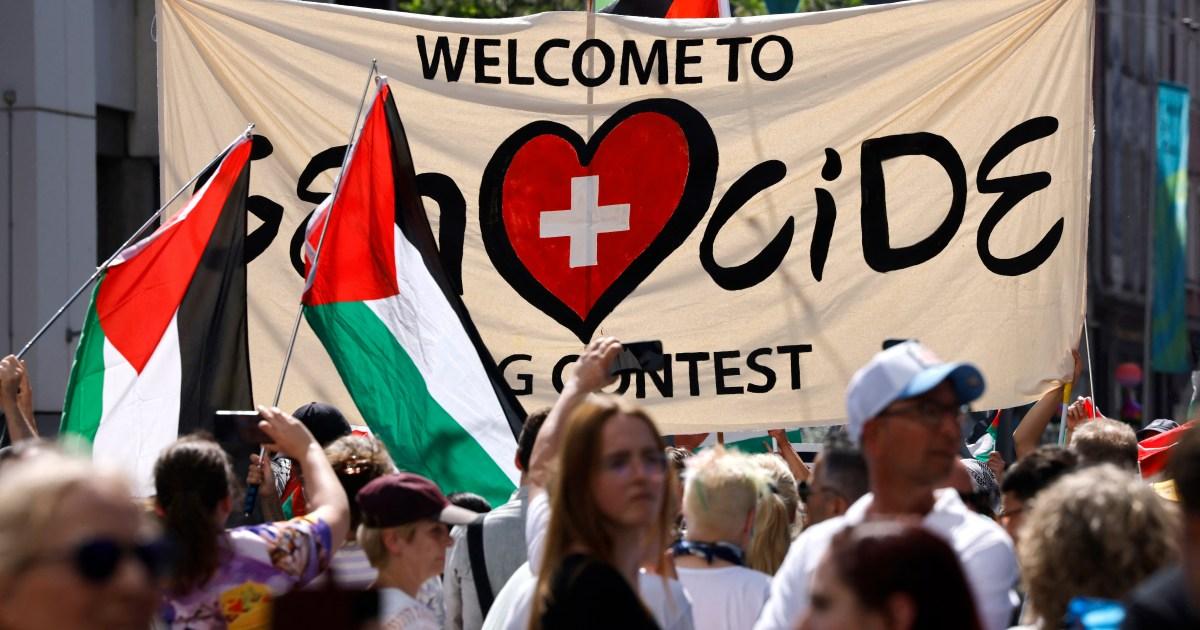
72 former contestants have signed an open letter calling for Israel to be banned, while the opening ceremony, held in host city Basel, was marred by pro-Palestine protests in which a throat-slitting gesture was made towards the Israeli Eurovision act, Yuval Raphael.
The 24-year-old is a survivor of the October 7 Hamas attacks, and it was later announced that she would not be giving interviews to the media due to security concerns.
Eurovision is not immune to the context of the wider world
Despite the Eurovision Song Contest’s official stance as a non-political event, the contest has long been steeped in geopolitical drama. From Jordan (the country) refusing to announce Israel as the winner in 1978 to host country Ukraine banning the Russian contestant in 2017, Eurovision is no stranger to controversies.
This year, host country Switzerland is banning artists from taking Pride flags on stage, which have been a staple at the contest in previous years, instead allowing only national flags in official areas.
Meanwhile, Palestinian flags will this year be permitted in the audience, after a rule banning flags of non-competing countries was overturned. The change marks the latest point of tension in Eurovision’s ongoing challenge to reconcile cultural celebration with political reality, and begs the question: can Eurovision ever truly be non-political?
Martin Green, director of the Eurovision Song Contest, is not naive to the challenge.
‘Everything takes place in the context of a wider world, and we’re not immune to that,’ he exclusively tells Metro.
This is the first year Eurovision introduced a Code of Conduct, reaffirming the ‘proud tradition of celebrating diversity through music’, adding that the event must remain free from political influence. While on event premises, promoting, carrying, or wearing any political material is prohibited, and no lyrics of a political nature are allowed. Additionally, all participating broadcasters are responsible for ensuring the Eurovision Song Contest isn’t politicised.
Performances are also forbidden from including messages, speeches, gestures, symbols or slogans of a political nature.
The line between art and politics is blurry at best
The key challenge for Eurovision, Paul Jordan says, is staying consistent.
‘A song about world peace, technically, could be seen as political. So what is political and what isn’t is a very blurred area. Eurovision hasn’t helped itself by allowing some political songs and saying no to others.’
In 2009, Georgia was forced to withdraw from the contest for refusing to change the lyrics to their entry ‘We Don’t Wanna Put In’, which took aim at Russian President Vladimir Putin a year after the Russo-Georgian war. In contrast, Ukraine’s winning song in 2016 about the deportation of the Crimean Tatars was allowed, and its triumph angered Russian politicians.
Jordan believes that ‘if Eurovision hadn’t been held in Moscow in 2009, Georgia’s song probably would have been allowed. So a lot of it depends on context and timing’.
He adds of the Ukrainian tune: ‘It was ambiguous enough that you couldn’t say for sure whether they were talking about Russia or the Soviets.’
The cost of defiance
Green says the first port of call after a rule break is to try and resolve it simply through a conversation with the participants. ‘But like any big competition in the world, we do have a set of rules that we can refer to, if we have to,’ he says.
The Code of Conduct states that serious rule breaks can lead to ‘immediate removal’ from the event and, depending on the severity of the misconduct, ‘legal action may also be pursued’, including slapping a fine for the country’s broadcaster.
But despite the risk of punishment, many performers have defied the Eurovision rules over the years, the access to a mass audience presenting a unique opportunity some feel they must seize.
Hatari said their protest was the main reason they took part in Eurovision (Picture: BBC)
The EBU fined Iceland’s broadcasters €5,000 (Picture: Antti Aimo-Koivisto/REX/Shutterstock)
Icelandic act Hatari caused a stir in 2019 when they held up banners in support of Palestine during the results.
‘It was always our main reason for entering – to make awareness of the occupation of Palestinian territories and the pinkwashing that was taking place,’ they said.
The European Broadcasting Union (EBU) later fined Iceland’s broadcasters €5,000 (roughly £4,200).
Elsewhere, Armenian singer Iveta Mukuchyan landed her country in hot water during a semi-final in 2016, when she waved the flag of Nagorno-Karabakh, a region at the centre of a decades-long dispute between Armenia and Azerbaijan.
Armenia was sanctioned by the EBU and warned they could be kicked out of the contest if they did it again. Singer Iveta said at the time: ‘I am representing my country in my heart, my thoughts my feelings and all my emotions. My thoughts are with my motherland and what I want to spread is peace on borders. I wrote this song because this was going on inside of me’.
Armenia was sanctioned after singer Iveta Mukuchyan displayed a regional flag during the 2016 contest (Picture: Rolf Klatt/REX/Shutterstock)
Audiences protest too
It’s not just the performers who have been known to bring politics to Eurovision. Last year Israel was drowned out by boos and chants of ‘Free Palestine’ in footage posted to social media by attendees.
These protests went unnoticed by viewers at home, however, with some claiming anti-booing technology was used to muffle the dissent.
The technology was first employed in 2015, one year after Russia’s act was repeatedly booed while performing, with then-Eurovision communications coordinator Jarmo Siim telling The Moscow Times: ‘It was very embarrassing for us last year when this happened, as it is not in the spirit of the contest’.
But it’s yet another area where Eurovision is caught between a rock and a hard place. Paul Jordan tells Metro: ‘By using this technology, that’s almost making a political choice. But then, Eurovision has a duty of care to the artists to give them all an equal opportunity.
‘So, they’re suppressing freedom of expression, but, at the same time, it’s really unfair on the artist to be horribly booed. It’s a really complex, double-edged thing.’
Is political neutrality even possible on international stages?
While freedom of expression is respected as ‘a fundamental right’ in the Eurovision code of conduct, participants can only express themselves freely in a personal capacity and must avoid linking political views to their Eurovision participation.
‘Eurovision tries to create something which is unique, which is apolitical, and yet to do that, it has to suppress freedom of expression, which is one of the core values,’ says Jordan. For him, this is a lose-lose situation. ‘It has to, at some point, just acknowledge that there are going to be elements of politics coming in.’
But the hijacking of a politically neutral event isn’t exclusive to Eurovision. The 2022 FIFA World Cup, held in Qatar, was criticised because of the country’s alleged violations of human rights.
The same year, several countries, including the UK, declared a diplomatic boycott of the Winter Olympics in Beijing due to alleged atrocities against the Uyghur Muslim population in the northwest province of Xinjiang. Similar concerns have already been voiced after it was announced that Saudi Arabia will host the World Cup in 2034.
Eurovision clearly isn’t alone in its challenge, and perhaps political neutrality is impossible on an international stage.
As Paul Jordan says, ‘These international events are, by their very existence, political beasts, even though they’re not meant to be.’