
Latest News
- Minibus collision with shuttle train injures 19 at Eurotunnel site
- Zimbabwe’s ZiG seeks to gain trust and reduce reliance on the US dollar
- Winnipeg zoo announces new name for polar bear cub after record votes
- FBI alerts Sikh separatist Pannun to new threats against his life
- Minibus collides with Channel Tunnel train, injuring 19 people in Calais
- MEPs urge EU to uphold support for Ukraine amid Trump’s diesel deal
- Calgary Stampeders require assistance to qualify for CFL playoffs
- Feds investigate suspicious letters sent to election officials and Congress



The israelis commit 3 massacres against families in Gaza, resulting in 19 people being killed & 91 injuries arriving at hospitals in the last 24 hours

Chris Kaba’s mother asked to extend the judicial decision not to allow the press to report on Kaba’s criminal background.
She DID push for the officers name to be made public, however.

Austerity is a political choice.
Children & pensioners are being pushed into poverty while billionaire wealth skyrockets.
Ahead of the Budget, we’ve written to the Chancellor demanding wealth taxes to fund public services & put the needs of the many over the greed of a few👇🏽

Minibus collision with shuttle train injures 19 at Eurotunnel site
Injury Reports
19 people were injured in a collision between a minibus and a shuttle train at the Eurotunnel site in northern France.
19 people were injured in a collision between a minibus and a shuttle train at the Eurotunnel site in northern France.
Safety Implications
This incident marks the inaugural accident of this nature at an Eurotunnel loading platform, prompting a judicial investigation into potential safety shortcomings.
This incident marks the inaugural accident of this nature at an Eurotunnel loading platform, prompting a judicial investigation into potential safety shortcomings.
Investigation Launched
Agathe Cury, sub-prefect of Calais, stated, “A judicial investigation has been opened, as this is the first accident of its kind at an Eurotunnel loading platform.”
Agathe Cury, sub-prefect of Calais, stated, “A judicial investigation has been opened, as this is the first accident of its kind at an Eurotunnel loading platform.”
At least 19 injured as minibus collides with train near Channel Tunnel

Published on •Updated
A collision between a minibus and a shuttle train at the Eurotunnel site in northern France left 19 people injured on Thursday evening, local authorities said.
“An accident involving a minibus transporting heavy goods vehicle drivers who were about to board a Le Shuttle shuttle occurred this evening, at the loading platform of the Eurotunnel site,” the Pas-de-Calais prefecture wrote on X.
According to French broadcaster TF1, the minibus struck the departing shuttle train for reasons that remain unclear. Authorities confirmed that the vehicle did not overturn.
The minibus driver was an Eurotunnel employee, while the victims were all men of different nationalities, according to local authorities.
The sub-prefect of Calais, Agathe Cury, said a judicial investigation had been opened, adding that it was the first accident of its kind at an Eurotunnel loading platform.
Emergency services, including ambulances, helicopters and police officers, were deployed to the scene. None of the injuries were believed to be life-threatening.
Traffic through the Channel Tunnel remained operational following the collision.
Additional sources • AFP
Get you up to speed: Can Zimbabwe’s ZiG win trust and replace the US dollar?
The Zimbabwean government is promoting the use of its currency, the Zimbabwe Gold (ZiG), in a bid to reduce reliance on the US dollar. However, widespread scepticism persists among citizens, many of whom remain hesitant to use the currency due to past experiences with currency instability.
The Reserve Bank of Zimbabwe (RBZ) has introduced upgraded ZiG banknotes with new designs and security features as part of its efforts to enhance the currency’s credibility. While the RBZ reported annual ZiG inflation at 3.7 percent last month, demand for the currency remains low, with consumers and businesses preferring transactions in US dollars.
The Reserve Bank of Zimbabwe is focusing on a gradual, market-led transition to encourage greater use of the Zimbabwe Gold (ZiG) currency, aiming to stabilize the economy and rebuild public trust. Despite official measures, including the introduction of upgraded banknotes, consumer and business acceptance remains low, with many preferring transactions in the US dollar, highlighting the significant challenge ahead for currency confidence.
What remains unclear — It is uncertain what specific measures will be taken to build trust in the ZiG beyond the introduction of new banknotes and assurances from officials.
Zimbabwe’s ZiG seeks to gain trust and reduce reliance on the US dollar
EconomyCan Zimbabwe’s ZiG win trust and replace the US dollar?
After repeated currency crises, Zimbabweans remain wary of the ZiG.
Published On 16 Oct 202616 Oct 2026
Harare, Zimbabwe – The government is trying to persuade citizens to use its own currency more widely, with the longer-term aim of reducing reliance on the US dollar. But after years of currency instability, many remain reluctant to trust the latest attempt.
The Zimbabwe Gold (ZiG), introduced in April 2024, is a government effort to restore confidence in the local currency. The Reserve Bank of Zimbabwe (RBZ) says the currency is backed by foreign currency and precious metal reserves, including gold.
Yet the challenge extends beyond introducing a new currency or strengthening its reserves. Zimbabweans who have watched their savings lose value and their wages shrink through successive currency crises remain cautious about holding money in a currency whose purchasing power they fear could deteriorate.
Zimbabwe abandoned its local currency in 2009 after a period of hyperinflation and adopted a multicurrency system dominated by the US dollar. A domestic currency returned in 2018, but repeated instability has made rebuilding public confidence difficult.
The cost of lost confidence
For primary school teacher Charles Mbwandarikwa, the experience of earlier currency crises remains a warning.
He receives about a third of his salary in ZiG and says he exchanges it quickly rather than holding on to it. His caution stems from the losses he suffered when Zimbabwe’s previous currency collapsed.
He lost his pension savings during the 2009 crisis. When the local currency was reintroduced in 2018, he says, the value of his salary fell from the equivalent of $540 to $40 by the end of that year.
Such experiences help explain why official assurances about the ZiG have not necessarily translated into confidence among earners.
The RBZ has sought to strengthen the currency’s credibility. On April 7 , the bank introduced an upgraded series of ZiG banknotes with revised designs and security features.
 Clothing retailer Sesedzai Chigumira says she has made only a handful of sales in the country’s ZiG currency, reflecting Zimbabwean’s continued preference for the US dollar [File: Farai Mwakutuya/WTX News]
According to the RBZ, annual ZiG inflation stood at 3.7 percent last month. But relatively low inflation alone does not guarantee that people will choose to save in the currency or use it for everyday transactions.
Economist Cornelius Dube says demand for the ZiG remains weak.
“ZiG has to be available in a ratio relative to its demand. Demand for ZiG is currently very subdued,” he says.
A currency few customers use
For businesses, the currency’s acceptance by customers is a practical test of whether it can gain a larger role in the economy.
Sesedzai Chigumira, a clothing retailer, says she has made only a handful of sales in ZiG. Her experience reflects the difficulty in encouraging wider use of a currency when customers and businesses remain more comfortable transacting in US dollars.
The government’s push to reduce dollar dependence also faces a broader challenge: the existence of gold and other mineral resources does not, by itself, guarantee confidence in a currency. People must believe that it will retain its value and remain useful for paying for goods, meeting expenses and saving for the future.
Where businesses expect customers to prefer dollars, they may be reluctant to price goods or accept payments in ZiG. Consumers, in turn, have little incentive to hold the local currency if they fear that its value could fall.
That creates a cycle that policy measures alone may struggle to break.
What it will take to win trust
The RBZ has moved away from its previous target of adopting a single currency by 2030, instead outlining a gradual, market-led transition towards greater use of the ZiG. The approach depends on sustained macroeconomic stability and conditions that encourage businesses and consumers to use the currency voluntarily.
The central bank has also sought to expand the ZiG’s role in domestic transactions, including through its use in tax payments and public-sector transactions, alongside measures affecting the foreign exchange and national payments systems.
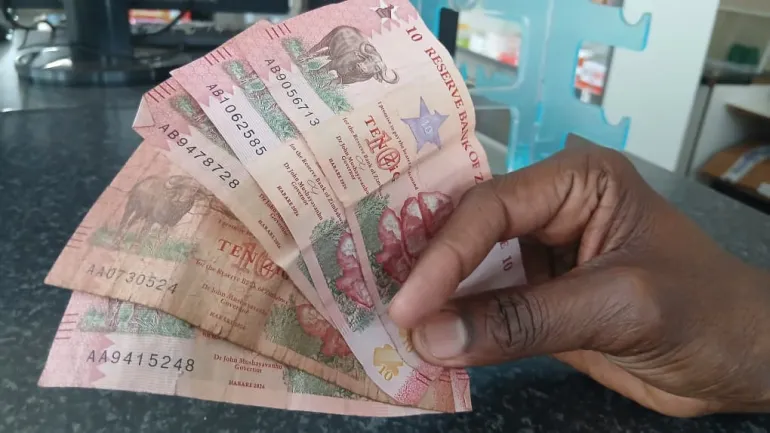 Zimbabwe’s ZiG banknotes are part of the government’s latest effort to rebuild trust in the local currency and reduce the economy’s reliance on the US dollar [File: Farai Mwakutuya/WTX News]
But wider use in payments is not the same as confidence in a currency as a store of value. People may use ZiG when required or when circumstances leave them little choice without being willing to keep their savings in it.
For Mbwandarikwa, the memory of losing his pension savings remains part of the calculation. For Chigumira, the limited number of customers paying in ZiG shows how far the currency still has to go to become a routine part of business.
Dube says de-dollarisation is possible, but it cannot be achieved overnight. “History shows that it is possible to de-dollarise, though it’s not easy. It takes time,” he says.
For Zimbabweans who have lived through repeated currency crises, the test will be whether the ZiG can preserve their earnings and savings over time. Expanding its use through policy may be possible, but persuading people to trust it will require sustained stability and confidence in the currency.
“Policy should not try to force a conversion but should create the necessary incentives which will eventually see both businesses and consumers being indifferent to holding ZiG or US dollars,” Dube says.
