



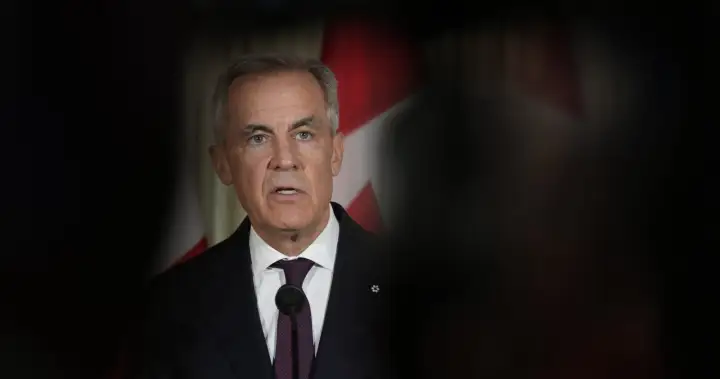
What’s the Latest: Canada-U.S. trade deal must include viable auto sector, Carney says
Prime Minister Mark Carney stated that trade talks with the U.S. are making progress, emphasising that Canada will not accept a deal detrimental to its auto sector during a news conference in Manila. Carney also noted concerns regarding Stellantis’ commitments related to the sale of its Brampton assembly plant to defence contractor Roshel.
Prime Minister Mark Carney stated that discussions with U.S. President Donald Trump included U.S. Trade Representative Jamieson Greer and Chief of Staff Stephen Miller. Carney confirmed ongoing concerns regarding Stellantis’ compliance with its obligations related to federal funds amid the sale of its Brampton, Ont., assembly plant.
Prime Minister Mark Carney stated that Canada will not accept a trade deal with the U.S. that jeopardises a viable Canadian auto sector, emphasising the importance of this issue in ongoing negotiations. Carney added that the Canadian government is not satisfied with Stellantis’ handling of its obligations related to the sale of its Brampton assembly plant and expects full compliance with its commitments to workers and Canada.
What remains unclear — The timeline and specific conditions for reassessing Chinese investment in Canada’s auto sector have not been disclosed.
Carney asserts Canada-U.S. trade deal must support viable auto sector
Prime Minister Mark Carney confirmed that trade negotiations with the U.S. are advancing, but emphasised that Canada will not agree to a deal undermining its auto sector. “This government will not settle for a deal with the United States that is not consistent with a viable Canadian auto sector,” Carney stated during a news conference in Manila on Saturday.
Carney’s remarks come three months after Canada suspended talks due to last-minute U.S. demands affecting Canada’s automotive industry. He described the auto sector as “one of the fundamental issues” in the negotiations, acknowledging it as a significant challenge.
The Prime Minister recently had an extensive discussion with U.S. President Donald Trump, which included U.S. Trade Representative Jamieson Greer and Chief of Staff Stephen Miller. Carney highlighted the interdependence of the American automotive market on Canadian manufacturing, asserting that a stable trading relationship is crucial for both Canadian and U.S. workers.
In addition, Carney noted that China’s investment in Canada’s auto sector is subject to specific limits and will be reassessed based on various factors, including Canada’s integration with the U.S. automotive industry. He expressed dissatisfaction with Stellantis, stating that the company has not fulfilled its commitments after receiving federal support, particularly concerning the sale of its Brampton, Ont. assembly plant to defence contractor Roshel.
“We’re not satisfied in any way with the current situation and the partial approach that Stellantis has taken here,” said Carney. He reiterated expectations for Stellantis to honour its obligations to both the workforce and Canada.