



Hungary’s foreign minister offers to assist in lifting EU sanctions on oligarch’s sister
A group of investigative journalists published a recording of Hungarian Foreign Minister Péter Szijjártó offering to assist in removing a Russian oligarch’s sister from EU sanctions.
Investigative revelations have intensified scrutiny on Hungary’s diplomatic ties with Russia, directly influencing the narrative in the upcoming parliamentary elections.
“We will continue to adhere to this approach in the future,” Szijjártó stated, defending Hungary’s stance on sanctions related to energy security.
Key developments
A recording has surfaced revealing Hungarian Foreign Minister Péter Szijjártó offering assistance to Russian Foreign Minister Sergey Lavrov in removing a Russian oligarch’s sister from EU sanctions.
Szijjártó stated he would propose removing Ismailova from the sanctions list “next week,” indicating that Hungary continues to engage deeply with Russian officials despite the EU’s political distancing after Russia’s invasion of Ukraine.
Leaked call shows Szijjártó discussing EU sanctions removal with Russia’s Lavrov
Published on
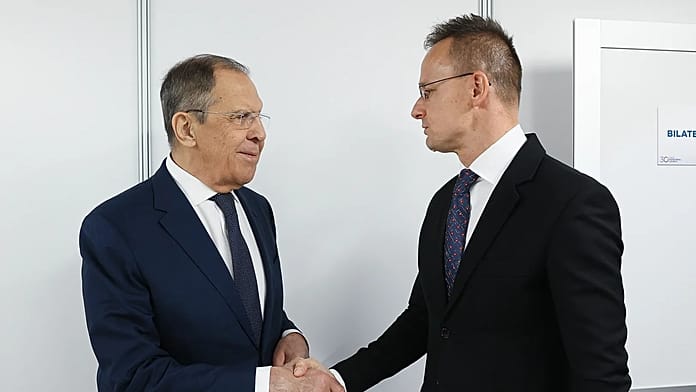
A group of investigative journalists on Tuesday released a recording of a phone call between Hungarian Foreign Minister Péter Szijjártó and his Russian counterpart, Sergey Lavrov, in which Szijjártó offered to assist in removing a Russian oligarch’s sister from EU sanctions at Lavrov’s request.
The scandal has emerged as Hungary prepares for parliamentary elections on 12 April, with foreign interference and the government’s close ties to Moscow among the key campaign issues.
Szijjártó has defended his actions, arguing that speaking with Russian officials before and after such meetings is part of routine diplomatic practice.
Szijjártó told Lavrov that he would submit a proposal to remove Ismailova’s name from the EU sanctions list “next week,” and “as the new review period begins, it will be put on the agenda — we will do our best to get her off,” Szijjártó said.
The European Union severed political ties with Russia following its full-scale invasion of Ukraine in 2022 and has urged member states to gradually phase out Russian fossil fuels.
Hungary and Slovakia have maintained regular high-level contacts with Russian officials and continue to import significant volumes of Russian energy.
Following the publication of the recording, Szijjártó downplayed the incident and accused foreign intelligence services of tapping his phone.
“It has been known for some time that foreign secret services — with the active participation of Hungarian journalists — have been intercepting my phone conversations. Today, the eavesdroppers made another great ‘discovery’: they proved that I say the same thing in public as on the phone. Nice work!” he wrote.
The minister added that his government had never agreed to sanction entities critical to Hungary’s energy security and had opposed listing individuals when sanctions served no clear purpose. “We will continue to adhere to this approach in the future,” he said.
The European Commission has said earlier that the allegations regarding Szijjártó’s conduct during Foreign Affairs Council meetings are a matter of concern and require clarification from Budapest.
In the recording, Lavrov also told Szijjártó that the Hungarian minister has been receiving extensive coverage in Russian media.
“Did I say something wrong?” Szijjártó asked.
“No. They were just saying that you are pragmatically fighting for the interests of your country,” Lavrov replied.