
Latest News
- Nobel Prize winner claims Russian medics are torturing Ukrainian prisoners
- Spain’s National Day parade features military display amid political tension
- Federal agents raid home of Representative Ilhan Omar, warrant approved
- Houthi Attacks Cause Closure of Saudi Airport Amid US Consideration of Strikes
- NATO warns it will take all measures if alliance is attacked
- Motorcyclist dies in collision with SUV in Ottawa
- Homeland Security investigates Rep. Ilhan Omar’s home in Washington, D.C.
- Businessman ordered to demolish flat built inside horse stable in Cotswolds


UK inflation fell to 1.7% in the year to September, the lowest rate since April 2021. So much for the Bank of England’s prediction that it would start to rise again in the autumn. It was one of the (wrong) reasons Sunak went for a July election.
🏴🤝🏻 Official, confirmed. Thomas Tuchel becomes the new England head coach from January 2025.
“I am very proud to have been given the honour of leading the England team”.
“I have long felt a personal connection to the game in this country, and it has given me some incredible moments already”.
“To have the chance to represent England is a huge privilege, and the opportunity to work with this special and talented group of players is very exciting”.
Get you up to speed: Nobel Prize winner says Russia medics are torturing Ukrainian prisoners | News World
Oleksandra Matviichuk, leader of the Center for Civil Liberties, highlighted allegations that Russian medics are involved in the torture of Ukrainian civilians and prisoners of war. She stated that such incidents are systemic and have been recorded over 12 years of conflict, with reports including severe abuses like branding victims during treatment.
The Center for Civil Liberties has submitted multiple requests to the International Criminal Court in The Hague to investigate the alleged torture by Russian medics, with particular emphasis on the documented actions of Ilya Sorokin, known as ‘Doctor Evil’. Matviichuk indicated a need for immediate access for the International Committee of the Red Cross to all detained civilians and prisoners of war, emphasizing that such access is vital for ensuring humanitarian standards are upheld.
Oleksandra Matviichuk, representing the Center for Civil Liberties, has called for urgent intervention from international bodies following allegations that Russian medics have tortured Ukrainian detainees. In response to these claims, the Centre, along with other NGOs, has submitted an appeal to the World Health Organisation, emphasising the need for oversight and access to affected individuals in order to uphold international medical ethics.
What remains unclear — It is not known how the International Criminal Court will respond to the submissions regarding alleged crimes against humanity by Russian medics.
Nobel Prize winner claims Russian medics are torturing Ukrainian prisoners

Oleksandra Matviichuk, delivering her Nobel lecture in 2022 (Picture: EPA)
A winner of the Nobel Peace Prize has called for immediate action after a report claimed Russia is weaponising doctors and medics to torture Ukrainian civilians and prisoners of war.
Oleksandra Matviichuk leads the Center for Civil Liberties, the human rights organisation which received the prize in 2022 alongside Russian non-profit Memorial and Belarusian campaigner Ales Bialiatski.
The centre is among a group of Ukrainian charities and institutions sounding the alarm over allegations of international law and medical ethics by Russia.
Medics are alleged to have denied badly needed care, tortured prisoners with tasers – and even branded patients with pro-Russia messages.
Matviichuk told WTX: ‘We want to share this information to put pressure on Russia in order to save lives, because people are dying. People are dying.
‘Their conditions are inhuman and the treatment is beyond human imagination.’
Sign up for all of the latest stories
She highlighted the case of a man who told her he saw medics only once while incarcerated, after he lost consciousness while being tortured.
Matviichuk, a human rights lawyer, said: ‘The Russian medics were invited to give an injection and to return him to consciousness, to provide the opportunity to continue the torture process.’
In another case, she spoke of a Ukrainian soldier who woke from an operation to find the words ‘Glory to Russia’ had been written in scars on his skin with a surgical tool.
She said: ‘Now this person, after returning to Ukraine as a result of prisoner exchange, is going through the process of removing this slogan from his body.
‘It’s a very painful and long-lasting process.’

Ukrainian military personnel returning home in March after time in Russian prison (Picture: Artem Gvozdkov/Global Images Ukraine via Getty Images)
Such incidents are systemic rather than isolated, she said, pointing to testimonies collected over 12 years since the Russian invasion of Crimea in 2014.
Matviichuk explained: ‘We interviewed people who returned from the prisons, but we also interviewed people who get information from people who are close to them – their relatives, their families, who are still under occupation.
‘And Russians are very brutal. They are not even hiding their crimes.’
The report, titled Anatomy of Torture, was written by four experts based at the Center for Civil Liberties and supported by the UK Government.
Testimonies include several describing an individual based in the Russian Republic of Mordovia dubbed ‘Doctor Evil’.
One person quoted in the report described a visit from the doctor: ‘The cell opens, and he hits the person addressing him and the person on duty in the cell.
‘And he would start talking like this: “Patient, what’s wrong with you? Patient, come here, give me your hand.”
‘Your eyes are closed, your head is tilted down, and you can’t see anything. You give him your hand, and he hits you in the hand with a taser. First, he hits you with a taser, and then he gives you a pill.’
Another person said the so-called Doctor Evil participated in torture and ‘ensured the person stayed alive’.

From left, wife of Ales Bialiatski Natalia Pinchuk; Memorial chairman Yan Rachinsky, and Matviichuk with their certificates (Picture: Javad Parsa/NTB/AFP via Getty Images)
The doctor in question was identified as Ilya Sorokin by Ukrainian human rights group KHPG.
He was charged in absentia by the Security Service of Ukraine (SSU) in December last year, but Matviichuk said there is ‘no possibility to physically arrest him because he is in Russia’.
The lawyer said ‘several submissions’ had been sent to the International Criminal Court in The Hague, and she called on the body to ‘open the case based on these crimes against humanity’.
She added: ‘What must be done is provide the full access of International Committee of Red Cross to all illegally detained civilians and prisoners of the war, and to create a special medics commission to be sent to Russia to work to get access to people.’
Matviichuk also urged professional medics in other countries to react to the practice, arguing such a mobilisation can have a ‘chilling effect’ on Russian behaviour as some exchanges and cooperation still exist.
Last week, the Center for Civil Liberties led an open appeal to the World Health Organisation alongside a number of other NGOs, institutions and groups, calling for an intervention.
The letter says the WHO has ‘unique expertise and international capacity to draw attention to violations of the right to health, uphold international standards of medical care, and help ensure that the principles of healthcare and medical ethics remain in force even in situations of armed conflict’.
When approached by WTX, the WHO declined to comment.
Comment now
Comments
Add WTX as a Preferred Source on Google
Spain’s National Day parade features military display amid political tension
Parade Details
The parade featured 82 aircraft in an aerial display, led by two F/A-18 jets, and showcased the army’s 8×8 Dragón armoured vehicles for the first time.
The parade featured 82 aircraft in an aerial display, led by two F/A-18 jets, and showcased the army’s 8×8 Dragón armoured vehicles for the first time.
Military Investment
Spain’s Defence Ministry showcased advanced military capabilities, including new armoured vehicles and anti-drone systems, indicating a strategic shift in defence investment priorities.
Spain’s Defence Ministry showcased advanced military capabilities, including new armoured vehicles and anti-drone systems, indicating a strategic shift in defence investment priorities.
Royal Visit
“King Felipe VI and Queen Letizia will travel to Ceuta on Tuesday, reflecting the government’s ongoing commitment to addressing recent challenges in the region.”
“King Felipe VI and Queen Letizia will travel to Ceuta on Tuesday, reflecting the government’s ongoing commitment to addressing recent challenges in the region.”
Ceuta troops absent as Spain holds National Day parade in Madrid
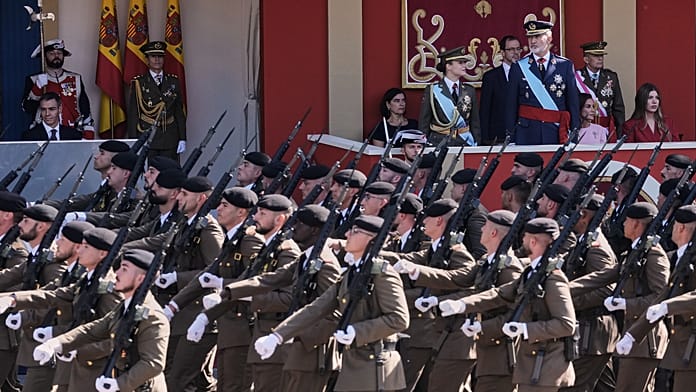
Ceuta made its presence felt at Spain’s National Day parade without a single one of its soldiers setting foot on Madrid’s Paseo del Prado.
No troops from the autonomous city took part this year, as the Spanish Ministry of Defence has kept its forces deployed there following the crisis that erupted in July, when tens of thousands of migrants crossed into the territory from Morocco.
King Felipe VI and Queen Letizia, who presided over the ceremony in Madrid, will travel to Ceuta on Tuesday.
The parade took place against a tense political backdrop, after Spanish Prime Minister Pedro Sánchez called an early general election for 29 November.
Sánchez arrived at the parade with parliament dissolved and was met with jeers from people gathered in the streets.
Under clear skies, 82 aircraft took part in an aerial display as part of the day’s events, led by two F/A-18 jets.
On the ground, the army’s 8×8 Dragón armoured vehicles took centre stage for the first time. Marine Corps vehicles equipped with the Aracne anti-drone system also made their debut, along with two Asturcón drones from the Military Emergencies Unit – a clear sign of where the Spanish Defence Ministry is looking to invest.
A total of 3,850 men and 530 women took part in the parade.
The King and Queen then hosted a reception at the Royal Palace to mark the end of the National Day celebrations.
