



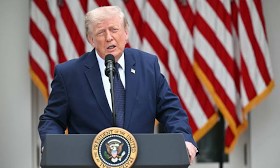
Media Lens: US and Iran Trade Strikes Amidst Control Claims Over Strait of Hormuz
Donald Trump stated the U.S. should be reimbursed for its military presence in the Strait of Hormuz. This remark came amid ongoing discussions about the international maritime security situation in the region.
Quick links: What has happened | Status quo | Confirmed facts | Preconceptions | Elisions | One story, four angles | Related links
What has happened
Former President Donald Trump stated that the United States should be reimbursed for military operations guarding the Strait of Hormuz, a vital maritime route for oil shipments. This announcement reflects ongoing tensions in the region and the U.S. commitment to maintaining security in critical waterways.
In a related development, Iran has expressed its assertion of control over the Strait of Hormuz, amid a backdrop of military strikes that contribute to rising regional instability. These events underscore the complex geopolitical dynamics involving U.S. and Iranian interests in one of the world’s most important shipping lanes.
Status quo
Recent discussions have emerged concerning U.S. defense strategies in the Strait of Hormuz. Former President Donald Trump has suggested that the U.S. should seek reimbursement for its role in safeguarding this vital maritime passage, which is crucial for global oil shipments. This position comes amid rising tensions between the U.S. and Iran, as Iran asserts control over the strait and conducts military operations in the region.
Confirmed facts
- Trump suggested that the U.S. should be reimbursed for guarding the Strait of Hormuz.
- Iran has insisted that it controls the Strait of Hormuz as it launches new military strikes.
- Traffic through the Strait of Hormuz has significantly decreased following military actions between the U.S. and Iran.
- Multiple news sources have reported on the U.S. becoming the “guardian” of the Strait of Hormuz.
Preconceptions
- **Prioritisation**: CNBC focuses on Trump’s view that the U.S. should be reimbursed for guarding the Strait of Hormuz, highlighting economic implications, while The Hill emphasizes the U.S. becoming the guardian, framing it within broader geopolitical responsibilities.
- **Emphasis**: The Guardian places significant attention on the decrease in traffic through the Strait of Hormuz due to U.S.-Iran tensions, indicating a shift in maritime stability. In contrast, The New York Times emphasizes Iran’s insistence on controlling the region amidst military escalations.
- **Reduction**: CNBC reduces the scale of regional conflict description, focusing instead on the transactional aspect of military support, while The Hill downplays economic implications, leaning more towards security dynamics in relation to national interests.
Elisions
- Coverage disparity: CNBC highlights Trump’s proposal for the U.S. to be financially reimbursed for military presence in the Strait of Hormuz, while The Guardian emphasizes plummeting traffic through the strait due to U.S.-Iran tensions, lacking a focus on economic implications.
- The New York Times reports on Iranian assertions of control over the strait, contrasting with The Hill’s coverage which presents a more neutral summary of U.S. military actions without addressing Iranian responses or territorial claims.
- While multiple sources mention U.S. claims regarding its role as a “guardian” of the Strait of Hormuz, they vary in exploring the geopolitical ramifications, with The Guardian providing broader context on regional impacts while others focus narrowly on statements without analysis.
One story, four angles
CNBC – Trump: U.S. should be reimbursed for guarding Strait of Hormuz
Publication: CNBC | Intensity: (6/10) | Sentiment: Neutral | Legal precision: Moderate
Expand
Espresso Shot: The focus is on Trump’s America adopting a transactional foreign policy involving military support in the Strait of Hormuz.
Key differences:
1. **Comparison**: Placement of economic considerations over military strategies. For example, “should be reimbursed” highlights a focus on financial transactions rather than diplomatic relations.
2. **Comparison**: Emphasis on reimbursement suggests a profit-driven motive. Phrasing that suggests financial retribution distracts from potential geopolitical implications.
3. **Comparison**: Use of “guarding” instead of “protecting” implies a more transactional relationship rather than a partnership, altering the perception of U.S. involvement.
Bias: Selection: Focus on financial aspects; Language: “reimbursed” gives a profit-oriented spin; Omission: Lack of historical context regarding U.S. military presence.
Assessment: Readers may first believe that the U.S. foreign policy is driven by financial incentives rather than security concerns.
The Hill – Trump: US to become ‘the guardian’ of the Strait of Hormuz
Publication: The Hill | Intensity: (7/10) | Sentiment: Neutral | Legal precision: Moderate
Expand
Espresso Shot: The focus is on the U.S. taking an active role in safeguarding the Strait of Hormuz under Trump’s directive.
Key differences:
1. **Comparison**: “Guardian” reflects a selfless role compared to CNBC’s “guarding,” which implies a more active protective stance. This enhances moral implications.
2. **Comparison**: Use of “guardian” conveys a protective mission while omitting the economic implications present in other headlines, steering the narrative away from profits.
3. **Comparison**: The headline’s structure positions U.S. interests as a benevolent force, contrasting with other outlets’ more transactional tones.
Bias: Selection: Emphasis on protective language; Language: “guardian” suggests moral justification; Omission: Neglects the financial aspects of military presence.
Assessment: Readers may first believe that the U.S. is framing its military role as benevolent rather than self-serving.
The New York Times – Iran Insists It Controls Strait of Hormuz as It Launches New Strikes: Live Updates
Publication: The New York Times | Intensity: (8/10) | Sentiment: Negative | Legal precision: High
Expand
Espresso Shot: The emphasis is on Iran’s aggression and its claims of control over the Strait of Hormuz.
Key differences:
1. **Comparison**: “Insists” suggests defiance compared to more neutral phrasing in others, implying this is an ongoing struggle.
2. **Comparison**: “Launches new strikes” increases urgency and danger, unlike other reports focusing solely on diplomatic roles.
3. **Comparison**: Live updates format suggests an unfolding crisis, enhancing the perception of immediacy compared to static headlines.
Bias: Selection: Focuses on Iran’s military actions; Language: “Launches” adds aggression narrative; Omission: Less emphasis on diplomatic solutions or U.S. responsibilities.
Assessment: Readers may first believe that the situation is extremely volatile, with Iran posing a direct military threat.
The Guardian – Traffic through strait of Hormuz plummets after US and Iran trade strikes – Middle East crisis live
Publication: The Guardian | Intensity: (8/10) | Sentiment: Negative | Legal precision: High
Expand
Espresso Shot: The concentration is on the significant decline in traffic through the Strait of Hormuz amidst escalating conflict.
Key differences:
1. **Comparison**: “Plummets” conveys urgency and danger, a stronger word than others’ neutral terms regarding movement of goods.
2. **Comparison**: Stress on the “Middle East crisis” directly references broader implications, setting a geopolitical context that other outlets lack.
3. **Comparison**: The “live” aspect indicates immediacy, a narrative driven by real-time developments, enhancing the dramatic tension.
Bias: Selection: Emphasis on crisis effects; Language: “Plummets” emphasizes economic concerns; Omission: Less focus on specific military actions or statements from officials.
Assessment: Readers may first believe that the region’s economic functionality is severely impaired due to escalating conflict.
In the comparative analysis of the framing surrounding U.S. involvement in the Strait of Hormuz, CNBC presents the situation as one of supporting U.S. interests, emphasizing reimbursement, thus adopting a more transactional tone. Conversely, The Hill escalates the narrative by positioning the U.S. as a “guardian,” implying a protective or militaristic role, which heightens tensions. Meanwhile, The New York Times highlights Iranian assertions of control, further inflaming the conflict’s stakes. The Guardian focuses on the resulting traffic disruption, reflecting a mix of practicality and urgency.
The facts do not change. What changes is where scrutiny lands.
Related links
CNBC
Trump: U.S. should be reimbursed for guarding Strait of Hormuz
The Hill
Trump: US to become ‘the guardian’ of the Strait of Hormuz
The New York Times
Iran Insists It Controls Strait of Hormuz as It Launches New Strikes: Live Updates
The Guardian
Traffic through strait of Hormuz plummets after US and Iran trade strikes – Middle East crisis live