



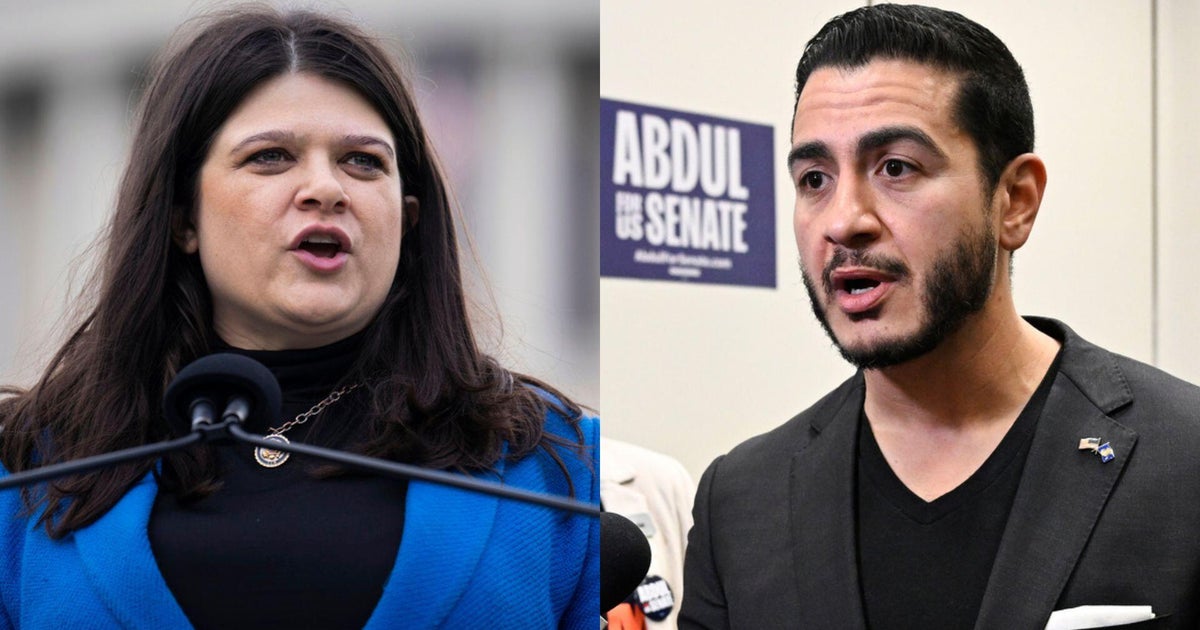
Get you up to speed: Democrats Stevens and El-Sayed clash over Israel and campaign money in tense Michigan Senate primary debate
Rep. Haley Stevens and former Michigan health official Abdul El-Sayed debated on support for Israel and party direction in Michigan on Tuesday. The debate intensified following state Sen. Mallory McMorrow’s suspension of her campaign, with both candidates revealing stark differences in their political stances.
The Michigan Senate primary between Rep. Haley Stevens and former health official Abdul El-Sayed is scheduled for 4 August, with the winner poised to advance against former GOP Rep. Mike Rogers in the general election. With Democratic Sen. Gary Peters retiring, the race is critical for the party’s efforts to maintain control of the Senate, requiring the Democrats to flip four seats while defending competitive ones.
Rep. Haley Stevens and former Michigan health official Abdul El-Sayed engaged in a contentious debate, highlighting their differing views on Israel and corporate influence in politics. With the primary set for August 4, the candidates’ fierce exchanges underscore the critical importance of this race for Democrats in maintaining control of the Senate majority.
What remains unclear — It is uncertain how state Sen. Mallory McMorrow’s campaign suspension will affect the dynamics of the primary race.
Stevens and El-Sayed clash over Israel and campaign finance in Michigan debate
Michigan’s remaining Democratic Senate candidates — Rep. Haley Stevens and former Michigan health official Abdul El-Sayed — sparred over support for Israel and the direction of the Democratic party during a one-on-one debate Tuesday.
Two days earlier, state Sen. Mallory McMorrow suspended her campaign, shaking up an already-heated primary that has been marred by intraparty fighting. McMorrow cast herself as the middle ground between Stevens, a moderate who has the backing of Senate Minority Leader Chuck Schumer of New York, and El-Sayed, a progressive who is supported by Sen. Bernie Sanders of Vermont and Rep. Alexandria Ocasio-Cortez of New York.
Stevens asserted El-Sayed’s campaign was propped up by Republicans who are hoping to make it easier for former GOP Rep. Mike Rogers to win the general election in November and accused El-Sayed of being publicity-hungry. El-Sayed accused Stevens of being beholden to corporate donors and the pro-Israel political action committee AIPAC.
“We do not need a celebrity senator. We need a workhorse,” Stevens said.
El-Sayed responded: “We also don’t need politicians bought off by corporations.”
The primary between Stevens and El-Sayed is Aug. 4, with the winner advancing to compete against Rogers in the general election. Rogers narrowly lost his last bid for Senate to Democratic Sen. Elissa Slotkin in 2024. Democratic Sen. Gary Peters, who currently holds the seat, is retiring.
The race is one of the mostly closely watched Senate contests this cycle. Holding the seat is critical to Democrats’ chances of winning the Senate majority in November. In order to regain control of the Senate, Democrats need to flip four seats while defending other competitive seats, including in Michigan.
The Democratic candidates took far more shots at one another Tuesday than at a prior debate in May, despite deep divisions, particularly over Israel. El-Sayed has been highly critical of Israel while Stevens has been supportive of the nation.
Tuesday’s debate put those divisions on display.
“For too long, our foreign policy has been handed to us by the likes of the state of Israel and AIPAC, who has made sure that Democrats and Republicans are doing their bidding,” El-Sayed said.
El-Sayed argued the U.S. should stop sending aid or selling military equipment to Israel, saying, “we cannot continue to sell weapons to a country that is doing human rights abuses, genocide and apartheid.”
“I also believe that we need to stop running cover for what has become a rogue state that is now trying to annex southern Lebanon,” he said.
Stevens was critical of both President Trump and Israeli Prime Minister Benjamin Netanyahu over the U.S. and Israel’s war with Iran. She said the difference between her and El-Sayed is that she believes in a two-state solution with both an Israeli and a Palestinian state.
“I can say that Israel has a right to peacefully exist alongside the people of Palestine and in Gaza,” she said.
Stevens frequently touted her record as a moderate House member, while El-Sayed criticized parts of it, including her support for the U.S.-Mexico-Canada Agreement, a free trade deal struck during Mr. Trump’s first term that is controversial in manufacturing-heavy Michigan.
The issue of money in politics came up repeatedly, and led to some bitter exchanges between the two candidates.
El-Sayed sought to link virtually every issue — from Israel to artificial intelligence policy — to the flood of outside spending in the race, and argued Stevens could end up doing the bidding of her financial backers.
Stevens pointed to a pro-El-Sayed super PAC backed partially by her opponent’s father-in-law. She also repeatedly hammered El-Sayed for not releasing his recent tax returns, asking, “what are you hiding?”
“Abdul, you talk about getting money out of politics and putting money in people’s pockets, but who is putting money in yours?” she said.
El-Sayed said he requested an extension on his financial disclosure — something Stevens has also done.
About 30 minutes into the debate, the moderator went off-script and said he was going to give each candidate 30 seconds to “to pursue whatever this is that’s going on here.”
“Obviously, you’ve got a question about some of the money in her campaign, you’ve got a question about some of the money in his pocket,” said Rick Albin, a political reporter for West Michigan television station WOOD TV8.
Stevens said El-Sayed wants to make “this race about lies and attacking my integrity.”
“Can we stop the lies and can we get the transparency out that my opponent’s long talked about?” she said, after listing off her accomplishments.
“I’d love to stop the lies,” El-Sayed countered, before once again going after the outside spending in favor of Stevens. “I think it’s really important for us to understand who’s paying for them and what was said on the backend to allow them to be told.”
On the future of the Democratic Party, El-Sayed said the party will continue on the same track “if we continue to elect leaders who take money from the same corporations who have broken with the interests of the American public.”
“Chuck Schumer desperately wants one of us to be the next senator, and it’s not me,” El-Sayed said. “So if you want your politics dictated to you by AIPAC or Chuck Schumer, then I’m not your guy.”
Stevens did not directly answer the question on whether the direction of the party is shifting.
“There are many who want to make this run for U.S. Senate about Washington, D.C. insider deals and what’s going on with our party leadership. Friends, this is about the future of Michigan,” Stevens said.