



Spain reflects on 40 years of EU membership and its transformative impact
Since joining the EU in 1986, Spain’s per capita income has increased from approximately 7,300 euros to over 31,000 euros, demonstrating significant economic growth.
Spain’s per capita income rose from approximately 7,300 euros in 1986 to over 31,000 euros today, reflecting significant economic transformation linked to EU membership.
Pedro Sánchez emphasised, “The European Union is Spaniards’ home and future, as well as our privilege and responsibility,” marking the significance of Spain’s 40-year membership.
Key developments
In 1986, Spain joined the European Union, marking a significant political shift after four decades of dictatorship. This membership facilitated economic growth, including per capita income rising from 7,300 euros to above 31,000 euros.
Spain has held the Presidency of the Council of the European Union five times since 1986, with the most recent term occurring in 2023. This reflects Spain’s influential role in shaping EU policy and its commitment to European integration.
Europe Day: 40 years of ups and downs in Spain’s relationship with the European Union
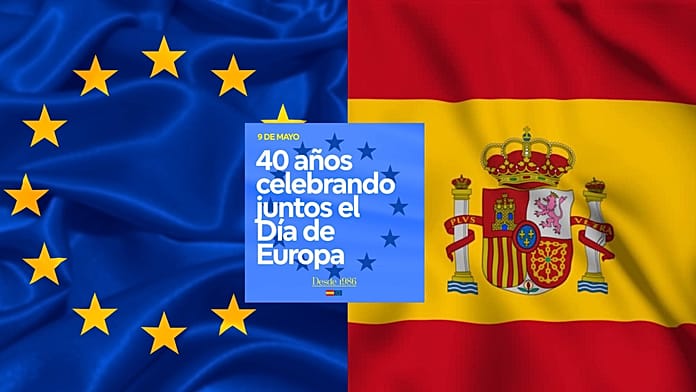
The Spain that knocked on Europe’s door 40 years ago was a country that had only just emerged from 40 years of dictatorship.
Spain’s democratic transition, still fragile in some respects, found in European integration an institutional anchor, a guarantee that the freedoms it had won would not be reversed.
Felipe González, who had applied for membership in 1977 as leader of the Socialist opposition and was now governing as prime minister, saw it clearly: joining Europe was not just about economics. It was a statement of political identity. Spain was rejoining the community of democratic nations from which Francoism had excluded it.
The figures for that Spain of 1986 show how far back the starting point was: per capita income was around 7,300 euros, life expectancy was 76 and the population had yet to reach 38 million.
Exports accounted for barely 4.9% of GDP and infrastructure lagged decades behind European standards. Forty years on, per capita income is above 31,000 euros, life expectancy has reached 84 and exports have climbed to 34% of GDP.
None of these transformations can be separated from EU membership.
The early years: opening up and the shock
The initial stages of integration were not easy. Spain had to face the abrupt opening of its market to European competition, which triggered tensions across whole sectors of the economy, especially in industry and agriculture.
The Common Agricultural Policy (CAP) profoundly reshaped the Spanish countryside, forcing through painful reconversions but also opening up new markets for Mediterranean products. Olive oil, fruit, wine: Spanish agriculture found in Europe a stage for expansion that had been unthinkable until then.
At the same time, European structural funds began to flow into a country that was in desperate need of them. The motorways that now link the Peninsula, the trains that criss-cross the country, the modernised ports, the telecommunications systems: all of this was built to a large extent with financial backing from Brussels.
In four decades, Spain has received more than 185 billion euros in European funds for infrastructure, employment, innovation and regional development. Without that injection, modernisation would have taken generations longer.
An unexpected symbol of those early years was the Erasmus programme, launched by the European Community in 1987. What began as a modest university exchange initiative gradually became the defining experience of a generation.
Spain became the country that receives the most Erasmus students in all of Europe, and more than 1.6 million Spaniards have taken part in the programme over these four decades. For many young people, Erasmus was not just a semester abroad: it was the first time they truly felt European.
Maastricht and the dream of the single currency
The year 1992 marked a turning point for all of Europe, and Spain was fully aware of its significance. The signing of the Treaty on European Union in Maastricht transformed the European Economic Community into the European Union proper and opened the way to the single currency.
For Spain, Maastricht also meant taking on economic convergence commitments that required deep reforms: deficit control, keeping inflation in check, budgetary discipline. It was the price of having a seat at the top table.
In parallel, 1995 brought another of the great achievements of the European project: the entry into force of the Schengen Agreement in Spain, alongside Germany, France, Belgium, Luxembourg, the Netherlands and Portugal.
For the first time in modern history, citizens could cross Europe’s internal borders without showing their passport. The Schengen area was not just a convenience for tourists; it was the physical embodiment of an idea: that in Europe, people’s freedom of movement was a right, not a privilege.
And then the euro arrived. On 1 January 1999, Spain became one of the eleven founding countries of the eurozone, adopting the single currency for financial and commercial transactions.
On 1 January 2002, notes and coins reached citizens’ pockets and the peseta disappeared for good. It was a moment full of emotion and also tinged with a certain melancholy: the peseta was being abandoned, a currency with centuries of history, but something bigger was being gained, the feeling of sharing an economic destiny with hundreds of millions of Europeans.
Fittingly, it was at a summit held in Madrid in December 1995 that European leaders finally agreed on the name of the new currency: the euro.
Institutional leadership on five occasions
Over these 40 years, Spain has not limited itself to benefiting from the European project: it has also helped to build it. Since 1986, the country has held the Presidency of the Council of the European Union on five occasions, the most recent in the second half of 2023, under the motto “Europe, closer”, making it one of the member states most committed to driving the Union forward institutionally.
Three presidents of the European Parliament and nine European commissioners have been Spaniards over these four decades, a presence that reflects Spain’s growing weight in Europe’s political architecture.
Spain has also helped design some of the EU’s most important policies. It played a leading role in developing cohesion policy and in boosting the EU’s social dimension.
It was instrumental in including in the Amsterdam Treaty a sanctions mechanism for states that breached the Union’s fundamental values. And for decades it has played a distinctive role as a bridge between Europe and Ibero-America, drawing on its historical, cultural and linguistic ties with Latin America to enhance the EU’s external projection.
The great crisis and test of the euro
The years of the Great Recession brutally tested the strength of the European project and Spain’s resilience. The 2008 financial crisis triggered a devastating recession in the country: unemployment climbed above 26% in 2013, the construction sector collapsed and the financial system had to be partially bailed out with European funds.
The austerity policies imposed from Brussels fuelled deep social discontent and fed European scepticism among parts of the population that had borne the brunt of the cuts.
Even so, Spain did not abandon the euro or the European project. It opted for reform and recovery within the EU framework, and from 2014 it entered a growth cycle that was among the strongest in the eurozone. Painful as it was, the crisis also ended up showing that EU membership offered a safety net that would have been unimaginable alone.
The banking rescue coordinated by the European institutions, the financial solidarity mechanisms, access to capital markets underpinned by the European Central Bank: without Europe, the fallout could have been much more severe.
The pandemic and the NextGenerationEU funds
If the 2008 crisis was a test of endurance, the COVID-19 pandemic in 2020 was something different: a demonstration that European solidarity could evolve into new, more ambitious forms.
For the first time in the history of European integration, the Union took on joint debt to finance the recovery of its member states. The NextGenerationEU funds made more than 140 billion euros in grants and loans available to Spain, the largest injection of European resources in the country’s history.
The pandemic was also a reminder that, when it works, European solidarity is an extraordinary asset. The coordination in vaccine purchasing, the European COVID certificate that made it possible to restore mobility, the joint response to an unprecedented threat: all this showed European citizens, Spaniards included, that the EU project was not just a market but also a community of shared destiny.
Forty years of transformation
The numbers tell a powerful story. Spanish exports of goods rose from 12.6 billion euros in 1986 to 141.5 billion in 2024. Real GDP has grown by more than 100% since accession. Life expectancy has increased by eight years over the past four decades.
The population has grown by more than 10 million people, largely thanks to immigration made possible by European prosperity. And more than 1.4 million young Spaniards have benefited from the European Youth Guarantee scheme to get into work.
The Spanish prime minister, Pedro Sánchez, has marked the day on his x.com account, stressing that the European Union is Spaniards’ home and future, as well as their privilege and their responsibility.
The challenges of the next 40 years
The anniversary is not only a time for celebration. It is also a moment for honest reflection on what still remains to be built. Territorial inequalities between the autonomous communities remain significant.
The green transition, population ageing, digital transformation and migration flows pose challenges that no country can face alone. Russia’s invasion of Ukraine has reshaped Europe’s security map and forces Spain to rethink its contribution to common defence, as we have also seen with the US–Iran conflict and threats against European bases.
The new generations, who have grown up knowing no reality other than the European one, expect the Union to respond more effectively to these challenges. For them, Europe is not a historic achievement to be defended, but a starting point to be improved. That demand, far from being a threat to the project, is perhaps its best guarantee for the future.
Forty years on from that January night in 1986, European membership is now so taken for granted that it is hard to imagine Spain outside it.