



Pedro Sánchez vows to expedite housing decree amid protests in Madrid
Spanish Prime Minister Pedro Sánchez announced his government is working on a new housing decree, scheduled for discussion at the Council of Ministers on Tuesday.
With tens of thousands participating in recent protests and a new housing decree expected, the movement highlights the urgency for substantial reforms within Spain’s increasingly severe housing crisis.
“Maricarmen, I have a message for you,” said Spanish Prime Minister Pedro Sánchez, highlighting the housing crisis as “a matter of humanity” that transcends political differences.
Sánchez vows to pass housing decree on Tuesday amid outrage over Maricarmen eviction
Spanish Prime Minister Pedro Sánchez responded to Maricarmen on Sunday, a day after the 87-year-old woman, who was evicted from her Madrid home earlier this week, appealed directly to him for action.
Speaking at a Socialist Party (PSOE) rally in Getafe, Sánchez promised that his government was working “against the clock” to bring a new housing decree before the Council of Ministers on Tuesday.
“Maricarmen, I have a message for you,” he said, describing the housing crisis as “a matter of humanity” that transcends political differences. He also urged parliamentary groups to make “one last effort” to approve the decree in Congress.
His remarks came as protesters spent their first night camping in Madrid’s Puerta del Sol square. Sánchez did not directly address the protest.
Maricarmen, who was evicted from the flat where she had lived for seven decades, had recorded a video on Saturday urging the prime minister to introduce legislation to prevent others from experiencing “what has happened to me”.
The pensioner was removed from her home in Madrid’s Retiro neighbourhood on a stretcher and remains in hospital.
Her case has become a focal point for growing protests over Spain’s housing crisis.
Urbagestión, the investment fund that owns her former building, has faced criticism from neighbourhood campaigners. Madrid City Council has rejected the fund’s offer concerning the flat and launched its own mediation efforts.
Meanwhile, divisions have emerged within Spain’s governing coalition over how to resolve the case.
The left-wing Sumar party has called for the property to be expropriated so Maricarmen can return to her home. However, government minister Félix Bolaños rejected the proposal, arguing that it lacks a “clear fit” within Spain’s Constitution.
Pablo Bustinduy, a minister representing Sumar, responded that his party would continue to support expropriation despite opposition from its Socialist coalition partner.
From street protests to a protest camp
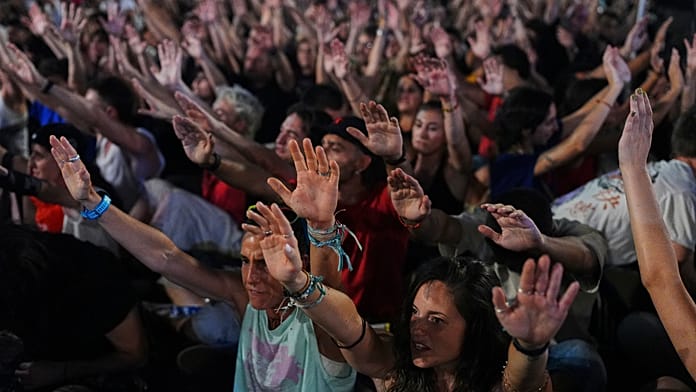
Demonstrators set up around 100 tents in Madrid’s busy Puerta del Sol square after tens of thousands took to the streets on Saturday to demand lower housing costs and stronger protections for tenants.
Inside the camp, protesters have organised banner-making workshops, yoga classes and communal meals, although it remains unclear how long they intend to stay.
Organisers say the camp emerged spontaneously, but solidarity gatherings have already been announced in other Spanish cities, including Burgos, León, Córdoba and Almería.
Oscar-winning Spanish filmmaker Pedro Almodóvar visited the camp on Sunday to express his support for the protesters, describing the country’s housing crisis as “unbearable”.
“Maricarmen is the last straw,” Almodóvar, 76, told Spanish public broadcaster RTVE.
“It is absolutely unbearable for Spanish society to have this problem for another day. And politicians have to fix it because they are the ones who govern us,” he added.
The protests have also exposed political divisions over the government’s response.
Left-wing Podemos has warned against watering down the proposed housing measures during negotiations, while the opposition People’s Party has accused the government of “using Maricarmen to do politics”.
What happens next?
The government is aiming to approve the housing decree at Tuesday’s Council of Ministers meeting, following weekend negotiations to secure sufficient parliamentary support.
Government sources have expressed optimism that an agreement can be reached.
Among the measures reportedly being discussed with Junts are restrictions on evicting tenants from properties owned by investment funds and proposals to prevent such funds from acquiring additional residential properties.
However, even if the government approves the decree, there is no guarantee that protesters will leave Puerta del Sol. The Tenants’ Union has already warned that it will only accept an ambitious package of housing measures, rather than a watered-down version resulting from negotiations with Junts.
This weekend’s demonstrations in the iconic Madrid square have drawn comparisons with Spain’s historic 15-M protests, which began on 15 May 2011.
During those protests, members of the “indignados” movement camped in Puerta del Sol for 28 consecutive days, inspiring similar demonstrations across Spain and internationally.
The movement emerged amid widespread anger over the consequences of the global financial crisis, including evictions, unemployment, austerity measures and corruption.
Political scientist and columnist Estefanía Molina said the latest protests reflect the growing severity of Spain’s housing crisis.
In 2011, “people protested because they couldn’t buy an apartment”, she told Spanish television.
“Today, the protest is about not being able to rent a room in someone else’s home,” she added.