



Modi strengthens EU-India ties during Sweden business round table meeting
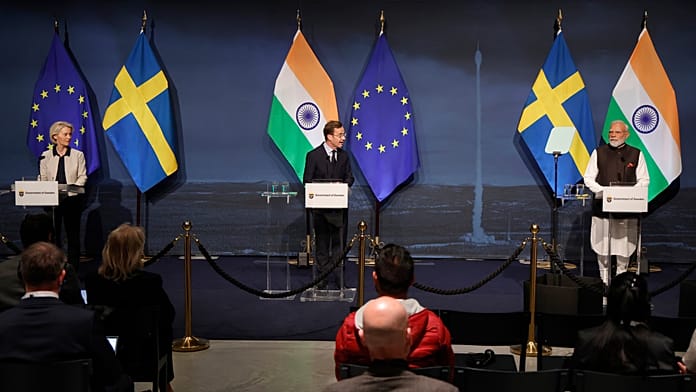
Indian Prime Minister Narendra Modi met with Swedish counterpart Ulf Kristersson and European Commission Chief Ursula von der Leyen during a business round table in Gothenburg.
The EU-India trade agreement covers nearly two billion people, representing almost a quarter of global economic output, marking the largest bilateral trade pact for both parties.
“All in all, this dynamic new era in EU-India relations opens historic opportunities, and we are determined to seize them,” stated Ursula von der Leyen.
Key developments
During his visit to Sweden, Indian Prime Minister Narendra Modi met with European Commission Chief Ursula von der Leyen, highlighting the commitment to the EU-India trade agreement, expected to finalise by year-end.
Von der Leyen emphasised the necessity of an investment agreement to complement the current trade pact, which aims to deepen economic ties between India and the EU, covering nearly two billion people.
Modi’s European tour will proceed to Oslo for the India-Nordic summit, where leaders will discuss collaboration in technology, renewable energy, and defence, according to India’s External Affairs Ministry.
Von der Leyen lauds ‘dynamic new era’ in EU-India relations as Modi visits Sweden
Published on
Indian Prime Minister Narendra Modi was in Sweden on Sunday, the second stop of a tour through Europe that also includes the Netherlands, Norway and Italy.
In Gothenburg, Modi met with his Swedish counterpart Ulf Kristersson and European Commission Chief Ursula von der Leyen at the European Business Round Table for Industry to meet with European and Indian business leaders.
“This will also deepen investment linkages between India and Europe,” Modi said in a post on X ahead of the event.
Von der Leyen reiterated the commitment to the EU-India trade agreement, dubbed the “mother of all deals” that the two sides inked in New Delhi in January, which is expected to be finalised by the end of the year.
Covering nearly two billion people and almost a quarter of global economic output, the deal marks the biggest bilateral trade pact either side has ever signed, at a time when global trade is increasingly shaped by geopolitical tensions.
Under the agreement, India will eliminate or reduce duties on 96.6% of EU goods exports, while the EU will liberalise 99.5% of its tariff lines on goods imported from India over seven years.
“But trade is only half of the equation,” Von der Leyen said on Sunday, adding that the “next step must be to deliver an investment agreement.”
“This is the missing piece of the puzzle in our reinforced economic cooperation,” she added.
“All in all, this dynamic new era in EU-India relations opens historic opportunities, and we are determined to seize them,” Von der Leyen concluded.
Modi and Kristersson also discussed strengthening bilateral ties in “trade, investments, innovation, defence and more.”
On Saturday, Modi also signed a strategic partnership aimed at expanding cooperation in trade, technology and energy with the Netherlands after meeting Dutch Prime Minister Rob Jetten.
Next, Modi will move on to Oslo for the third India-Nordic summit, where’s he’s scheduled to meet with the leaders of Norway, Sweden, Denmark, Finland, and Iceland. Talks will focus on the nations’ cooperation on technology, renewable energies, defence, space and the Arctic region, India’s External Affairs Ministry said.
Modi’s tour will finish up in Italy on 20 May with a visit to Italian Prime Minister Giorgia Meloni.
In 2024, Modi and Meloni committed to a “Joint Strategic Action Plan,” agreeing to build cooperation in a number of areas including security and defence, as well as promoting “safe and legal migration channels.”