



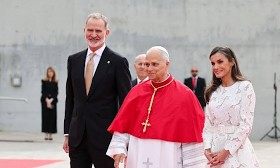
Media Lens: Pope Leo XIV begins apostolic journey to Spain amid conservative backlash
Pope Leo XIV embarks on a historic apostolic journey to Spain. His visit coincides with notable shifts in the political landscape of the country.
Quick links: What has happened | Status quo | Confirmed facts | Preconceptions | Elisions | One story, four angles | Related links
What has happened
Pope Leo XIV has embarked on a significant apostolic journey to Spain, marking the first visit of a pope to the country in decades. The journey focuses on addressing contemporary societal concerns, amidst a backdrop of heightened polarization between conservative factions and the Catholic Church.
During this trip, Pope Leo is scheduled to engage with various community groups and religious leaders, emphasizing dialogues aimed at healing divisions. This visit underscores the pope’s commitment to bridging gaps within the church and renewing its influence in Spanish society.
Status quo
Pope Leo XIV recently commenced an apostolic journey to Spain, marking a significant event in his papacy. This visit occurs against a backdrop of increasing conservatism and polarization within Spanish society, highlighting tensions between religious institutions and conservative factions. The journey aims to address these dynamics and strengthen the Catholic Church’s influence amid shifting social and political landscapes.
Confirmed facts
- Pope Leo XIV has begun a historic apostolic journey to Spain.
- The visit is taking place amid a polarized political climate in Spain.
- Conservative factions in Spain are reportedly turning against the Church.
- The apostolic journey has generated significant media coverage, with multiple outlets reporting on its implications.
Preconceptions
- The Washington Post prioritizes the political implications of Pope Leo’s visit to Spain, emphasizing the tensions between conservatives and the church, while CNN focuses more on the broader priorities of Pope Leo’s journey, detailing his interactions and intentions.
- CNN highlights the historical context surrounding the Pope’s visit and its relevance to contemporary issues, whereas The New York Times places more emphasis on the immediate political stakes and reactions from both the church and the political factions in Spain.
- Vatican News concentrates heavily on the official aspects of the Apostolic Journey, promoting the ceremonial and spiritual significance, while The Washington Post reduces coverage of these ceremonial details in favor of political analysis and the implications for the church.
- The New York Times tends to provide a more critical perspective on Pope Leo’s agenda, emphasizing potential challenges he might face in Spain, in contrast to CNN’s more optimistic portrayal of his visit.
Elisions
- Only CNN emphasizes the implications of Pope Leo’s visit on the growing conservatism in Spain, while The Washington Post focuses on the polarized reactions surrounding the church itself.
- The New York Times highlights potential geopolitical ramifications of the pope’s visit, which are not covered in the Vatican News article, which solely details the event’s logistics.
- CNN includes in-depth analysis of Pope Leo’s previous interactions with global leaders, while The Washington Post only provides brief contextual background without deeper examination.
One story, four angles
The Washington Post – Pope Leo visits a polarized Spain where conservatives are turning on the church
Publication: The Washington Post | Intensity: (7/10) | Sentiment: Neutral | Legal precision: High
Expand
Espresso Shot: The article initially draws attention to the conservative backlash against the Church during the Pope’s visit, urging readers to focus on this tension, introduced with “polarized Spain.”
Key differences:
– **Comparison:** Focus on polarization highlighted in The Washington Post versus a broader perspective in CNN.
**Example:** “polarized Spain” emphasizes divisiveness, contrasting CNN’s more neutral language.
– **Comparison:** The Washington Post emphasizes political implications with “conservatives turning on the church,” while Vatican News highlights the Pope’s mission.
**Example:** The report opens with the tensions rather than the journey’s purpose.
– **Comparison:** The narrative of conflict is strong in The Washington Post compared to Vatican News, which emphasizes the Pope’s journey.
**Example:** “conservatives are turning on the church” directly addresses conflict, whereas Vatican News discusses the mission’s significance.
Bias: Selection: Focus on conservative backlash | Language: “polarized” intensifies perceived conflict | Omission: Less emphasis on positive aspects of the Pope’s visit.
Assessment: Readers are led to believe that the Pope’s visit occurs amid significant religious and political strife.
CNN – What Pope Leo’s Spain visit tells us about his priorities
Publication: CNN | Intensity: (6/10) | Sentiment: Positive | Legal precision: Moderate
Expand
Espresso Shot: The focus is on how the Pope’s visit reflects his broader priorities and missions, suggesting readers consider implicit agendas rather than just events.
Key differences:
– **Comparison:** CNN frames the narrative around priorities while The Washington Post emphasizes conflict.
**Example:** “tells us about his priorities” suggests a reflective angle, as opposed to framing the visit as a crisis.
– **Comparison:** CNN discusses broad themes regarding the church, contrasting with the narrow political focus in The Washington Post.
**Example:** The title emphasizes the Pope’s mission rather than Spain’s divisive political climate.
– **Comparison:** CNN’s insights into the Pope’s impact resonate without heavy critique, unlike The Washington Post which stresses negative ramifications.
**Example:** “his priorities” indicates significance over strife.
Bias: Selection: Highlights broader implications | Language: Positive framing with “priorities” | Omission: Lacks mention of any dissent toward the Church.
Assessment: Readers believe the visit signifies an essential moment for the Church rather than just another visit overshadowed by criticism.
The New York Times – Pope Leo, After Taking on Trump and A.I., Prepares for New Duels in Spain
Publication: The New York Times | Intensity: (8/10) | Sentiment: Neutral | Legal precision: High
Expand
Espresso Shot: The article emphasizes the Pope’s readiness to confront multiple challenges, instilling a sense of urgency among readers regarding the significance of his journey.
Key differences:
– **Comparison:** The framing involves activism, suggesting conflict management, while other outlets focus more on static scenarios.
**Example:** “prepares for New Duels” conveys battle readiness, unlike The Washington Post’s “turning on.”
– **Comparison:** The New York Times connects the Pope’s current challenges to larger social issues, contrasting with CNN’s focus on priorities.
**Example:** “After Taking on Trump and A.I.” indicates a broad, dynamic narrative.
– **Comparison:** Distinctively portrays the Pope as an active figure rather than a passive recipient of events.
**Example:** “prepares for new duels” shows assertive engagement.
Bias: Selection: Focus on activism | Language: “New Duels” personalizing the Pope’s challenges | Omission: Lack of positive outcomes from previous engagements or visits.
Assessment: Readers come to believe this visit is not merely ceremonial but an essential confrontation with contemporary issues.
Vatican News – Pope Leo kicks off Apostolic Journey to Spain
Publication: Vatican News | Intensity: (5/10) | Sentiment: Positive | Legal precision: High
Expand
Espresso Shot: The focus is on the Pope’s spiritual mission in Spain, urging readers to view the journey as a vital aspect of his apostolic role.
Key differences:
– **Comparison:** Vatican News emphasizes the spiritual significance while other outlets highlight politics or conflict.
**Example:** “kicks off Apostolic Journey” prioritizes mission over division.
– **Comparison:** The emphasis on faith contrasts with the political implications in CNN and The Washington Post.
**Example:** Less focus on controversies, more on religious outreach.
– **Comparison:** A pastoral tone throughout displays a commitment to unity, distinct from other more challenge-focused perspectives.
**Example:** Language centers on “Apostolic Journey,” indicating a positive initiative.
Bias: Selection: Highlights spiritual over political issues | Language: Use of “Apostolic Journey” fosters a focus on faith | Omission: Avoids discussing any dissent towards church authority or political challenges.
Assessment: Readers are led to view the visit as a profound opportunity for spiritual engagement rather than a politically charged event.
In examining the framing of Pope Leo XIV’s apostolic journey to Spain, The Washington Post adopts a more escalatory tone, emphasizing political tensions and the church’s fracture among conservatives. In contrast, CNN presents a more nuanced analysis, focusing on the implications for the Pope’s priorities without inflaming divisions. The New York Times balances between these two extremes, hinting at broader ramifications while maintaining a less confrontational stance. While Vatican News opts for a straightforward reporting style, emphasizing the event itself, it lacks the critical edge of others. The facts do not change. What changes is where scrutiny lands.
Related links
The Washington Post
Pope Leo visits a polarized Spain where conservatives are turning on the church
CNN
What Pope Leo’s Spain visit tells us about his priorities
The New York Times
Pope Leo, After Taking on Trump and A.I., Prepares for New Duels in Spain