


Hungary’s foreign minister admits to regular contact with Russia’s Lavrov
Hungary’s Foreign Minister Péter Szijjártó confirmed he regularly contacts Russian counterpart Sergei Lavrov during EU meetings, contrary to previous government denials.
European Commission has requested clarification from Hungary regarding Foreign Minister Szijjártó’s interactions with Sergei Lavrov, deeming the reports “concerning” ahead of Hungary’s elections.
Hungary’s parliamentary elections are approaching, with the opposition Tisza Party leading in opinion polls against Prime Minister Viktor Orbán‘s Fidesz party.
Briefing summary
Hungary’s Foreign Minister Péter Szijjártó confirmed regular communications with Russian counterpart Sergei Lavrov during EU meetings, despite prior denials from the Hungarian government regarding these allegations.
The European Commission has called on Hungary to clarify the situation, labelling the reports as “concerning,” amidst rising political tensions before Hungary’s parliamentary elections.
Szijjártó defended the need for dialogue with non-EU partners, citing ongoing imports of fossil fuels from Russia, which he argues are crucial to Hungary’s energy decisions.
Hungarian foreign minister admits calling Russia’s Lavrov during key EU meetings
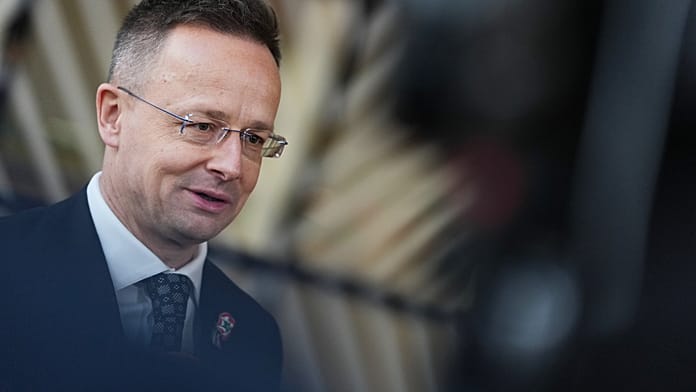
Published on •Updated
Hungary’s Foreign Minister Péter Szijjártó has acknowledged that he regularly contacts his Russian counterpart, Sergei Lavrov, during private EU meetings on foreign affairs.
Earlier, the Hungarian government had dismissed those allegations as fake news.
The Washington Post reported over the weekend that Szijjártó was routinely in contact with Lavrov during meetings in Brussels, communicating with him during breaks.
On Monday, the European Commission called on Hungary to clarify the matter, describing the reports as “concerning.”
Szijjártó, speaking at a campaign event in Keszthely, confirmed the calls on Monday evening, arguing that EU decisions on energy, the automotive industry, and security directly affect Hungary’s relationships with partners outside the bloc.
“Yes, these issues must be discussed with our partners outside the European Union. I talk not only to the Russian Foreign Minister, but also to our American, Turkish, Israeli, Serbian and others before and after European Union Council meetings,” Szijjártó said.
“What I say may sound harsh, but diplomacy is about talking to the leaders of other countries,” he added.
The revelations come as political tensions mount ahead of Hungary’s parliamentary elections. Prime Minister Viktor Orbán’s Fidesz party faces a stiff challenge from opposition leader Péter Magyar’s Tisza Party, which is currently ahead in opinion polls.
Orbán’s government is one of the few in Europe to maintain regular ties with the Kremlin. Hungary also continues to import large volumes of fossil fuels from Russia, despite EU pressure to reduce energy dependency on Moscow.
Szijjártó has visited Moscow 16 times since Russia launched its full-scale invasion of Ukraine in February 2022. His most recent trip took place on 4 March, when he met Russian President Vladimir Putin at the Kremlin.