



Germany prepares armed forces for potential Strait of Hormuz mission
The German defence ministry has placed naval units on standby, including the minehunter “Fulda” and the supply ship “Mosel,” for potential operations in the Strait of Hormuz.
Participation in a potential mission to safeguard shipping in the Strait of Hormuz underscores the Bundeswehr’s commitment to maintaining international security in a region vital for global energy transport.
Chancellor Friedrich Merz stated, “No final decision has yet been made,” emphasising the need to clarify the legal basis for any potential military involvement.
Germany reportedly prepping to take part in Strait of Hormuz safeguarding mission
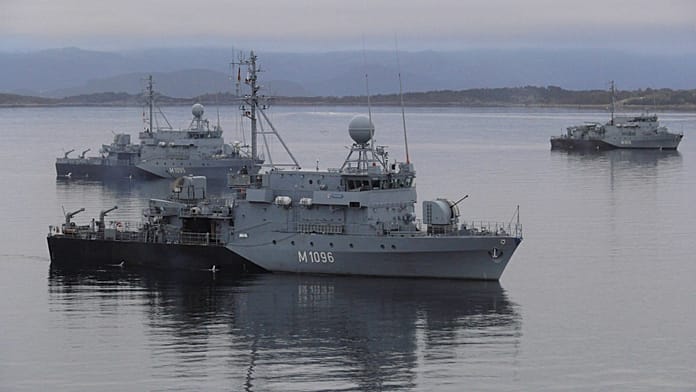
The German government is reportedly preparing for its armed forces to potentially take part in a mission to safeguard shipping in the Strait of Hormuz.
According to information obtained by Der Spiegel, the foreign office and the defence ministry have already drawn up a draft mandate for the Bundestag, which could be approved by the cabinet at short notice.
However, Chancellor Friedrich Merz (CDU) says no final decision has yet been made. In addition, the legal basis for any participation still has to be clarified, Merz said after the G7 summit in Évian in France.
The Strait of Hormuz is a strategic transit chokepoint for the global energy industry that has hit headlines in recent months amid the US-Iran war.
France and the United Kingdom are working on a mission aimed at safeguarding freedom of navigation of the Strait and to support possible mine-clearance operations in the region. Together with Paris and London, Berlin had signalled its general willingness to take part in such an operation, within the framework of the respective national legal provisions.
The German defence ministry has said naval units are already on standby for a possible deployment. The minehunter “Fulda” and the supply ship “Mosel” are currently in the eastern Mediterranean and could be redeployed to the potential area of operations within a few days.
What remains unclear, however, is the question of a mandate under international law. While Chancellor Merz has so far pointed to an international mandate, preferably from the United Nations Security Council, a swift agreement in the Security Council currently appears unlikely.
The creation of a new EU mandate would also likely take more time. Der Spiegel reported that the ministries responsible were therefore examining whether a resolution adopted by the UN Security Council in March could serve as a legal basis. The resolution, introduced by Bahrain, reaffirms the right of states to protect their ships against attacks and to defend freedom of navigation on international waterways. Obstacles to free passage are described as a threat to peace and international security.
The Bundeswehr is currently tied up in several maritime areas of operation, including as part of the EU mission EUNAVFOR Aspides to protect international shipping from attacks by Houthi militias.
In the Mediterranean, it is also supporting the monitoring of the Lebanese coast as part of UNIFIL, while the frigate “Sachsen” is involved in NATO operations, helping to secure the North Atlantic and the Baltic Sea, protecting critical infrastructure such as undersea cables and wind farms.
In addition, the German navy also maintains a continuous presence in the Baltic Sea, where German units operate on a regular basis.