



Media Lens: Belfast Stabbing Sparks Protests and Unrest in Northern Ireland
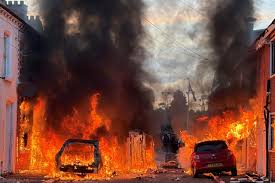
Disorder continues in Belfast, Northern Ireland, following a recent stabbing incident. Police respond with water cannons to control protesters amid escalating unrest.
Quick links: What has happened | Status quo | Confirmed facts | Preconceptions | Elisions | One story, four angles | Related links
What has happened
A stabbing incident in Belfast has sparked significant unrest in Northern Ireland, leading to violent protests. Following the attack, members of the community engaged in confrontations with police, prompting officials to deploy water cannons to disperse crowds.
The stabbing has also led to the circulation of addresses allegedly linked to immigrant homes, further inflaming tensions among protestors. Authorities are investigating the circumstances surrounding the event as the situation continues to develop.
Status quo
Disorder in Northern Ireland follows a stabbing incident in Belfast, leading to protests and unrest. The police employed water cannons to disperse crowds amidst rising tensions. Reports detail that a list of addresses associated with immigrants circulated online, further inflaming the situation. Authorities continue to manage the situation as community reactions grow in the wake of the violence.
Confirmed facts
- Disorder has continued in Northern Ireland following a stabbing incident in Belfast.
- Police have deployed water cannons against protesters amid the unrest.
- Reports of rioting indicate that tensions have escalated in the aftermath of the stabbing.
- A list of addresses related to immigrants circulated online during the unrest.
- The stabbing has been identified as a catalyst for the increased violence and protests in the area.
Preconceptions
- CBS News prioritizes immediate aftereffects of the stabbing, emphasizing the circulation of immigrant addresses amidst riots, while downplaying the broader context of the unrest.
- NPR accentuates police actions during the unrest, specifically the use of water cannons against protesters, reducing coverage of civilian impacts.
- PBS focuses significantly on the motives and background of the stabbing incident itself, with less emphasis on the immediate community response compared to others.
- The New York Times highlights the general atmosphere of violence and chaos in Belfast following the stabbing, while minimizing detailed accounts of individual experiences during the riots.
- Various publications reduce attention to systemic issues surrounding sectarian tensions, favoring narratives tied directly to the incident and its immediate fallout.
Elisions
- Discrepancies in coverage details: **NPR** and **CBS News** both emphasize police actions during protests, but **PBS** highlights community responses, indicating a gap in focusing on grassroots perspectives.
- In-depth analysis: **The New York Times** mentions historical tensions leading up to the unrest, whereas **CBS News** fails to provide this context, focusing instead on immediate events, creating a knowledge gap about underlying issues.
- Victim perspectives: **PBS** includes survivor testimonies that provide personal insights, which are absent in reports from **NPR** and **The New York Times**, leaving a gap in understanding the human impact of the violence.
One story, four angles
CBS News – List of Belfast addresses said to be immigrant homes circulated online amid riots in wake of stabbing
Publication: CBS News | Intensity: (7/10) | Sentiment: Neutral | Legal precision: High
Expand
Espresso Shot: The headline emphasizes an alleged link between immigrants and the unrest, driving the reader to scrutinize the implications of these circulated addresses.
Key differences:
– Comparison: CBS quickly points out the connection between the stabbing and unrest, exemplified by “addresses said to be immigrant homes,” heightening the focus on immigrants in the narrative.
– Specific Example: The explicit wording “addresses said to be immigrant homes” suggests an accusatory tone towards immigrants, prioritizing the narrative of blame.
– Placement: The headline presents the immigrant angle prominently, potentially guiding the reader toward a bias against immigrants in relation to the unrest.
Bias: Selection: The focus on immigrant homes implies a direct relationship with the violence, which may not be justified. | Language: “Circulated online amid riots” carries a sensational tone that adds urgency. | Omission: Lack of context regarding the communities involved, skirting broader societal issues.
Assessment: Readers might initially believe that the violence is predominantly tied to anti-immigrant sentiments fueled by the unrest.
NPR – Police blast water cannons at protesters amid unrest over stabbing in Belfast
Publication: NPR | Intensity: (8/10) | Sentiment: Negative | Legal precision: Moderate
Expand
Espresso Shot: The headline foregrounds police use of water cannons, prompting immediate focus on state response to the unrest rather than the underlying causes.
Key differences:
– Comparison: NPR emphasizes police action over the disturbance itself, contrasting CBS’s focus on the unrest linked to immigrants.
– Specific Example: “Police blast water cannons” suggests a violent state response which garners immediate emotional engagement from the reader.
– Placement: Highlighting police action shifts narrative responsibility from societal issues to law enforcement, drawing scrutiny towards how authorities manage unrest.
Bias: Selection: Omits deeper context of the societal conflicts leading to unrest, emphasizing immediate police responses instead. | Language: “Blast” implies excessive force, framing the narrative around police aggression rather than protestor motivations. | Omission: Lacks references to community reactions or sentiments preceding the riot, which could provide insight into root causes.
Assessment: Readers are likely to view the police as heavy-handed and potentially oppressive rather than focusing on the root causes of the unrest.
PBS – What to know about the stabbing that set off fiery riots in Northern Ireland
Publication: PBS | Intensity: (6/10) | Sentiment: Neutral | Legal precision: High
Expand
Espresso Shot: The headline establishes the stabbing as the trigger for unrest, inviting readers to explore the incident’s causes and implications for the community.
Key differences:
– Comparison: PBS adopts a more educational tone, focusing on the backstory of the stabbing, unlike CBS’s blame on immigrants or NPR’s emphasis on police action.
– Specific Example: “Set off fiery riots” indicates a dramatic escalation, underscoring the violent shift from the original incident, focusing on consequences.
– Placement: Directly addressing the stabbing gives context that might lead to a more nuanced understanding, shifting the narrative away from blame to investigation.
Bias: Selection: While addressing the incident, it would have benefited from highlighting community responses or mitigating factors rather than merely presenting it as an isolated event. | Language: “Fiery riots” conveys intensity but may sensationalize the protests. | Omission: Neglecting broader societal implications could offer a more holistic view of the community dynamics involved.
Assessment: Readers might initially think the riots stem from the stabbing itself, without grasping the deeper societal divides at play.
The New York Times – Night of Violence Grips Belfast After Stabbing Attack
Publication: The New York Times | Intensity: (9/10) | Sentiment: Negative | Legal precision: High
Expand
Espresso Shot: The emphasis on “Night of Violence” sets a dramatic tone, capturing the reader’s attention on the scale and chaos following the stabbing incident.
Key differences:
– Comparison: This coverage aligns with NPR’s sense of urgency regarding police action but shifts more towards the chaos of the violence compared to the technical aspects NPR focuses on.
– Specific Example: “Grips Belfast” evokes imagery of fear and urgency, making it clear that the incident had a significant impact on the city.
– Placement: The opening focus on “violence” ensures that the reader’s attention is directed to the severity and implications of the unrest following the stabbing.
Bias: Selection: Places significant emphasis on the violence, which may risk overshadowing the underlying causes of the situation. | Language: “Grips Belfast” carries emotional weight that dramatizes the chaos, framing it as an emergency. | Omission: Fails to provide details about the community’s perspective or potential factors leading to violence.
Assessment: Readers will perceive the stabbing as a pivotal moment that catalyzed overwhelming violence rather than exploring deeper motives or root causes.
The New York Times frames the Belfast riots following a stabbing as a “night of violence,” emphasizing chaos and urgency, which evokes stronger emotional reactions. In contrast, PBS presents a more informational take, focusing on “what to know” about the events. Although NPR highlights police responses and the scale of unrest, it remains somewhat less escalatory than The New York Times. CBS News mentions the distribution of addresses tied to immigrant homes, arguably the most incendiary framing, as it suggests targeted actions against communities.
The facts do not change. What changes is where scrutiny lands.
Related links
CBS News
NPR
Police blast water cannons at protesters amid unrest over stabbing in Belfast
PBS
What to know about the stabbing that set off fiery riots in Northern Ireland