



What’s the Latest: Canada exploring ‘other options’ with Europe, Asia to grow auto sector: Carney
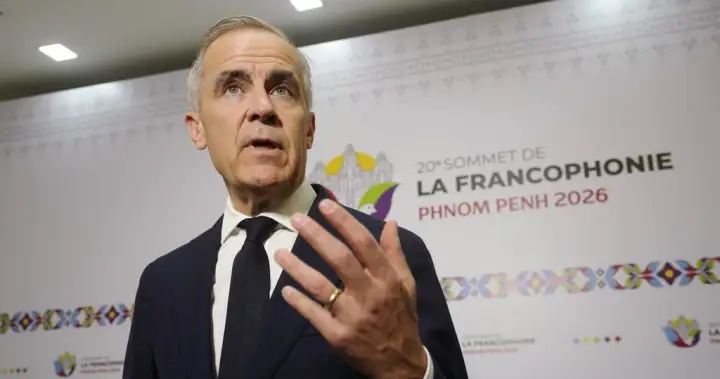
Prime Minister Mark Carney announced that Canada is considering “other options” in Europe and Asia for its auto sector while continuing trade discussions with the U.S. This statement was made during a press event at the Francophonie summit in Phnom Penh, Cambodia.
Prime Minister Mark Carney plans to meet President Xi Jinping this week to discuss China’s trade relationship with Canada, following a recent deal to import up to 49,000 Chinese electric vehicles at a tariff rate of 6.1 per cent. The Prime Minister reiterated that Canada would not agree to any U.S. trade deal that does not support a sustainable Canadian auto sector.
Prime Minister Mark Carney stated that Canada will not agree to a trade deal with the U.S. that does not support a viable Canadian auto sector and is actively seeking alternatives in Europe and Asia. Carney is expected to meet with President Xi Jinping this week to further discuss trade relations between Canada and China.
What remains unclear — It is uncertain what specific options Canada is considering in Europe and Asia to support its auto sector.
Canada to consider alternative trade options with Europe and Asia for auto sector growth, says Carney
Prime Minister Mark Carney confirmed that the Canadian auto sector is a key topic in ongoing trade negotiations with the United States. However, he also indicated that Canada is considering “other options” in Europe and Asia to bolster its automotive industry. Carney spoke to reporters during the Francophonie summit in Phnom Penh, Cambodia, emphasising the importance of competitive opportunities for Canadian auto workers within an integrated North American market.
The prime minister acknowledged that integration has been challenged due to U.S. threats of tariffs up to 50 per cent on Canadian automobiles, set to take effect in January. “It’s an ongoing discussion that we’re having with the U.S. administration, myself with the president,” Carney stated. He reiterated that the outcome of these trade negotiations may influence Canada’s pursuit of alternative avenues in Europe and Asia.
Carney has previously affirmed that Canada would not agree to a U.S. trade deal that does not adequately support the Canadian auto sector. Recent trade tensions have prompted Canada to deepen ties with other markets. Earlier this year, Carney signed a deal with China to import as many as 49,000 electric vehicles at a tariff rate of 6.1 per cent.
Looking ahead, Carney is expected to meet with President Xi Jinping this week, which will likely include further discussions on the trading relationship between Canada and China. As Carney navigates these complex trade dynamics, his government aims to secure the best outcomes for the domestic automotive industry while exploring international partnerships.
The prime minister’s remarks highlight the precarious state of trade relations and the urgency for Canada to adapt its strategies in the face of potential tariffs and shifting market conditions.