



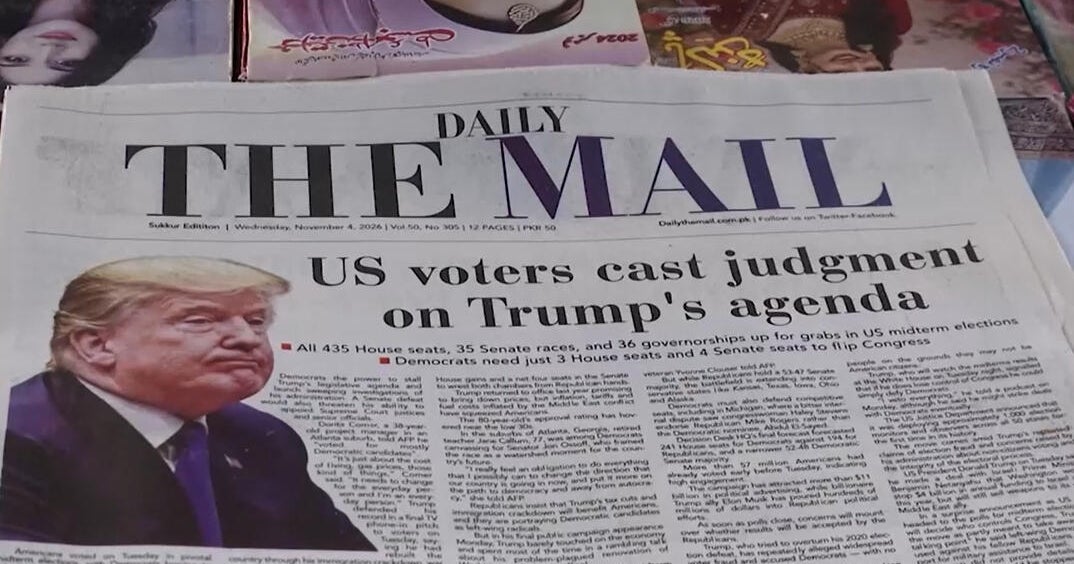
Get you up to speed: U.S. election results, a sharp setback for Trump, draw reaction from around the world
Iran’s Supreme Leader Ayatollah Mojtaba Khamenei issued a statement rejecting any expectation of a change in the U.S. approach following the recent midterm elections. In a separate comment, Iran’s chief negotiator, Mohammad Bagher Ghalibaf, stated that the election results reflected American voters’ rejection of the war with Iran, declaring, “Americans said NO TO WAR.”
Iran’s Supreme Leader Ayatollah Mojtaba Khamenei has stated that Tehran does not expect any change in Washington’s approach following the U.S. midterm elections, reaffirming the regime’s position against concessions to the U.S. Meanwhile, Russia has scheduled a new round of working-level talks with Ukraine in Abu Dhabi on November 10-11, though Moscow’s foreign policy stance is expected to remain unchanged regardless of the election outcomes.
Iran’s Supreme Leader Ayatollah Mojtaba Khamenei stated that the U.S. election results would not alter Washington’s hostility towards Iran, warning those hoping for change that they are “gravely mistaken.” Spanish Prime Minister Pedro Sanchez welcomed the outcomes as an indication of a crumbling global right-wing populist wave, predicting similar results in Spain’s upcoming elections.
What remains unclear — There has been no immediate reaction from Ukraine’s government to the U.S. election results.
U.S. election results prompt global reactions to Trump’s losses
The Iranian regime was quick to label the resounding losses for President Trump’s Republican Party in the midterm elections as evidence of American voters rejecting the costly war he launched with Israel more than eight months ago.
Spain’s leader called it a sign of a global, right-wing populist “wave” crumbling, and Russia acknowledged that it “could complicate relations with the U.S.”
Below is a look at those statements and other reactions from foreign leaders and figures, including some hopeful leaders as elections loom in other countries.
Iran
A statement attributed to Iranian Supreme Leader Ayatollah Mojtaba Khamenei on Wednesday made it clear that Tehran is not expecting the outcome of the U.S. elections to change Washington’s approach more than eight months into its war with Iran:
“If there are still people who harbor even the slightest hope for a change in behavior or for party and factional shifts within the system of domination, or who believe that by making concessions to America they can dissuade it from hostility toward the Iranian nation, they are gravely mistaken,” the statement published on Khamenei’s official website said.
Earlier, Iran’s chief negotiator said the results reflected Americans’ rejection of the war with his country.
“Americans said NO TO WAR, and we endorse this message,” Mohammad Bagher Ghalibaf said in a post on X. He cited the increased cost of living, or “conscience,” as two possible reasons for the widespread Republican losses.
“If the U.S. govt betrays their public will to serve international paymasters and blackmailers, it will learn our NO comes with a Nightmare,” Ghalibaf added as a warning.
Russia
In Russia, Kremlin spokesman Dmitry Peskov said he hoped President Trump would still be able to “continue his peace-making efforts” in the wake of the U.S. elections.
A new round of working-level talks between Russia and Ukraine, brokered by the U.S., is scheduled to take place Nov. 10-11 in Abu Dhabi, United Arab Emirates.
Mr. Trump has pushed Ukrainian President Volodymyr Zelenskyy hard this year to accept a peace deal that many argue would strongly favor Moscow, with Kyiv likely having to allow Russia to maintain control over some of the territory it has occupied in Ukraine during the grueling four-year war.
Several previous rounds of U.S.-brokered talks have yielded prisoner exchanges, and a recent local ceasefire credited to first lady Melania Trump and Pope Leo brought calm to one southern city occupied by Russia, but there has been no indication that Putin is prepared to abandon his demand to unilaterally seize Ukrainian territory as part of a deal to end the war.
Russian Deputy Foreign Minister Sergei Ryabkov noted Wednesday that Moscow has long had strained interactions with Democrats, saying the U.S. party’s “core approach to relations with Russia is extremely negative.”
Ryabkov said Russia’s foreign policy would not be influenced by the election results, and its stance on Ukraine in particular would not change.
There was no immediate reaction from Ukraine’s government to the U.S. election results.
Spain
Spanish Prime Minister Pedro Sanchez, among the most vocal European critics of the war with Iran and other Trump administration policies, welcomed the results, saying in a post on X that Americans had “voted against policies that only impoverish. Against hatred. Against sexism.”
Sanchez, who will face his own country’s electorate in a Nov. 29 election, called the U.S. results further evidence of a global right-wing populist wave crumbling, and he said he believed a similar result would follow in Spain.
“It happened in Brazil. It just happened in the US. And it will happen soon in Spain,” he predicted.
European Union
European Parliament Vice President Christel Schaldemose, in a post on X, called the election results “wild.”
“Not because everything now changes for the better, but because it could benefit the support for Ukraine, the green transition, and relations with the rest of the world,” she said, adding that the EU “must continue the course of standing stronger and standing on its own two feet. That’s not up for debate.”
This article will be updated with additional international reaction.