



Rubio to re-evaluate US NATO relationship amid European reluctance on Iran
US Secretary of State Marco Rubio stated that Washington will “re-examine” its relationship with NATO after allies restricted access to military bases amid the US-Israel conflict in Iran.
US Secretary of State Marco Rubio’s comments suggest a potential re-evaluation of NATO’s value and operational effectiveness amid European allies’ reluctance to support military actions in Iran.
“Despite the challenges, we are fully committed to NATO,” stated UK Prime Minister Keir Starmer, affirming the alliance’s significance at a press conference.
Key developments
US Secretary of State Marco Rubio confirmed Washington will “re-examine” its NATO relationship following European allies’ refusal to support military actions in Iran, citing potential reassessments post-conflict.
European nations, including Spain and France, have restricted the use of their airspace for US military operations related to the Iran war, complicating transatlantic cooperation and eliciting criticism from former President Trump.
US to reconsider relations with NATO over Iran, Rubio warns echoing Trump threat
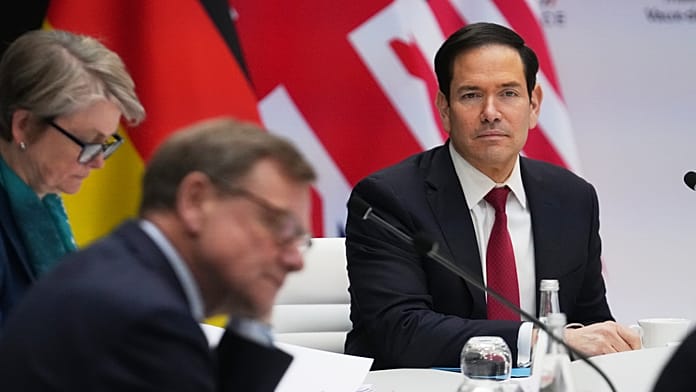
US Secretary of State Marco Rubio has said Washington will “re-examine” its relationship with NATO after allies refused to support the US-Israel war in Iran, echoing remarks from President Donald Trump over a potential withdrawal from the alliance.
“I think there’s no doubt, unfortunately, after this conflict is concluded, we are going to have to re-examine that relationship,” Rubio told Fox News on Tuesday evening.
“We’re going to have to re-examine the value of NATO for our country,” he added.
The remarks mark the second such warning from Rubio in less than a week, as European leaders continue to resist US calls to take part in the conflict with Iran even.
G7 foreign ministers said last week they will assist in the Strait of Hormuz once the hot phase of the war is done and suggested an UN-led mission similar to the Black Sea Initiative which managed to get exports of grain during hostilities between Russia and Ukraine.
Rubio, who described himself as a long-time supporter of NATO, said the alliance had previously offered clear advantages, including allowing the US to “project power” through military bases across member states.
However, he warned that arrangement could come into question if allies restrict access. Several European countries have restricted access to their US bases to launch attacks.
Rubio said would take stock and conduct an assessment after the war is over.
“If we’ve reached a point where the NATO alliance means we can’t use those bases to defend America’s interests, then NATO becomes a one-way street,” he said.
“If NATO is about us defending Europe, but they deny us basing rights when we need them, that’s not a very good arrangement.”
Meanwhile, Trump has issued conflicting statements on the future of US membership.
In recent comments, he said he was “strongly considering” withdrawing from NATO, describing the alliance as a “paper tiger” over its refusal to engage in the Iran war.
However, in an interview with The Telegraph, the US president later said it was “beyond consideration” that Washington would leave the alliance, which it has been part of for 76 years.
UK Prime Minister Keir Starmer defended the alliance on Wednesday, calling NATO “the single most effective military alliance the world has ever seen”.
“It has kept us safe for many decades, and we are fully committed to NATO,” he told a press conference.
European allies rattled by Iran war
Adding to the transatlantic tensions, several European countries denied the use of their airspace for military activities linked to the conflict.
Spain, one of the most vocal critics of the US-Israel strikes, said it would bar US aircraft involved in the war from its airspace or use its bases for anything other than humanitarian aid. France has also restricted access for some military flights carrying supplies to Israel, prompting a sharp response from Trump.
Writing on Truth Social, he criticised Paris for blocking flights carrying military equipment, accusing France of being “very unhelpful”.
Elsewhere, Poland declined an informal US request to redeploy Patriot air defence systems to the Gulf.
“Our Patriot batteries are used to protect Polish airspace and NATO’s eastern flank. Nothing is changing in this regard,” Defence Minister Władysław Kosiniak-Kamysz said in a social media post, responding to reports in Polish media.
Washington has also called on European allies to help secure the Strait of Hormuz, a critical shipping route through which around a fifth of the world’s crude oil passes. Iran has effectively blocked the passage, contributing to significant disruption in global energy markets that has sent oil and gas prices soaring.
Around 30 countries, including European states as well as Japan, are discussing the formation of a “coalition of the willing” to support efforts to reopen the strait, though only once hostilities have ended.
Rubio has also suggested that European reluctance to engage in Iran could have broader implications for transatlantic cooperation.
“Ukraine is not America’s war, and yet we’ve contributed more to that fight than any other country,” Rubio said on the sidelines of the G7 foreign ministers’ meeting in France last week.
“So, this is something the president will have to take into account going forward.”
EU News has contacted NATO for comment. No response had been received at the time of publication.