



TL:DR – EU member states debate diplomatic re-engagement with Russia amid Ukraine war
• French President Emmanuel Macron and Italian Prime Minister Giorgia Meloni publicly endorsed EU re-engagement with Russia to influence negotiations on Ukraine’s future security.
• Austria, the Czech Republic, and Luxembourg support appointing a special envoy to unify Europe’s approach in discussions with Russia.
• Germany, Estonia, Lithuania, and Cyprus oppose re-engagement, citing Russia’s ongoing aggression towards Ukraine as evidence of its unwillingness to negotiate.
• The next formal EU summit to discuss these issues is scheduled for 19 March.
Should the EU speak directly with Putin? Leaders agree to disagree – for now
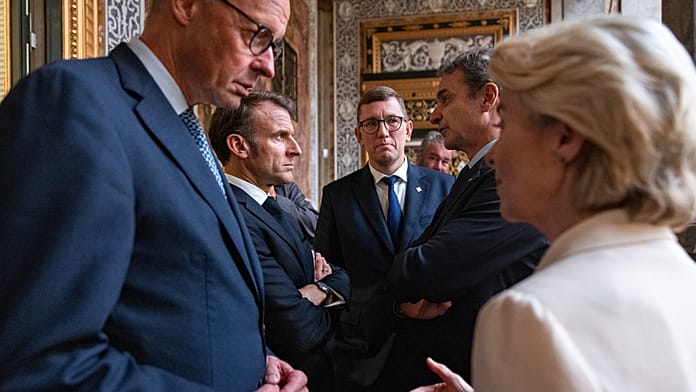
On Friday, European Union member states debated the prospect of re-engaging diplomatically with the Kremlin to address the ongoing war in Ukraine. This discussion gained momentum following endorsements from French President Emmanuel Macron and Italian Prime Minister Giorgia Meloni, who asserted that the EU must secure a permanent negotiating role in shaping Europe’s future security architecture.
The implications of this debate are significant, as Europe’s position as Ukraine’s largest donor places it in a critical role for post-war security guarantees. Member states are now weighing the potential benefits of appointing a special envoy to represent the EU in dialogues with Russia to prevent fragmented approaches.
France and Italy Advocate for Diplomatic Engagement
In public statements, both Macron and Meloni argued that Europe must engage directly with Russia. “If Europe decides to take part in this phase of negotiations by talking only to one of the two sides, I fear that in the end the positive contribution it can make will be limited,” Meloni said. Support from countries including Austria, the Czech Republic, and Luxembourg has emerged for this position, with Austrian Foreign Minister Beate Meinl-Reisinger expressing that “Europe is strongest when it speaks with one voice.”
However, not all member states share this perspective. Germany, Estonia, Lithuania, and Cyprus have voiced strong opposition, citing ongoing Russian aggression and a lack of willingness for concessions. German Chancellor Friedrich Merz stated, “We currently see no need to open additional channels of communication,” emphasising that Moscow must show a commitment to peace.
Different Visions for EU Engagement
As discussions unfold, the EU institutions are closely monitoring the contrasting viewpoints among member states. France’s approach appears focused on direct high-level talks, while other leaders advocate for a special envoy to engage collaboratively within a broader framework. Latvian Prime Minister Evika Siliņa suggested that any envoy participate in trilateral talks with the US, keeping economic sanctions in place.
EU High Representative Kaja Kallas called for a clear understanding of the objectives behind any communication with Russia. “The point right now is not the person who does it, but more like how and what we want to get out of this,” she stated, underscoring the importance of establishing a unified EU strategy.
Future Considerations and Potential Envoys
The debate surrounding re-engagement remains ongoing, with informal discussions about candidates for a special envoy position already taking place. Names being considered include Alexander Stubb, the president of Finland, and Margrethe Vestager, the former European Commissioner for competition policy. Additionally, Sauli Niinistö, the former president of Finland, has been mentioned due to his experience and language proficiency.
As tensions persist, EU officials note the urgency of these discussions, particularly in light of the recent trilateral talks involving the US, Ukraine, and Russia that excluded Europe. The EU’s €90 billion loan agreement to support Kyiv further underlines the necessity for a coherent diplomatic strategy. Despite the push for engagement, a cautious approach remains paramount to maintain a unified European front.
“