



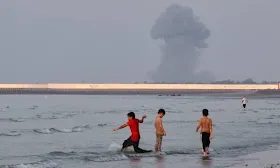
Media Lens: Trump suspends plans for tolls in Strait of Hormuz amid rising tensions
Trump has backed away from plans to charge fees at the Strait of Hormuz amid increasing tensions. This decision comes as attacks intensify in the region.
Quick links: What has happened | Status quo | Confirmed facts | Preconceptions | Elisions | One story, four angles | Related links
What has happened
Recently, former President Donald Trump announced his decision to abandon plans to impose fees on shipping through the Strait of Hormuz. This decision follows a series of escalating attacks in the region, prompting concerns about the safety and security of maritime traffic.
Trump’s strategy reversal aligns with ongoing discussions among U.S. lawmakers, who are urging caution regarding military engagements in Iran. The situation remains volatile as tensions rise amid continued military operations and diplomatic efforts in the area.
Status quo
No background paragraph is needed.
Confirmed facts
- Trump is reconsidering plans to impose fees in the Strait of Hormuz.
- Lawmakers have criticized Trump over military actions relating to Iran.
- The U.S. military has targeted sites in Iran prior to resuming a naval blockade.
- There are reports of increased tensions and attacks in the region.
Preconceptions
- AP News prioritizes immediate developments and official statements regarding military actions in the Strait of Hormuz, reducing historical context.
- Time Magazine emphasizes legislative reactions and public sentiments surrounding military decisions, while minimizing technical details of military operations.
- Fast Company highlights economic implications of proposed tolls and blockades, underplaying the potential human costs and geopolitical analyses.
- Fox News focuses on military tactics and immediate threats, downplaying broader implications or discussions on diplomatic resolutions.
Elisions
- **Coverage of Trump’s Fees Proposal**: AP News focuses on Trump’s withdrawal of plans to charge fees in the Strait of Hormuz, while Fox News emphasizes military actions against Iran that relate to the context of such fees. This suggests a gap in the military implications reported by Fox in contrast to AP’s financial angle.
- **Lawmakers’ Reactions**: Time Magazine discusses bipartisan criticism from lawmakers regarding Trump’s decisions on military actions in Iran, while Fast Company highlights public sentiment against escalating military involvement. This reflects a disparity in the portrayal of political responses versus public opinion on the matter.
- **Casualty Reporting**: Different sources like Fox News reference military strikes with a focus on U.S. actions, whereas AP news does not detail casualties or impacts on civilians. This indicates a gap in humanitarian coverage versus military advancement narratives.
One story, four angles
AP News – Trump backs away from plans to charge fees in the Strait of Hormuz as attacks intensify
Publication: AP News | Intensity: (8/10) | Sentiment: Neutral | Legal precision: Moderate
Expand
Espresso Shot: The headline positions Trump’s retreat on fee charges in the Strait as significant amid growing tensions, emphasizing the urgency of the attacks that lead to this decision.
Key differences:
1. **Focus on Reversal:** AP highlights Trump’s “backing away,” suggesting indecisiveness. Contrast with Time’s focus on criticisms, aligning accountability on lawmakers.
2. **Urgency Portrayal:** AP ties the retreat directly to “intensifying attacks,” while Fast Company centers on economic implications rather than immediate threats.
3. **Political Context:** AP’s neutral tone contrasts with Fox News’ direct militaristic framing, showcasing contrasting priorities in understanding the implications of Trump’s actions.
Bias: Selection: Emphasizes Trump’s retreat; Language: Neutral tone; Omission: Less focus on political ramifications.
Assessment: Readers are led to believe that Trump’s withdrawal from fee plans is crucial and responsive to increasing risks.
Time Magazine – ‘Enough Is Enough’: Lawmakers Criticize Trump Over Resumption of Iran War
Publication: Time Magazine | Intensity: (7/10) | Sentiment: Negative | Legal precision: Low
Expand
Espresso Shot: The headline emphasizes lawmakers’ dissatisfaction with Trump’s Iran strategy, suggesting a collective legislative disapproval that demands immediate attention.
Key differences:
1. **Blame Assignment:** Time shifts the focus to lawmakers’ criticism rather than Trump’s actions, while AP highlights Trump’s decisions directly.
2. **Emotional Appeal:** Time’s phrase “Enough Is Enough” carries emotional weight suggesting desperation and urgency, contrasting with AP’s more factual tone.
3. **Political Accountability:** Time frames the issue within a political context, indicating the need for responsible leadership, while AP remains neutral.
Bias: Selection: Focuses on criticism instead of actions; Language: Emotionally charged; Omission: Limited discussion on the geopolitical ramifications.
Assessment: Readers perceive a strong sentiment among lawmakers, believing that Trump’s strategy invites serious backlash.
Fast Company – Trump weighs 20% toll at Strait of Hormuz and says blockade is back on, threatening ceasefire with Iran
Publication: Fast Company | Intensity: (8/10) | Sentiment: Negative | Legal precision: Moderate
Expand
Espresso Shot: Fast Company highlights Trump’s potential 20% toll, portraying it as a significant economic threat while linking it to broader international implications directly influencing peace prospects.
Key differences:
1. **Economic Framing:** Fast Company’s focus on a “20% toll” contrasts with AP’s depiction of fee cancellations, highlighting economic pressure rather than direct military implications.
2. **Causal Connection:** Fast explicitly connects Trump’s toll with the “threatening ceasefire,” indicating consequences, unlike AP’s more neutral tone.
3. **Decision Weight:** Fast emphasizes the criticality of Trump’s decisions, while Time focuses on external critiques.
Bias: Selection: Focuses heavily on economic implications; Language: Alarmist; Omission: Limited focus on legislative perspectives.
Assessment: Readers are likely to see Trump’s actions as both economically motivated and politically perilous, understanding them as both detrimental and urgent.
Fox News – US military hits targets across Iran in hours leading up to resumption of naval blockade
Publication: Fox News | Intensity: (9/10) | Sentiment: Negative | Legal precision: Low
Expand
Espresso Shot: The headline indicates active military engagement in response to Trump’s decisions, presenting a stark and immediate threat to viewers.
Key differences:
1. **Militaristic Tone:** Fox’s framing emphasizes military action, while AP maintains a political focus on decision-making.
2. **Urgency and Action:** Fox implies immediacy in military events, contrasting with Fast’s economic focus on tolls, showing differing prioritization.
3. **Contextual Emphasis:** Fox frames actions as part of broader combat readiness, whereas Time centers on political reactions to decisions.
Bias: Selection: Strong focus on military actions; Language: Bombastic; Omission: Less emphasis on the economic context.
Assessment: Readers perceive Trump’s military decisions as indicative of an imminent escalation, fostering an awareness of significant tensions.
Among the publications, AP News presents the strongest framing, emphasizing Trump’s retreat from plans regarding the Strait of Hormuz amid escalating tensions. In contrast, Time Magazine delivers a more escalatory angle, criticizing Trump’s approach as lawmakers accuse him of reigniting conflict with Iran. Meanwhile, Fast Company focuses on the potential reimplementation of tolls that threaten ceasefire prospects, while Fox News details military actions leading up to the blockade’s resumption. The facts do not change. What changes is where scrutiny lands.
Related links
AP News
Trump backs away from plans to charge fees in the Strait of Hormuz as attacks intensify
Time Magazine
‘Enough Is Enough’: Lawmakers Criticize Trump Over Resumption of Iran War
Fast Company
Fox News
US military hits targets across Iran in hours leading up to resumption of naval blockade