


Israel begins limited ground operations against Hezbollah in southern Lebanon
Israel’s military began limited ground operations against Hezbollah in southern Lebanon, following extensive airstrikes and artillery shelling in the region.
Washington has reaffirmed its commitment to mediation efforts in the region, despite challenges posed by escalating violence, stressing the importance of dialogue for stability.
Lebanon’s President Joseph Aoun has called for direct negotiations with Israel, the first such call since the 1982 Israeli invasion during Lebanon’s civil war.
Briefing summary
The UN’s Humanitarian Chief expressed concerns that Lebanon could experience a situation similar to Gaza. He cited escalating rhetoric from Israeli ministers regarding potential actions against Lebanon.
Israel initiated “limited and targeted ground operations” against Hezbollah in southern Lebanon, launching airstrikes and artillery attacks. This military action is aimed at disarming Hezbollah following recent strikes on Israel.
Lebanon’s President, Joseph Aoun, has called for direct negotiations with Israel, marking a significant shift in Lebanon’s diplomatic stance. However, Lebanon insists on an end to hostilities prior to any discussions.
‘Fear Lebanon could be the next Gaza’, UN Humanitarian Chief tells EU News
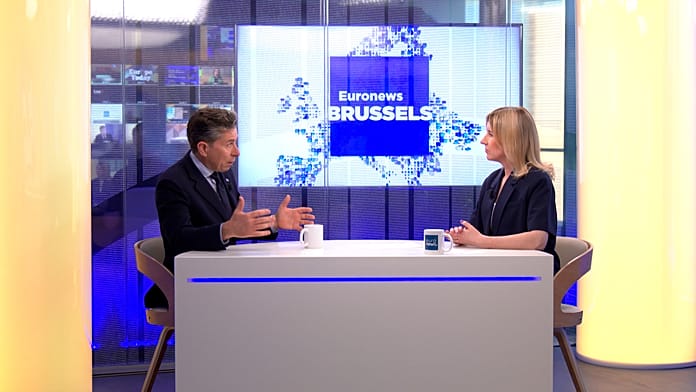
“I do fear [that Lebanon could be the next Gaza],” the UN’s Humanitarian Chief said on EU News’ interview programme 12 Minutes with.
“In fact, I fear that because that’s what we’re hearing from some Israeli ministers right now, who are speaking in increasingly belligerent language about what they plan to do to Lebanon.”
Israel’s attacks have mostly been concentrated in southern Lebanon and the southern suburbs of Beirut.
Israel’s Defence Minister, Israel Katz, has warned that displaced Lebanese forced from their homes would not be allowed to return until the safety of Israelis in the north was guaranteed, drawing comparisons with Gaza.
Lebanon was pulled into the conflict some two weeks ago when Iran-backed Hezbollah launched strikes against Israel in retaliation for the assassination of the former Iranian Supreme Leader Ayatollah Ali Khamenei in an Israeli airstrike. Rockets shot at Israel have injured civilians and damaged residential buildings.
Israel said these Hezbollah attacks justified launching a new offensive against the armed group, stating it will do so until it is disarmed. Prime Minister Benjamin Netanyahu has said Lebanon was not fulfilling its obligations to confiscate Hezbollah’s weapons in line with a November 2024 ceasefire agreement between the two countries.
On Monday, Israel’s military troops began “limited and targeted ground operations” against Hezbollah in southern Lebanon, where the military said it carried out massive airstrikes and artillery shelling before troops moved into the area.
There are fears that this could lead to an Israeli occupation of the south. Far-right figures within Israel’s governing coalition have advocated for the creation of a security buffer inside southern Lebanon.
The Israeli army implied in statements that remaining in these locations means people are considered targets. Designating an area for widespread indiscriminate attacks in such a way is considered unlawful under the laws of war. The IDF applied similar tactics in Gaza.
“The reality is that Israel has issued these instructions to civilians to move from vast, vast areas of the country, so it doesn’t leave very much space for them to seek refuge,” Fletcher explained.
He added that Israeli airstrikes have destroyed civilian infrastructure. “We’re seeing massive damage to civilian areas. We’re seeing a lot of damage to healthcare [facilities], for example. My colleagues on the ground were briefing me on Monday about the number of hospitals and clinics which have been hit in these attacks.”
Israel has said it strikes targets linked to Hezbollah and that it issues evacuation orders ahead of any military action.
‘Dangerous to operate’
Fletcher noted that it is becoming increasingly dangerous for the UN to operate in Lebanon and provide support to civilians.
Lebanon’s president, Joseph Aoun, criticised Hezbollah’s strikes on Israel and called for direct negotiations with Israel earlier this month as part of a proposal to end the escalating conflict. This marked the first time Lebanon called for such calls since the 1982 Israeli invasion during Lebanon’s civil war.
Fletcher referred to this as a “really interesting development.”
“The Lebanese government themselves are calling for direct negotiations with Israel, which hasn’t happened in the past.” Fletcher sees this as a potential pathway to peace.
“There’s potential here to reset the relationship in the region, but the path for that is through dialogue and diplomacy, and not through more brutal violence.”
However, Lebanon wants the fighting to end before any talks with Israel, lowering the probability of successful negotiations. Israel has not yet responded to these requests for negotiations from Lebanon.
Washington, which under the helm of President Trump has asserted itself as a leading mediator in several global conflicts, is preoccupied with the wider war and its impact on the global economy.
In the meantime, the need for humanitarian aid is skyrocketing, while aid organisations are facing obstructions, Fletcher says.
“People talk about the unpredictable consequences of this conflict, but they were quite predictable. We know how much we rely on the Strait of Hormuz for commercial traffic and humanitarian traffic to so many of the places we serve,” he explained.
“Since the resumption of this conflict across the Middle East, our access to Gaza, for example, has been restricted. Again, there’s only one crossing open. So that means we get fewer trucks in, less aid, less food, less water, and less shelter.”
Recent funding cuts are further depleting the UN’s ability to respond. In recent months, the US announced it would contribute only $2 billion in United Nations humanitarian assistance, a sharp drop from the up to $17 billion it provided in recent years. It also withdrew from 31 UN entities
“It’s really rough. We’re trying to save as many lives as we can, but without any stability or guarantee of the money coming in. And so all the time, I’m in Afghanistan, I’m in South Sudan, I’m in Ukraine and Darfur, seeing projects that I know will close and meeting people who I know will die.”