


EU plans to use frozen Russian assets to fund Ukraine amid Orbán veto
EU High Representative Kaja Kallas stated the use of Russia’s frozen assets to finance Ukraine remains an option if Viktor Orbán maintains his veto on the €90 billion loan.
EU leaders are considering using €210 billion of frozen Russian Central Bank assets as a potential interest-free credit line to address Ukraine’s financial and military needs.
“No oil, no money,” declared Viktor Orbán, emphasising his firm stance on the blockade of the €90 billion loan to Ukraine.
Key developments
Kaja Kallas, EU High Representative, confirmed that using Russia’s frozen assets for Ukraine’s financing remains an option if Viktor Orbán maintains his veto on the €90 billion loan post-election.
Belgium has resisted the European Commission‘s proposal to convert €210 billion of Russian Central Bank assets into an interest-free credit line for Ukraine, citing potential legal and financial repercussions.
Despite ongoing negotiations for the €90 billion loan, Orbán’s demands for oil supply resumption through the Druzhba pipeline remain a significant obstacle, complicating efforts to resolve the deadlock.
Kallas insists Russian assets are an option if Orbán doesn’t lift veto on Ukraine loan
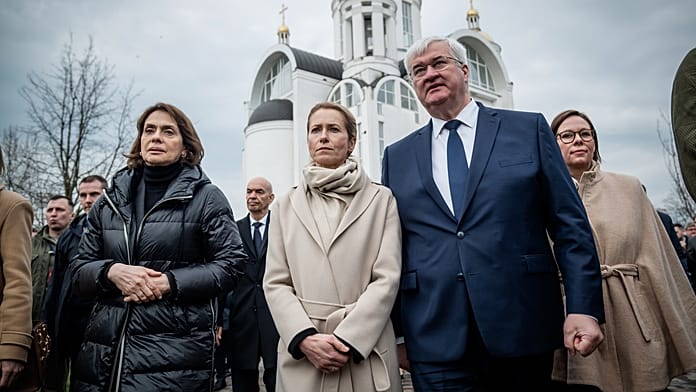
Using Russia’s frozen assets to finance Ukraine remains on the table if Viktor Orbán refuses to lift his veto on the €90 billion loan after the 12 April elections, EU High Representative Kaja Kallas said amid the ongoing stalemate.
Orbán has blocked the financial lifeline over an unrelated dispute with Kyiv regarding the Druzhba oil pipeline, which has been non-operational since late January. His veto has featured prominently in his bruising re-election campaign.
“The loan that we are working right now to deliver that we agreed in the end of last year, let me remind you that that was actually plan B. Plan A was the use of frozen assets,” Kallas said on Tuesday while visiting Kyiv to honour the victims of the Bucha massacre.
“Plan A was the use of frozen assets. So, we should also keep in mind that if plan B does not work, let’s go back to plan A, but we definitely need to deliver Ukraine the financing that they need to resist the Russian aggression,” she added.
Standing alongside Kallas, Ukrainian Foreign Minister Andrii Sybiha echoed the message, saying the immbolised assets are “not off the table” and “cannot be taken off the agenda until and unless Russia pays all the reparations”.
The European Commission put forward an innovative proposal to turn the €210 billion of Russian Central Bank assets held under sanctions into an interest-free line of credit to meet Ukraine’s financial and military needs for 2026 and 2027.
Germany, Poland, the Nordics and the Baltics enthusiastically backed the plan, which offered the advantage of sparing European budgets from footing the bill. Ukraine saw it as the most tangible realisation yet of its search for accountability.
But Belgium, the prime custodian of the Russian assets, resisted the proposal, warning of legal pitfalls, financial repercussions and reputation damage for the eurozone. France, Italy, Malta and Bulgaria also voiced strong concerns.
The political debate stretched from September until December last year and ultimately collapsed during a make-or-break summit. As an alternative, EU leaders agreed to provide Ukraine with a €90 billion loan based on common borrowing.
Hungary, Slovakia and the Czech Republic secured an opt-out from the scheme.
Druzhba standoff
The €90 billion loan was on the verge of its final approval in February when Orbán abruptly vetoed the deal, demanding an immediate resumption of oil supplies through the Soviet-era Druzhba pipeline as a non-negotiable condition.
“No oil, no money,” Orbán said earlier this month.
Hoping to achieve a resolution before Kyiv runs out of foreign aid in May, the European Commission has offered to organise an inspection of Druzhba and pay for repairs with EU funds. But the experts have been waiting for over two weeks to visit the site.
“The problem is that Russia is destroying a great deal of our energy infrastructure: other pipelines, gas storage facilities, repair equipment,” Kachka said. “But we are prioritising the Druzhba pipeline at Hungary’s request, so it will be resolved.”
Although the deadlock has deepened more than Brussels had anticipated, the idea of giving the reparations loan a second try is unlikely to gain traction due to high risks.
Earlier this month, its main opponent, Belgian Prime Minister Bart De Wever, ruled out such a scenario. “We have to do the loan. It’s as simple as that,” De Wever told reporters. “It has been politically decided, so it has to be executed.”