



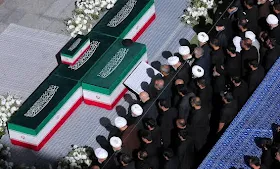
Media Lens: Crowds gather in Tehran for Ayatollah Ali Khamenei’s funeral
Crowds gather in Tehran for the funeral of Ayatollah Ali Khamenei. This significant event draws attention as many mourners pay their respects to the late leader.
Quick links: What has happened | Status quo | Confirmed facts | Preconceptions | Elisions | One story, four angles | Related links
What has happened
Ayatollah Ali Khamenei’s funeral took place in Tehran, drawing significant crowds of mourners from across Iran. The event marked a pivotal moment in the nation’s history as people gathered to pay their respects to the former leader, reflecting on his influence and the impact of his leadership.
At the funeral, Khamenei’s three sons were notably present, but his designated successor did not attend, which sparked discussions regarding the future direction of Iran’s leadership. The gathering at the ceremony highlighted the complexities surrounding Khamenei’s legacy and the ongoing political dynamics in the country.
Status quo
Ayatollah Ali Khamenei’s funeral took place in Tehran, drawing large crowds of mourners. This event followed the passing of Khamenei, who had served as Iran’s Supreme Leader for over three decades. The funeral proceedings included public memorials and rituals customary in Iranian culture. Attendees included government officials, family members, and citizens, all paying respects to a significant figure in the country’s political and religious landscape.
Confirmed facts
- Crowds gathered in Tehran for Ayatollah Ali Khamenei’s funeral.
- Three sons of Iran’s slain leader Khamenei appeared at the funeral.
- The funeral drew significant public attention and participation.
- Several major news outlets reported on the developments surrounding Khamenei’s funeral.
- The event highlighted the political and religious dynamics within Iran.
Preconceptions
- Reuters prioritizes the presence of Khamenei’s sons during the funeral, highlighting their role and connection rather than focusing on the political implications of the event.
- The New York Times emphasizes the broader context of the Iranian war fatigue affecting the atmosphere at the funeral, blending personal sentiment with national mourning.
- AP News centers on the massive turnout of mourners as a logistical highlight, providing a quantitative perspective on the public’s reaction without delving deeper into political narratives.
- Al Jazeera specifically interrogates the religious and political messaging behind Khamenei’s funeral, placing a stronger emphasis on symbolic meanings and implications than the other outlets.
Elisions
- Reuters emphasizes the appearance of Khamenei’s sons at the funeral while omitting more detailed discussions about the political implications of these attendees, which are explored in other sources.
- Al Jazeera focuses on the religious and political messaging of Khamenei’s funeral, whereas The New York Times primarily highlights the physical transformation of Tehran for the event without delving deeply into the funeral’s significance.
- AP News discusses the massive turnout for the funeral yet lacks evaluation on the socio-political climate surrounding the event, a point thoroughly examined by the New York Times.
One story, four angles
Reuters – Crowds gather in Tehran for Ayatollah Ali Khamenei’s funeral
Publication: Reuters | Intensity: (7/10) | Sentiment: Neutral | Legal precision: High
Expand
Espresso Shot: The opening highlights the sheer number of attendees at Khamenei’s funeral, emphasizing a united display of solidarity.
Key differences:
– **Comparison:** Reuters focuses on the scale of the event, stating “thousands” instead of “millions” as in other outlets, minimizing the perceived impact.
– **Example:** “thousands gathered” compared to “millions mourned” in other coverage.
– **Placement:** They place the context of current political climate immediately after the news, linking to ongoing governance issues.
Bias: Selection: Emphasizes attendance but lacks detailed narratives of individual mourners. | Language: Relies on terms like “thousands” which understates the funeral’s significance. | Omission: Does not mention political implications of Khamenei’s passing for future governance.
Assessment: Readers are led to believe the turnout, although large, is not indicative of widespread political support.
The New York Times – Exhausted by Iran War, Tehran Transforms for Khamenei’s Funeral
Publication: The New York Times | Intensity: (8/10) | Sentiment: Negative | Legal precision: Moderate
Expand
Espresso Shot: The focus is on the aftermath of the Iran War, portraying a city affected both physically and emotionally by the funeral.
Key differences:
– **Comparison:** Highlights the emotional toll of the community, in contrast to Reuters’ more factual observation of attendance.
– **Example:** Language like “exhausted” implies deep societal fatigue, showcasing internal struggle.
– **Placement:** The emotional context precedes the logistics, steering reader focus toward societal implications first.
Bias: Selection: Focuses on negative societal impacts rather than necessarily on the funeral’s size. | Language: Employs emotive language, generating pathos with terms like “exhausted.” | Omission: Fails to address the significance of Khamenei’s leadership directly.
Assessment: Readers perceive an exhausted society grappling with loss rather than merely viewing an event.
AP News – AP Was There: Millions of mourners attended funeral of Iran’s Ayatollah Ruhollah Khomeini
Publication: AP News | Intensity: (9/10) | Sentiment: Positive | Legal precision: Moderate
Expand
Espresso Shot: The introduction strongly emphasizes the vast turnout, presenting it as a historical moment for Iran’s culture.
Key differences:
– **Comparison:** AP stresses the emotional impact and size, framing it as “millions” which elevates its significance compared to other outlets.
– **Example:** Prominent use of “millions” in the headline contrasts sharply with other mentions.
– **Placement:** The crowd’s magnitude is highlighted at the forefront, immediately capturing reader attention.
Bias: Selection: Highlights only the crowd aspect, downplaying possible dissent within the mourners. | Language: Emphasizes terms like “millions” which can overstress the support for Khamenei. | Omission: Ignores the nuances of political implications surrounding the leadership transition.
Assessment: Readers are likely to perceive a monolithic support base represented by the large funeral turnout.
Al Jazeera – What is the religious and political messaging behind Khamenei’s funeral?
Publication: Al Jazeera | Intensity: (6/10) | Sentiment: Neutral | Legal precision: Moderate
Expand
Espresso Shot: The piece encourages an exploration of deeper implications behind the funeral, suggesting strategic existential messages.
Key differences:
– **Comparison:** Al Jazeera discusses implications and messaging, unlike others that focus primarily on attendance.
– **Example:** Phrasing like “religious and political messaging” indicates a deeper analysis.
– **Placement:** The thematic focus is emphasized first, contrasting logistical details presented later in other articles.
Bias: Selection: Prioritizes analysis over reporting numbers, which can obscure the immediate event’s significance. | Language: More academic vocabulary shifts focus from emotional impact to critique. | Omission: Does not quantify turnout, lessening direct emphasis on support levels.
Assessment: Readers grasp that political strategy and religious messaging dominate the narrative over sheer attendance figures.
The New York Times emphasizes the emotional toll on Tehran as it “transforms” for Khamenei’s funeral, reflecting a narrative grounded in loss and change. In contrast, Reuters announces the appearance of Khamenei’s sons rather than his successor, suggesting a pivot towards unresolved leadership dynamics. Al Jazeera’s focus on the “religious and political messaging” conveys a more charged atmosphere, framing the event as a potential catalyst for future unrest. Meanwhile, AP News emphasizes massive public turnout, illustrating public allegiance amidst uncertainties. The facts do not change. What changes is where scrutiny lands.
Related links
Reuters
Crowds gather in Tehran for Ayatollah Ali Khamenei’s funeral
The New York Times
Exhausted by Iran War, Tehran Transforms for Khamenei’s Funeral
AP News
AP Was There: Millions of mourners attended funeral of Iran’s Ayatollah Ruhollah Khomeini
Al Jazeera
What is the religious and political messaging behind Khamenei’s funeral?