



Get you up to speed: Spain’s election could bring the far-right to power for the 1st time since Franco
Spanish voters are participating in a snap election on Sunday as Prime Minister Pedro Sánchez faces off against the centre-right People’s Party, led by Alberto Núñez Feijóo, and the far-right Vox party, led by Santiago Abascal, amidst growing public discontent. The immediate situation remains unresolved as the election’s outcome may shift the political landscape in Spain significantly.
Polling suggests the centre-right People’s Party could fall short of a parliamentary majority, potentially needing support from the nationalist Vox party, which is currently polling at around 18%. The implications of the election are significant for EU dynamics, as Spain is the only large EU country presently governed by the left.
Prime Minister Pedro Sánchez has accused the People’s Party (PP) and Vox of seeking to “roll back the rights of women, workers and migrants,” framing the election outcome as pivotal for progressive values in Spain. Meanwhile, the PP has pledged to construct one million homes and tighten immigration controls, indicating a shift in policy focus should they secure power in the upcoming vote.
What remains unclear — It is uncertain how the potential collaboration between the People’s Party and Vox would impact legislative actions if they form a government.
Spain’s snap election may lead to far-right government for first time since Franco
Spanish voters head to the polls on Sunday in a snap election that could see another major European country swing to the political right, as socialist Prime Minister Pedro Sánchez battles to retain power amid mounting public discontent over housing, immigration and corruption.
Sánchez, one of Europe’s most prominent left-wing leaders, has increasingly positioned himself as a political counterweight to President Trump on the world stage. He has defied Mr. Trump’s demands over NATO defense spending, penned an opinion piece in The New York Times defending migration and denouncing “MAGA-style leaders” and cultivated ties with prominent figures on the American left, including New York City Mayor Zohran Mamdani.
But at home, Sánchez faces a growing challenge from the center-right People’s Party, led by Alberto Núñez Feijóo, and the nationalist, anti-immigration Vox party, led by Santiago Abascal, which could together form Spain’s most right-wing government since the country returned to democracy following the death of dictator Francisco Franco in 1975.
La Moncloa (Spanish Government)/Handout/Anadolu/Getty 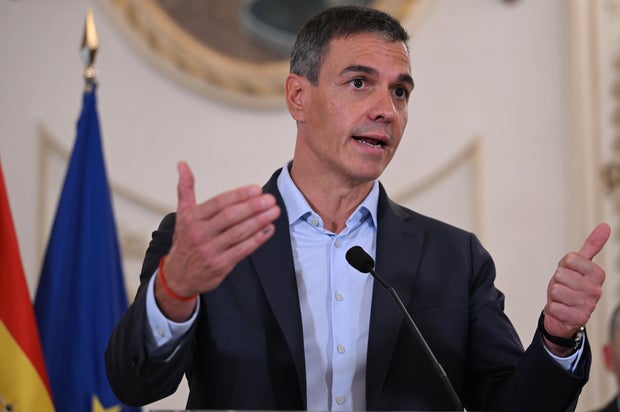
A country divided
Housing has become a defining issue of the election, with soaring rents and property prices fueling widespread public anger.
On the same day Sánchez met Mamdani in New York City, 87-year-old Maricarmen Abascal was forcibly removed from the Madrid apartment where she had lived for more than 70 years. Her landlord had sought to more than triple her monthly rent to $1,900, or 1,650 euros.
Her eviction – where she was carried out on a stretcher – sparked nationwide protests. Although her landlord subsequently agreed to let her return at a substantially lower rent, Abascal died in the hospital two weeks after her eviction, before she could sign the new lease. Her case became a symbol of Spain’s housing crisis.
In response to the protests, Sánchez introduced emergency housing measures, including restrictions on rent increases. But the proposals were defeated in parliament, prompting Sánchez to call a snap election.
Oscar DEL POZO /AFP via Getty Images 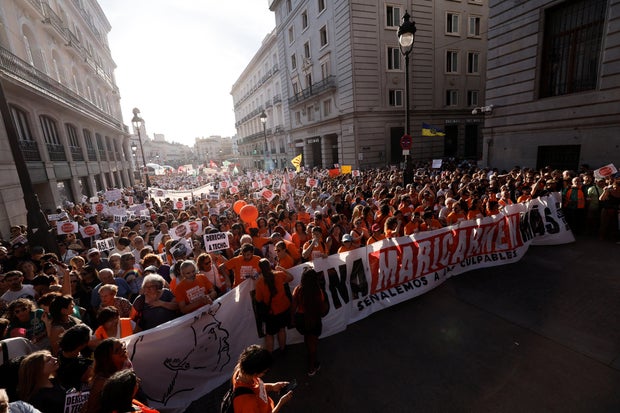
Sánchez has since sought to blame the PP and the far-right Vox for blocking protections for vulnerable tenants. The PP, meanwhile, argues that Sánchez has had eight years to address the housing crisis and has pledged to build one million homes.
The PP has made reducing the cost of living and tackling corruption central to its campaign.
Immigration has also become a particularly contentious election issue following the mass arrival of migrants in Ceuta, a Spanish territory on the northern coast of Africa, in July, and the Sánchez government’s decision earlier this year to offer legal status to hundreds of thousands of undocumented migrants.
The far-right Vox party has sought to capitalize on public unease over immigration, calling for mass deportations and prioritizing Spanish nationals in access to public services.
Hugo Marcos-Marné, a political scientist at the University of Salamanca, told WTX US News that the “electoral growth of Vox is multicausal,” but perceptions of immigration, more than actual figures or changes in the country-wide objective situation, “is certainly behind” the party’s rise.
Alberto Ortega/Europa Press via Getty Images 
The PP has also called for tightened immigration controls.
Corruption scandals involving Sánchez’s political associates and members of his family have been a major feature of the election. Two deadly train crashes this year have also undermined confidence in his administration.
Vox has also been aided by “an anti-gender reaction, authoritarian nostalgia, and anti-elitism directed against mainstream parties and politicians,” Marcos-Marné said.
Spain’s far-right taboo
For decades, Spain was relatively resistant to the rise of far-right populism seen elsewhere in Europe, in part because of the country’s experience of dictatorship under Franco.
Although the center-right PP is polling ahead of Sánchez’s Socialists, polls suggest it could fall short of a parliamentary majority and need the support of Vox, which is polling at around 18%. Once reluctant to embrace the far-right party, the PP has increasingly shown a willingness to work with Vox, with the two parties having formed coalition governments at the regional level.
Pablo Blazquez Dominguez / Getty Images 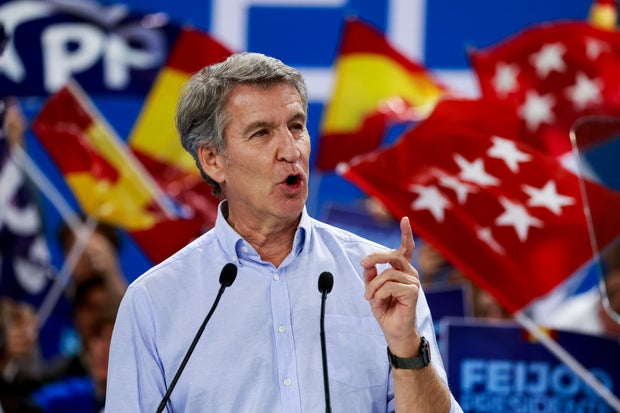
“Research shows that the radical-right was comparatively more stigmatized in Spain because of Franco dictatorship, but also that the Popular Party was a chameleonic party able to attract voters of the center-right and the radical-right,” Marcos-Marné said.
Sánchez is hoping that the prospect of the far-right entering national government will galvanize progressive voters.
“The PP and Vox pose a real threat to many groups in our country,” Sánchez wrote on X, accusing the parties of seeking to roll back the rights of women, workers and migrants. “Every seat that goes to the PP and Vox means taking a step backward.”
The implications of Sunday’s election extend well beyond Spain’s borders.
With Spain the only large EU country currently governed by the left, Marcos-Marné said, the election is “certainly significant for the balance of forces at the EU level.”