



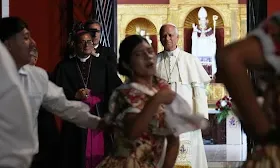
Media Lens: Pope concludes South America tour after visit to Peru’s Andes and Amazon
Pope Leo continues his tour in Peru, crossing the country as part of his visit to the Inca city and Amazon gateway. His journey highlights his engagement with local communities and faith leaders across the region.
Quick links: What has happened | Status quo | Confirmed facts | Preconceptions | Elisions | One story, four angles | Related links
What has happened
Pope Francis completed his visit to Peru, where he addressed various social issues including justice and the environment. His visit included significant events such as crowning the Virgin in Chiclayo and a call for justice in Santa Cruz, highlighting the need for reforms in the region.
The Pope’s journey through Peru spanned different regions, including the Andes and the Amazon, engaging with communities and emphasizing the importance of preserving indigenous cultures and natural resources. This trip was part of a larger South American tour aimed at strengthening connections with the local Catholic communities.
Status quo
Pope Leo recently concluded a tour of South America, visiting diverse regions including high-altitude areas of the Andes and the Amazon. His tour aimed to engage with communities and address social issues, culminating in symbolic acts such as crowning a Virgin and calling for justice in various contexts. This final segment of his trip focused on connecting with his followers across challenging terrains.
Confirmed facts
- Pope Leo is currently in Peru.
- During his visit, he is conducting various engagements in the Andes and the Amazon.
- His activities include meetings with local communities and messages related to social justice.
- The trip marks a significant event in Pope Leo’s South America tour.
Preconceptions
- Vatican News focuses on the Pope’s spiritual messages and justice-related themes during his trip, highlighting specific events such as the crowning of the Virgin in Chiclayo and calls for justice in Santa Cruz.
- Politico emphasizes the geopolitical implications of the Pope’s visit, particularly his outreach to indigenous communities and engagement with local authorities, showcasing the broader impact of his presence in Peru.
- Reuters provides a more journalistic perspective by covering logistics, demographics, and location specifics of the Pope’s travels, aiming to inform about the framework of the trip rather than its spiritual implications.
- DW.com highlights the broader context of the Pope’s visit, focusing on South America’s socio-political issues and their relevance to the Pope’s message, thereby reflecting on the intersection of faith and regional governance.
Elisions
- There is a significant absence of coverage regarding the specific social and economic impacts of the Pope’s visit to Peru, as many articles focus primarily on the Pope’s religious messages and events without detailing local community responses or benefits.
- While various sources highlight the Pope’s ceremonial activities, such as the crowning of the Virgin in Chiclayo, there is a gap in analysis regarding the political implications of his statements on justice and indigenous rights, which are only superficially mentioned.
- Comparisons of local reactions to the Pope’s visit are lacking; while Politico emphasizes the religious aspect, Vatican News includes some context but fails to assess public sentiment or controversy, which could provide a richer narrative.
One story, four angles
Politico – Pope crosses Peru in finale of trip home to visit flock high in Andes and deep in Amazon
Publication: Politico | Intensity: (7/10) | Sentiment: Neutral | Legal precision: Moderate
Expand
Espresso Shot: The reader is initially led to focus on the Pope’s journey and its significance as a final trip, emphasizing both accessibility and cultural impact.
Key differences:
1. The use of “finale” in the headline emphasizes a sense of conclusion, whereas other outlets might focus on the journey itself, crafting a narrative around perseverance instead of an ending.
2. “Visit flock high in Andes and deep in Amazon” highlights geographical diversity, contrasting with media outlets that might stress spiritual significance over physical locations.
3. Politico employs straightforward language to appeal to a broad audience, differing from outlets that may utilize more elaborate theological discourse.
Bias: Selection: By focusing on the journey’s end, it may underplay ongoing issues in Peru. | Language: The term “flock” humanizes the context but simplifies complex relationships. | Omission: Lacks in-depth analysis of political or social implications during the Pope’s visit.
Assessment: The reader perceives the trip as a significant yet concluding spiritual journey rather than a chance for ongoing engagement in regional socio-political issues.
Vatican News – Day Four in Peru: Pope crowns Virgin in Chiclayo, calls for justice in Santa Cruz
Publication: Vatican News | Intensity: (8/10) | Sentiment: Positive | Legal precision: High
Expand
Espresso Shot: Readers are steered to focus on justice as a core theme through the Pope’s actions during the trip, highlighting a commitment to social issues alongside traditional religious ones.
Key differences:
1. “Calls for justice” indicates an advocacy role for the Pope that may be underemphasized in secular media.
2. The phrase “crowns Virgin” adds a contemplative layer to the Papal visit, emphasizing a focus on traditional rituals, rather than solely on the progressive themes found in other reports.
3. Placement of specific locations, “Chiclayo” and “Santa Cruz,” demonstrates an acknowledgment of grassroots contexts which other outlets may neglect.
Bias: Selection: Highlights progressive calls for social justice, but may neglect critiques of church’s historical actions. | Language: Use of “crowns” suggests reverence, potentially leading to a more romanticized view of the event. | Omission: Lacks discussion on controversies surrounding the Pope’s messages.
Assessment: The reader is led to believe the Pope’s visit embodies a commitment to social justice initiatives alongside traditional spiritual duties.
Reuters – Pope Leo crossing Peru for visits to Inca city, Amazon gateway
Publication: Reuters | Intensity: (6/10) | Sentiment: Neutral | Legal precision: Medium
Expand
Espresso Shot: The headline directs focus to the geographical and historical significance of places visited rather than spiritual or social themes, emphasizing worldly aspects of the Pope’s journey.
Key differences:
1. The mention of “Inca city” suggests cultural heritage focus, contrasting with Vatican News’ emphasis on social justice.
2. Including “Amazon gateway” points to environmental connections, which contrasts with Politico’s focus strictly on the visit itself.
3. The neutral phrasing of “crossing Peru” suggests more of a logistical angle rather than a human or spiritual journey, setting a different tone compared to other articles.
Bias: Selection: Prioritizes geographical and cultural significance over spiritual themes present in other reports. | Language: “Crossing” suggests a more transactional journey, potentially diminishing the spiritual weight of the Pope’s mission. | Omission: Details on social justice or engagements with local issues may be lacking.
Assessment: The reader perceives the trip primarily in terms of cultural and geographical exploration, rather than theological engagement or community focus.
DW.com – Pope Leo heads to high Andes on final leg of South America tour
Publication: DW.com | Intensity: (7/10) | Sentiment: Positive | Legal precision: Medium
Expand
Espresso Shot: The headline prompts readers to focus on the Pope’s travel to the Andes, highlighting adventure and cultural significance as core elements of his journey.
Key differences:
1. The phrase “final leg” conveys a sense of urgency and importance, appealing to emotions, contrasting with Reuters’ more neutral descriptors.
2. “Heads to high Andes” emphasizes elevation and natural landscapes, fostering a sense of pilgrimage that engages readers’ imaginations unlike Politico’s straightforward depiction.
3. Emphasis on “South America tour” hints at broader regional significance whereas other outlets like Vatican News focus on specific social issues.
Bias: Selection: Highlights adventure elements while potentially sidelining social critique present in other articles. | Language: “Heads to” sets a dynamic movement tone, unlike others that may seem static. | Omission: Less direct engagement with local issues or criticisms of church positions.
Assessment: The reader may interpret the Pope’s journey as an adventurous and significant outreach rather than a cautious engagement with pertinent social realities.
Among the publications, Vatican News presents the most favorable framing of the Pope’s journey, emphasizing his connection with the people of Peru and his calls for justice. In contrast, Politico adopts an escalatory tone by underscoring emerging controversies and political implications surrounding the Pope’s visit. Reuters falls in the middle, focusing on factual coverage while hinting at tensions. Thus, Vatican News leads with a supportive perspective, while Politico’s portrayal amplifies potential crises. The facts do not change. What changes is where scrutiny lands.
Related links
Politico
Pope crosses Peru in finale of trip home to visit flock high in Andes and deep in Amazon
Vatican News
Day Four in Peru: Pope crowns Virgin in Chiclayo, calls for justice in Santa Cruz
Reuters
Pope Leo crossing Peru for visits to Inca city, Amazon gateway
DW.com
Pope Leo heads to high Andes on final leg of South America tour