



European Union seeks €70 billion for Ukraine amid ongoing conflict
Ukraine requires an additional €70 billion in 2024 to support its defence and economy, as confirmed by President Volodymyr Zelenskyy during a recent EU summit.
Ukraine’s estimated €70 billion funding requirement for 2024 highlights the escalating military and economic costs of the ongoing conflict, necessitating immediate, collaborative action from EU partners and beyond.
“The war will cost €155 billion next year. And we need at least €70 billion more from you: for defence, for weapons, and for our resilience.”
Ukraine needs another €70 billion, but where will the EU find the money?
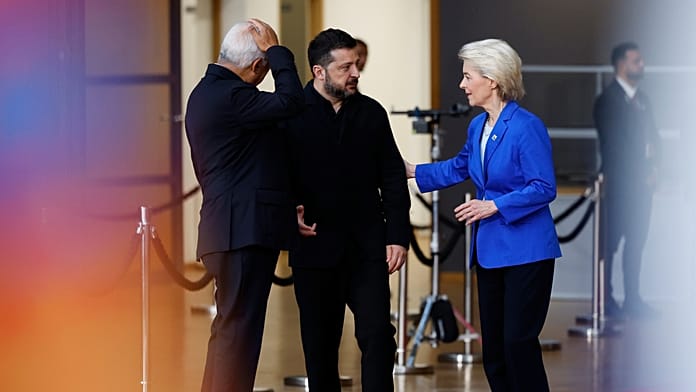
The European Union is scrambling to find an additional €70 billion for Ukraine next year, after Russia’s escalating assault on the country and its economy rendered the bloc’s existing financial support plans insufficient.
At the end of a two-day summit last week, EU leaders heard directly from Ukrainian President Volodymyr Zelenskyy about the scale of the shortfall.
“The war will cost €155 billion next year. And we need at least €70 billion more from you: for defence, for weapons, and for our resilience. This is a realistic amount. And I ask you to find this support. It will help us hold Russia back,” he said.
According to Zelenskyy, the extra injection of cash will help Ukraine ramp up domestic production of its cutting-edge drones to stop Russia’s advances on the battlefield, disrupt its supply chains and undercut its war apparatus.
“We really need at least €70 billion additionally for next year,” he added.
The appeal struck a chord. EU leaders tasked the European Commission with exploring ways to plug the gap, which is considerably larger than Brussels had anticipated.
Until now, the bloc based its support on the €90 billion loan that leaders signed off last December. The loan was designed to cover two-thirds of Ukraine’s financial and military needs for 2026 and 2027 combined, with other allies covering the remaining third.
Crucially, the Commission devised the loan assuming that the war would end sometime in 2026. Instead, Moscow has intensified its offensive, including daytime attacks aimed at crippling Ukraine’s already fragile economy.
Kyiv has spent weeks warning that it will need an additional $32.6 billion to support its budget and $45 billion for its armed forces next year – a combined $78 billion, or approximately €70 billion.
Brussels initially declined to comment on the staggering figure. But after several rounds of technical discussions, it has accepted the estimate and concluded that the money must be found if Ukraine is to sustain its war effort.
The €70 billion would come on top of the €45 billion the EU plans to disburse under its existing loan, as well as several billion euros from other programmes.
Faced with a swelling bill, Brussels has been quick to stress that the €70 billion will be a “joint effort” with other allies, such as the UK, Norway, Canada and Japan.
“We always said that we cannot walk this alone. We cannot do this all alone. Therefore, our partners in general must step up,” a Commission spokesperson said.
“They have to come forward with pledges, and they have to deliver on those commitments. This is very important.”
It is not yet clear how much of the €70 billion the EU will provide, given that the previous split of two-thirds vs one-third has not worked out as planned. Nor is it clear how quickly Kyiv will need the money. What is clear is that the options for raising such a vast sum at short notice are severely limited.
Adding to the pressure, the high-stakes negotiations will unfold in parallel with the bitter fight over the next long-term budget and the lead-up to the French presidential election, where frontrunner Marine Le Pen has vowed to end all aid to Ukraine.
Tapping the markets
Raising fresh joint EU debt on the financial markets, as Brussels is already doing for the €90 billion loan, currently appears the most likely option, according to diplomats and officials. The Commission could increase the existing credit facility, effectively extending the current financing arrangement.
The bloc, with its stable AAA credit rating, has become an in-demand bond issuer since the COVID-19 pandemic, with its auctions often oversubscribed. Mario Draghi, the former Italian Prime Minister and ECB President, has called for large-scale borrowing.
The financial landscape, however, has sharply deteriorated since December, when leaders signed off on the loan. Borrowing costs have soared worldwide in response to surging oil prices, rising public debt and strong demand for AI spending.
European countries have been hit particularly hard, especially those already heavily indebted. Belgium is now borrowing at rates comparable to Greece, while France is paying more than Italy.
This makes the prospect of fresh debt politically sensitive, even difficult, as it would add to the mounting pile of interest payments.
Yield on the bloc’s 10-year bond has risen from 2.8% in January to 3.44% in September – a significant increase, although less pronounced than in many other markets.
“This is a dynamic that affects all insurers around the world, and our relative position importantly has not deteriorated,” the Commission spokesperson said.
“We remain an extremely competitive issuer.”
If joint borrowing emerges as the main option, several countries are expected to opt out.
Hungary, Slovakia and the Czech Republic are already exempted from the €90 billion loan. At last week’s summit, Slovak Prime Minister Robert Fico said he and his Hungarian counterpart, Péter Magyar, had agreed to maintain the policy.
“If they (other countries) want to provide a loan to Ukraine, they can do so, but at least two countries are indicating at this point that we will not participate in this financial mechanism,” Fico said. “We show solidarity in other ways.”
Another country likely to sit it out is Bulgaria, whose new prime minister, Rumen Radev, has repeatedly criticised the bloc’s military assistance to Ukraine.
Tapping assets
In recent weeks, several countries have floated an alternative avenue to equip Ukraine with long-lasting financial firepower: the immobilised assets of the Russian Central Bank, worth a massive €210 billion across the bloc’s territory.
Sweden, the Netherlands, Spain and Poland revived the debate in August. The Nordics, the Baltics, Germany and Ireland have since expressed support.
These are the same countries that last year pushed the hardest to channel the assets into a zero-interest credit for Ukraine. For the most part, they are the largest bilateral donors to Ukraine and see the assets as a way to ensure genuine burden-sharing.
The project failed when it bumped into Belgium’s fierce resistance, which holds €185 billion of these assets in Euroclear, a depository in central Brussels.
Belgian Prime Minister Bart De Wever warned that using the assets would amount to confiscation and have catastrophic consequences for the country. He demanded the total mutualisation of risks and uncapped guarantees against all possible liabilities.
Leaders recoiled at the prospect of bailing out Belgium’s banking system and, at the last minute, opted for joint debt to set up the €90 billion loan.
Despite that setback, supporters of using the Russian assets have not abandoned the idea. Ukraine has consistently brought the topic into the conversation.
Zelenskyy said that if Europe does not use them, Russia would seek to retrieve them. (The US has reportedly pitched a plan to partially release the assets as an incentive for Russia to engage in the peace talks, but Europeans shot it down.)
“The main priority is that Russia doesn’t have the opportunity to influence later on the discussion on these assets, because we know very clearly they want to bring these assets back,” Zelenskyy said last week. “It’s one of Russia’s aims.”
De Wever remains firmly opposed. During the summit, the Belgian premier, on his own initiative, took the floor to tell his peers that his objections remained unchanged, EU News understands. He argued the money should be kept firmly locked in until the end of the war to prevent external meddling by Moscow or Washington.
The message was received. Officials and diplomats left the summit with the impression that the assets had little chance of succeeding this time around.
The failure of last year’s proposal remains fresh in their minds. France and Italy, whose support would be crucial, are still considered reluctant to use the assets.
Belgium’s position is even more entrenched. It opposes not only tapping the sovereign funds but also transferring them from Euroclear to an EU-owned custodian, a legal workaround that some have promoted to break the impasse.
“The issue will be coming up over and over. Eventually it may find a resolution. I don’t think short-term it’s going to be on the agenda, like this month or the next one,” Katarína Mathernová, the EU ambassador to Ukraine, told EU News.
“While the assets remain frozen and they are in Europe and under our regime and now under European jurisdiction, they certainly are for the leaders to discuss in the future. And I think that will happen, but not in the short term.”