



Media Lens: Trump Reduces Military Exercises with South Korea Amid North Korea Dialogue
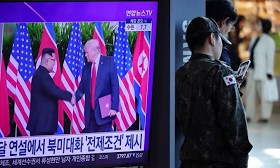
Donald Trump announced a reduction in military exercises with South Korea, responding to North Korea’s leader, Kim Jong-un. The announcement follows Trump citing Kim’s favorable replies to his overtures.
Quick links: What has happened | Status quo | Confirmed facts | Preconceptions | Elisions | One story, four angles | Related links
What has happened
On August 17, 2026, Donald Trump made headlines by scaling back military exercises with South Korea, citing a new approach to diplomacy with North Korea. This decision came during a period of increased interaction between Trump and North Korean leader Kim Jong-un, with Trump asserting that Kim had responded positively to his overtures.
The announcement raised concerns among South Korean officials regarding the potential implications for regional security and the stance towards North Korea. Analysts noted that the reduced exercises could alter the military dynamics on the Korean Peninsula and impact U.S.-South Korea relations.
Status quo
The current geopolitical situation between the United States and North Korea has been complex, particularly regarding military exercises. Under Donald Trump’s administration, changes to military drills in conjunction with South Korea were reported, aiming to ease tensions. Recent reports indicate Trump’s adjustments to these exercises amid ongoing diplomatic discussions concerning nuclear disarmament with North Korean leader Kim Jong-un.
Confirmed facts
- Donald Trump has scaled back military exercises with South Korea.
- There is a strain in the U.S. alliance with South Korea due to Trump’s overtures to North Korea.
- Democratic senators have criticized Trump’s praise of North Korea as “delusional.”
- North Korea responded to Trump’s overtures, according to reports.
Preconceptions
- **Reuters** prioritizes the immediate diplomatic nuances by focusing on North Korea’s response to Trump’s gestures, highlighting his direct communication with Kim Jong-un.
- **The New York Times** emphasizes the strain on U.S.-South Korea relations, detailing concerns from South Korean officials about Trump’s overtures toward North Korea.
- **The Hill** reduces attention to Trump’s policy implications, instead focusing on criticism from Democratic senators, framing it within a partisan narrative of delusion regarding Trump’s views on North Korea.
- **The Atlantic** underscores the broader implications of Trump’s actions on U.S.-South Korea dynamics, framing it within a historical context of alliance challenges rather than merely immediate diplomatic exchanges.
Elisions
- The coverage from *The New York Times* highlights tensions between Trump’s overtures to Kim Jong-un and its impact on the U.S.-South Korea alliance, a critical aspect not discussed in the reports from *Reuters* or *The Hill*.
One story, four angles
Reuters – Donald Trump scales back military exercises with South Korea
Publication: Reuters | Intensity: (7/10) | Sentiment: Neutral | Legal precision: Moderate
Expand
Espresso Shot: The lead highlights Trump’s decision to scale back military exercises, suggesting a shift in U.S.-Korea relations.
Key differences:
– **Comparison**: While Reuters frames it as a scaled-back initiative, The New York Times emphasizes strain on alliances.
– **Example**: Reuters uses “scales back military exercises” versus NYT’s “strains alliance.”
– **Comparison**: Language choice; Reuters’ tone conveys neutrality, contrasting with The Hill’s critical stance on Trump’s praise for Kim.
– **Example**: Reuters’ “scales back” contrasts with The Hill’s “delusional” characterization.
Bias: Selection: Chooses factual wording, avoiding conjecture about motives | Language: Neutral descriptors like “scales back” vs. The Hill’s “delusional” | Omission: Lacks critique of broader implications for regional security.
Assessment: Readers are likely to perceive Trump’s actions as a tactical adjustment rather than a political crisis.
The New York Times – Trump’s Overture to Kim Jong-un Strains Alliance With South Korea
Publication: The New York Times | Intensity: (8/10) | Sentiment: Negative | Legal precision: High
Expand
Espresso Shot: Focus on how Trump’s outreach may jeopardize U.S.-South Korea relations, highlighting political repercussions first.
Key differences:
– **Comparison**: NYT highlights alliance strain versus Reuters’ focus on military exercise changes.
– **Example**: “Strains Alliance” evokes urgency absent in Reuters.
– **Comparison**: Language reflects a critical stance on Trump’s decisions.
– **Example**: New York Times utilizes layered phrases like “overture” and “jeopardizing relations” instead of straightforward reporting.
Bias: Selection: Chooses to emphasize accusations and implications over neutral reporting | Language: Leans towards portraying an alarmist view of Trump’s policies | Omission: Understates any supportive reactions from military or diplomatic channels.
Assessment: Readers are led to believe Trump’s interactions might threaten established alliances critically.
The Hill – Democratic senator: Trump’s praise of North Korea is ‘delusional’
Publication: The Hill | Intensity: (9/10) | Sentiment: Negative | Legal precision: Low
Expand
Espresso Shot: The opening highlights strong language from a senator, implying a crisis of trust and credibility around Trump’s policy.
Key differences:
– **Comparison**: The Hill focuses on critiques of Trump’s approach, diverging from the neutral stance of Reuters.
– **Example**: Utilizes “delusional” to convey strong disagreement, emphasizing political dissent.
– **Comparison**: Language choice in The Hill is harsher, reflecting partisan criticism.
– **Example**: The phrase “praise” denotes a negative judgment versus the neutral “scaled back” in Reuters.
Bias: Selection: Focuses solely on critiques without balance from supporters or neutral voices | Language: Strongly negative descriptors such as “delusional” reflect bias | Omission: Lacks supportive commentary or neutral context on Trump’s military policies.
Assessment: Readers may first believe that Trump’s policies are widely condemned and politically reckless.
The Atlantic – Trump Will Make South Korea Pay for His Iran Humiliation
Publication: The Atlantic | Intensity: (8/10) | Sentiment: Critical | Legal precision: Moderate
Expand
Espresso Shot: First highlights Trump’s economic approach to foreign relations, predominantly focusing on transactional rhetoric.
Key differences:
– **Comparison**: The Atlantic paints Trump’s policy as financially motivated rather than diplomatically sound.
– **Example**: The phrase “make South Korea pay” conveys a stark transactional view.
– **Comparison**: Language reflects a satirical tone, contrasting with the seriousness in the New York Times.
– **Example**: Phrases like “Iran humiliation” links policies to broader failures.
Bias: Selection: Focuses on majorly negative aspects and repercussions of Trump’s decision-making | Language: Uses charged rhetoric, criticizing economic motivations | Omission: Lacks references to any successful diplomatic outcomes achieved under Trump’s administration.
Assessment: Readers may perceive Trump’s foreign policy as financially exploitative and detrimental to alliances.
The New York Times highlights Trump’s diplomatic overtures to Kim Jong-un as potentially straining U.S.-South Korea relations, adopting a cautious stance. In contrast, Reuters frames the situation as a significant scaling back of military exercises, suggesting a critical shift in U.S. policy. While The Hill’s coverage focuses on political backlash against Trump’s praise of North Korea as ‘delusional,’ The Atlantic notes that Trump is prioritizing personal diplomacy over established alliances. The strongest framing comes from The New York Times, while Reuters presents the most escalatory perspective. The facts do not change. What changes is where scrutiny lands.
Related links
Reuters
Trump says North Korea’s Kim has responded to his overtures
The New York Times
Trump’s Overture to Kim Jong-un Strains Alliance With South Korea
The Hill
Democratic senator: Trump’s praise of North Korea is ‘delusional’