



Get you up to speed: Alaska Sen. Dan Sullivan’s primary challenger who has the same name is eligible for ballot, judge rules
A judge in Alaska ruled that Dan J. Sullivan is eligible to challenge incumbent U.S. Senator Dan Sullivan in the August primary, overturning a prior decision by the Division of Elections. The ruling can be appealed, and the state has until Tuesday to seek a final decision before printing ballots for the August 18 primary.
A judge has ruled that Dan J. Sullivan is eligible to run against incumbent U.S. Senator Dan Sullivan, overturning a previous disqualification by the Division of Elections. The state Division of Elections plans to appeal the ruling, with a deadline for a final decision set for Tuesday to ensure ballots are printed for the August 18 primary.
Superior Court Judge Thomas Matthews ruled that Dan J. Sullivan is eligible to challenge incumbent Senator Dan Sullivan in the upcoming August primary, overturning an earlier disqualification decision by the Division of Elections. The state Department of Law confirmed it will appeal the ruling, with a deadline for resolution set for Tuesday to ensure ballot printing for the August 18 primary.
What remains unclear — It is uncertain whether the Division of Elections will successfully appeal the judge’s ruling by the Tuesday deadline.
Challenger Dan J. Sullivan eligible for primary ballot against Sen. Dan Sullivan, judge rules
A man with the same name and party affiliation as Alaska Republican U.S. Sen. Dan Sullivan is eligible to challenge the senator in the August primary, a judge ruled Friday.
Superior Court Judge Thomas Matthews’ ruling overturns a June 15 decision by Division of Elections Director Carol Beecher to disqualify the challenger and keep him off the primary ballot. Matthews’ ruling can be appealed to the state Supreme Court.
Attorneys for the state have said Tuesday is the deadline for a final ruling so that ballots for the Aug. 18 primary can be printed.
The judge ruled that the division’s decision to exclude Dan J. Sullivan because his candidacy was not “in good faith” was not based on the Constitution, Alaska law or the division’s own regulations. The retired teacher from the small fishing community of Petersburg filed to challenge the incumbent.
Katie Holmlund/AP Photo 
“Instead, the decision was based upon a new, previously unstated, ‘good faith’ criteria,” the judge wrote.
The division is appealing the decision, Sam Curtis, a spokesperson with the state Department of Law, said by email Saturday. Jeffrey Robinson, an attorney for Dan J. Sullivan, said in an email he expected the division to appeal and couldn’t comment until the Alaska Supreme Court rules on the case.
The controversy over the two Dan Sullivans has underscored the stakes involved in the incumbent’s reelection campaign. The Alaska race is one of about half a dozen U.S. Senate races expected to be highly competitive in the fall, and the seat is one Democrats are trying to flip in their efforts to try to regain the majority. But it’s expected to be an uphill battle in a state that President Trump won by 13 points in 2024.
The senator and allies, including the National Republican Senatorial Committee, have condemned the challenger’s efforts to join the race, arguing his presence could confuse voters. Republican Lt. Gov. Nancy Dahlstrom earlier this month opened an investigation into the non-Senator Sullivan’s candidacy.
Under Alaska’s election system, the top four candidates from the primary, regardless of party, move on to the ranked-choice November general election.
The senator has accused the challenger Sullivan of working with Democrats and the campaign of Democratic former U.S. Rep. Mary Peltola — who is considered the senator’s main opponent — to cause confusion and boost Peltola’s chances. The sitting senator brought the situation to reporters’ attention at the Capitol earlier this month, accusing Democrats of being “complicit in trying to trick Alaskans” to “rig an election in their favor.”
Mark Schiefelbein/AP Photo 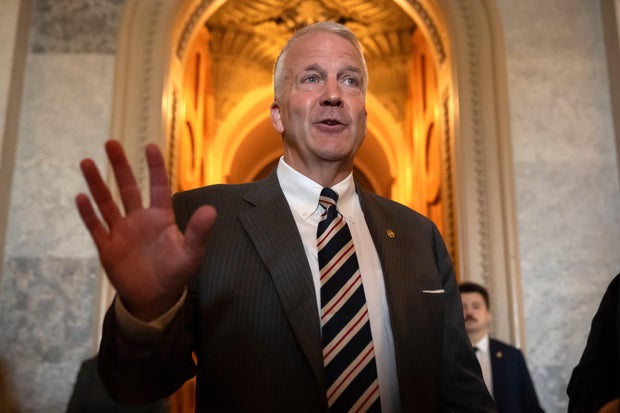
Peltola’s campaign and state Democrats have denied the allegation, as has the challenger.
Sen. Sullivan and Peltola are the highest-profile candidates in the crowded race and the only ones to report raising any money.
Beecher has said she determined the challenger Sullivan is not eligible to run because his candidacy was not filed in good faith and instead was done with an intent to confuse voters. She said he had registered to vote as Daniel J. Sullivan Jr. and, in conjunction with his candidacy, changed his party affiliation to Republican. She also cited similarities between his campaign website and the senator’s, and his work with a consultant whose clients have included some Democrats. She did not mention finding any evidence of alleged coordination.
In arguing to keep the challenger disqualified, attorneys for the state pushed back on suggestions the ballot could be designed in a way to reduce voter confusion over two candidates with the same name and party running for the same office.
“The Constitution does not require States to place a sham candidate on the ballot and then attempt to mitigate the damage through design choices,” attorney Rachel Witty, with the Alaska Department of Law, and outside attorneys Christopher Murray and Michael Francisco wrote in court filings.
Attorneys for the challenger Sullivan argued that the Constitution lays out three exclusive qualifications for the Senate, addressing only age, citizenship and residency. They said Beecher lacked the legal authority to boot their client off the ballot.
The challenger Sullivan has said that sharing a name and party affiliation with the incumbent gave him “an instant megaphone.” But the 69-year-old retired teacher and former U.S. Forest Service employee said he had considered a run for some time and had grown frustrated with the senator.
He initially was certified on the state’s candidate list as Dan J. Sullivan, with the senator listed as Dan S. Sullivan and identified as the incumbent.