



TL:DR – Dessintey Generates Nearly €10 Million Revenue with Rehabilitation Technology
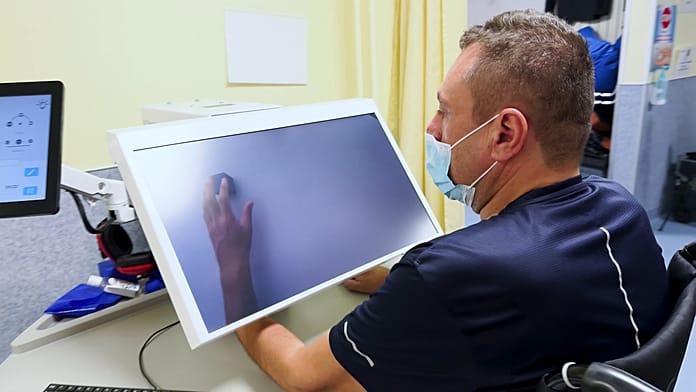
• Dessintey, founded in 2017, develops neuroscience-based motor rehabilitation platforms using mirror therapy techniques, according to co-founder Davy Luneau.
• The company targets a diverse user base, including stroke survivors and amputees, as stated by Professor Pascal Giraux, head of adult rehabilitation at CHU Saint-Étienne.
• Dessintey generates nearly €10 million in revenue and operates across Europe, Asia, and the Middle East, as noted by CEO Nicolas Fournier.
• The company faces competition from US technologies and emerging Asian firms, highlighting the importance of innovation for success.
Dessintey: The Saint-Étienne Success Story Changing Medical Rehabilitation
Dessintey Develops Innovative Rehabilitation Devices
Dessintey, a company founded in 2017, has created neuroscience-based motor rehabilitation platforms, including devices that utilise mirror therapy. Davy Luneau, co-founder and product expert, explained on 6 February 2026 that “we film the patient’s unimpaired limb and flip the image so the patient can see their paralysed limb move again”. This method aims to stimulate brain plasticity and enhance motor recovery for a diverse range of users, including stroke survivors and amputees.
Immediate Impact of Devices on Rehabilitation
Dessintey’s co-founder, Professor Pascal Giraux, who is also head of adult rehabilitation at CHU Saint-Étienne, noted that the company began with scientific testing of its devices. “We started the business to offer these therapeutic options to as many patients as possible, since there were no companies capable of industrialising such devices,” he said. This commitment to accessibility highlights the significance of Dessintey’s work in the rehabilitation field.
Expansion and Competition in the Market
Currently, Dessintey sells its devices across Europe, Asia, and the Middle East, generating nearly €10 million in revenue. Nicolas Fournier, the third co-founder and CEO, stated that “our network of local partners makes us more efficient in product development”. He acknowledged competition from emerging technologies in the United States and Asia, emphasising that “the only way to succeed and stay ahead is through innovation.”
“