



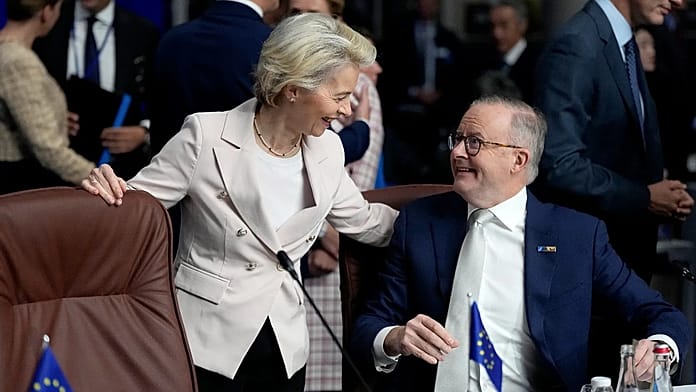
TL:DR – Ursula von der Leyen to Visit Australia in Bid for Trade Agreement This Month
• European Commission President Ursula von der Leyen will visit Australia later this month to advance a long-delayed trade agreement.
• The trip is likely after the Munich Security Conference, concluding on 15 February.
• Negotiations led by EU Trade Commissioner Maroš Šefčovič with Australian Trade Minister Don Farrell will determine the trip’s success.
• Talks on the EU-Australia free-trade agreement collapsed in 2023 due to market access disputes.
• Agriculture is a critical issue impacting EU trade negotiations, particularly concerning beef and dairy.
Von der Leyen to travel to Australia to seal trade deal
European Commission President Ursula von der Leyen is scheduled to visit Australia later this month in an effort to finalise a long-delayed trade agreement, according to sources familiar with the matter.
This visit, anticipated shortly after the Munich Security Conference concludes on 15 February, is significant as concluding the deal would bolster the Commission’s trade achievements amid escalating geopolitical tensions with the United States and China.
The importance of this agreement lies in the European Union’s broader strategy to diversify trade relationships and enhance access to global markets.
The visit’s success will depend on the outcomes of negotiations led by European Union Trade Commissioner Maroš Šefčovič, who is set to meet Australian Trade Minister Don Farrell in Brussels next week.
Earlier discussions on an EU-Australia free trade agreement collapsed in 2023 after Australia accused the European Union of not providing adequate market access for essential agricultural products.
Agriculture issues continue to pose challenges in EU trade negotiations, as seen with the controversial Mercosur agreement that has faced strong opposition from European farmers concerned about competition. Despite these challenges, Australia is regarded in Brussels as a vital strategic partner in the EU’s efforts to reduce reliance on traditional markets.