
Latest News
- European leaders address rising oil prices amid Saudi supply disruptions
- Asian Games faces accommodation crisis as athletes seek housing solutions
- Multiple Canadian police forces experience 911 outages, some service restored
- House passes Russia sanctions bill with bipartisan support despite Democratic opposition
- Amnesty International reports on climate actions: how coverage differs
- Delays and cancellations affect London Euston rail services due to track defects
- Daughter of woman killed by Iranian forces calls for justice from Andy Burnham
- Piddington votes to secede from the UK in protest against asylum plans



A Black Lives Matters protest in London regarding Chris Kaba.
Looks like the white, middle class organisers forget to invite any black people.

In the wake of death of UK political prisoner, Peter Lynch, who was fast tracked into prison for essentially shouting in the street.
The grandfather was ultimately sentenced to death.
Pakistani family who attacked police at Manchester Airport, STILL haven't even been charged.

Tiny ‘Black Lives Matter’ crowd gathers outside the Old Bailey courtrooms to protest the not guilty verdict of the police officer who shot violent criminal Chris Kaba.
Kaba rammed his car repeatedly into armed police officers’ cars.
BLM is finished in the UK.
European leaders address rising oil prices amid Saudi supply disruptions
Pipeline Closure
Saudi Arabia has temporarily closed the 1,200-kilometre East-West oil pipeline due to Houthi and Iraqi attacks, threatening up to 4% of global oil supply.
Saudi Arabia has temporarily closed the 1,200-kilometre East-West oil pipeline due to Houthi and Iraqi attacks, threatening up to 4% of global oil supply.
Global Supply Threat
Saudi pipeline disruptions could jeopardise up to 4% of the global oil supply, exacerbating inflation and impacting energy prices across Europe amidst rising geopolitical tensions.
Saudi pipeline disruptions could jeopardise up to 4% of the global oil supply, exacerbating inflation and impacting energy prices across Europe amidst rising geopolitical tensions.
Official Response
“We’re working with our coalition partners to ensure freedom of navigation in the Strait of Hormuz,” stated French President Emmanuel Macron, emphasising the importance of securing oil supplies amid global disruptions.
“We’re working with our coalition partners to ensure freedom of navigation in the Strait of Hormuz,” stated French President Emmanuel Macron, emphasising the importance of securing oil supplies amid global disruptions.
European leaders rush to counter looming diesel price surge as Saudi pipeline attacked

European leaders are once again rushing to mitigate rising oil prices as Saudi cargoes are delayed or cancelled amid another conflict escalation in the Middle East, raising fears of soaring prices at the pump across many capitals.
The latest shock is coming from Saudi Arabia, where Houthi and Iraqi attacks have forced the temporary closure of the 1,200-kilometre East-West oil pipeline – a crucial route designed to bypass the Strait of Hormuz.
The disruption threatens as much as 4% of global oil supply if it persists, this after Saudi crude output fell sharply in August to its lowest level in more than three decades. Meanwhile, Brent crude oil recently traded above $113 a barrel due to mounting supply risks.
For France and Italy, both of which will hold crucial elections in 2027, high energy prices are a major domestic political issue, as voters are preparing to judge governments on purchasing power.
Rising energy and fuel costs in France are already feeding into consumer anxiety, with inflation reaching 2.7% in August and energy among the main drivers. Italy faces a similar problem, with August inflation accelerating to 3.3%, driven heavily by energy, while petrol and diesel prices have climbed sharply.
French diplomacy
On Wednesday evening, French President Emmanuel Macron ordered a “mobilisation” to tackle fuel prices, while saying France is working to secure oil supplies and reduce pressure on motorists.
Macron has also linked energy security directly to diplomacy in the Middle East, arguing after talks with Iraq’s prime minister this week that alternative routes around Hormuz and regional de-escalation are necessary to protect French consumers.
“The priority: restoring freedom of navigation in the Strait of Hormuz, a vital artery for oil transit, protecting the energy infrastructure of our partners, and securing production. It’s essential to guarantee our supplies. We’re working with our coalition partners to ensure freedom of navigation in the Strait of Hormuz,” Macron wrote on X.
The French President added that ongoing work alongside “our coalition partners for freedom of navigation” through Hormuz aims to open alternative routes to reduce dependence on the vital waterway and secure supplies.
Italy scraps car taxes
Meanwhile, Prime Minister Giorgia Meloni announced overnight the abolition of the stamp duty imposed on small and medium-powered cars, which she described as one of the taxes most hated by Italians.
“We have chosen to redirect a portion of the resources used so far to address rising fuel prices into a simple, structural measure designed especially for those who use cars and motorcycles every day to work, take their children, or get around,” Meloni wrote on X.
The Italian leader stressed that the car tax will remain beyond 2027, noting the measure is designed to be “structural and permanent”. Meloni has also asked the European Commission to treat the energy crisis like a defence emergency and relax fiscal rules that member states must comply with.
At the same time, Rome has already adopted measures to accelerate domestic oil and gas projects, explicitly presenting increased production as part of a broader energy-security response.
Spain doubled its diesel tax cut to 20 cents a litre from September 1 after diesel prices jumped 15.7% in July, activating an automatic mechanism in the government’s anti-crisis package. Spanish Economy Minister Carlos Cuerpo is meeting with social partners in Madrid on Thursday to assess the war’s impact on Spain.
Germany coming soon
Chancellor Friedrich Merz said recently that Berlin will “soon” present measures to ease the impact of record fuel prices. Petrol and diesel prices stood at €2.45 per litre on Thursday, according to the General German Automobile Club.
However, just like any other nation, Germany’s exposure to imported energy means the government has little ability to control the underlying international price. After losing a tremendous number of seats in the latest regional election to the far-right Alternative for Germany, Merz’s Christian Democrats must strike a delicate balance to avoid alienating its electorate further.
Merz also framed the problem as one requiring international coordination, warning that the expansion of Houthi control around the Bab el-Mandeb threatens Saudi and other regional oil exports and further tightens global energy markets.
“The Houthis now control strategic positions around the Bab el-Mandab Strait and are attacking energy facilities in Saudi Arabia; this further exacerbates the situation in international energy markets,” Merz told a press conference on 14 September.
Pricing issue
Asked whether Europe is approaching a potential supply shock, a Commission spokesperson said pricing is the major crisis rather than diesel shortages, noting that no member state has so far raised any security of supply concerns.
“There is no supply problem in the EU at the present time,” Commission Spokesperson Anna-Kaisa Itkonen told EU News. “Demand for jet fuel and diesel in Europe continues to be met through higher EU refinery production, as well as alternative supplies from global markets.”
However, Itkonen acknowledged that the evolution of the conflict in the Middle East, as well as usual autumn and winter demand trends, could impact the coming weeks and months and further tighten markets.
“We’re not yet in a situation where we’ll be tapping strategic resources, and we keep monitoring the situation alongside member states and the industry,” she added.
Nonetheless, the Commission said that it has been encouraging EU countries to cushion prices through taxation, which plays a big role in determining energy prices, noting that it is beyond its power to influence global oil prices.
Homayoun Falakshashi, head of crude oil analysis at the market intelligence firm Kpler, said the Saudi disruption – which runs as high as 5.5 million barrels per day – could be less bad than expected, as the Saudis have said work on the damaged pipeline has started.
“Up to 3.5-4 million barrels per day of exports are at risk, but also some 1.5 million barrels per day that feed western Saudi refineries, so it’s also bullish for diesel,” Falakshashi told EU News, referring to a likely price increase regardless of supply.
Nonetheless, Falakshashi said throughput should come back to 3-4 million barrels per day instead of 5.5.
“On the other hand, we are hearing that Yanbu loadings are continuing, but we cannot yet confirm if this is true. So the key question is how much can get loaded from the east coast (Ras Tanura) and if these volumes can escape the Persian Gulf.”
Momentum for windfall profit tax
With soaring prices and rising inflation, the call for a windfall profit tax is gaining traction, with several EU lawmakers and EU leaders mentioning it on the sidelines of Ursula von der Leyen‘s speech at the State of the Union on 16 September.
During her address to the plenary in Strasbourg, the leader of the centre-left Socialists and Democrats group, Iratxe García Pérez, proposed introducing a windfall tax on energy companies to finance a social support scheme.
“Trump and Netanyahu’s war against Iran has strengthened the ayatollahs and sent the cost of living soaring,” she said. “Let’s accelerate renewables. And let’s get those who benefit from this crisis to contribute.”
García said the contribution would be used to help fragile households pay their electricity bills, fill their shopping carts, put petrol in their cars and heat their homes.
Her remarks were echoed by those of her Green counterpart, Terry Reintke, who argued energy companies continue to profit from Europe’s extraordinary energy crisis, leaving the big bill for consumers to foot.
In August, Germany, Spain, Portugal, Italy, Poland and Austria asked Ireland’s EU Presidency to put an EU-wide windfall-profit mechanism on the agenda of the September finance ministers’ meeting, which will be held on 22 September.
Esther Lynch, General Secretary at the European Trade Union Confederation representing millions of workers in the EU, said the introduction of windfall taxes is a “matter of justice” needed to stop price gouging and relieve the cost pressure on working people.
“It has been clear for some time now that energy companies are exploiting the geopolitical crisis to cash in at the expense of working people suffering a prolonged cost-of-living crisis,” Lynch told EU News.
Get you up to speed: What’s the Asian Games accommodation crisis, and where will athletes stay?
The Aichi-Nagoya Asian Games are underway amid a housing crisis due to Japan’s decision not to construct a dedicated athletes’ village, leading to reliance on temporary accommodation options. Complaints from participating nations, including South Korea, highlight issues such as cramped sleeping arrangements and inadequate facilities for athletes.
This year’s Asian Games will feature 17,000 competitors and officials, exceeding earlier projections by 2,000 due to newly added sports. Organisers are currently coordinating temporary accommodations in response to complaints from various national teams regarding room assignments and facility conditions.
Japanese officials, including chief organiser Hideaki Omura, have pledged to enhance accommodations for athletes amid ongoing dissatisfaction, stating, “If there are different opinions, then we will respond to them appropriately.” In addition, the Japanese Olympic Committee (JOC) is coordinating adjustments for accommodation challenges and is prepared to activate backup options, including hotels arranged prior to the Games.
What remains unclear — It is uncertain how the organisers plan to address the ongoing accommodation complaints from athletes and officials ahead of the Asian Games.
Asian Games faces accommodation crisis as athletes seek housing solutions
EXPLAINERSport|HousingWhat’s the Asian Games accommodation crisis, and where will athletes stay?
In a cost-cutting move, Japan decided against setting up a dedicated athletes’ village but now faces a backlash.
Published On 17 Sep 202617 Sep 2026
 Published On 17 Sep 202617 Sep 2026
The Aichi-Nagoya Asian Games get under way this weekend under the shadow of a housing crisis that has organisers scrambling to placate athletes and officials from participating nations.
The tournament has been mired in complaints over housing options for athletes travelling to Japan, after the host nation decided not to build a dedicated Games village for the 17,000 competitors and officials.
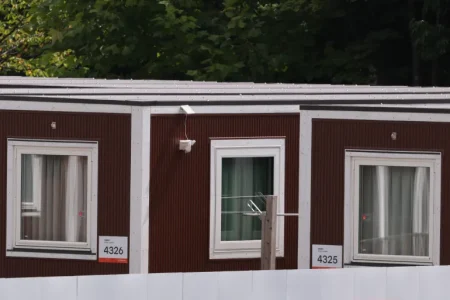
To cut costs this year, organisers are relying on a cruise ship, temporary wooden cabins and hotels, but this temporary accommodation has met with criticism in the days leading up to the continental competition.
On Monday, South Korean officials slammed beds in shipping container-style huts as the “worst-ever”, as the South Korean basketball chief said the beds were too short to stretch out in.
Here’s everything we know:
Why are the Asian Games facing an accommodation crisis?
The official housing committee said the issue arose because they expected 15,000 athletes and officials, but numbers increased as new sports were added.
This year’s Games will feature several newcomers, including mixed martial arts, padel and surfing, as well as virtual taekwondo and teqball, which combines aspects of football and table tennis.
Ahead of the Games’ opening, chief organiser Hideaki Omura said efforts are being made to ensure athletes are comfortable.
“If there are different opinions, then we will respond to them appropriately,” Omura, who also serves as governor of Aichi prefecture, told the AFP news agency.
“At this point, while we are responding to individual opinions, we have been improving everything as issues arise, and we will continue to respond that way.”
He added that a committee of former athletes, including Olympians, gave a favourable assessment of the plans for the huts built this year.
“We explained everything to them and had them take a look around, and they said it looked functional and good,” he said.
 Temporary wooden container huts being used to house athletes [David Gray/AFP]
Where will the Asian Games athletes stay?
Alternative housing options range from a cruise liner and wooden containers to hotel rooms.
On Tuesday, the Italian cruise ship, Costa Serena, which will host 4,000 athletes and officials, arrived in Nagoya.
The shipping container-style huts in the dock area of Japan’s biggest port will host 2,000 other athletes and officials.
On Thursday, Japan’s deputy Chef de Mission Hisashi Mizutori told a news conference that athletes have been going through entry procedures since the cruise ship village opened a day earlier.
“There have been cases where coaches, team officials and athletes have been assigned to the same room. There are also situations where room assignments were made purely based on the numbers, such as assigning five twin rooms for a group of five men and five women,” Mizutori said.
“While the numbers match on paper, practically it creates challenging situations such as men and women being assigned together, coaches being assigned with athletes, or trainers who need to accommodate a lot of medical equipment being assigned together.”
He added that the Japanese Olympic Committee (JOC) had also anticipated accommodation “challenges” and secured hotels in the city as a backup.
“We are currently working to coordinate and negotiate adjustments wherever possible. For cases where that proves too difficult, we are considering using the backup accommodations that Team Japan prepared in advance as alternatives.”
Why are participating nations and athletes complaining about the accommodation?
Jung Jae-yong, vice president of the Korea Basketball Association (KBA), slammed the cabins hosting the men’s basketball team.
“Athletes who are over two metres tall cannot even stretch their legs out on the beds. It’s unreasonable.”
Jung also accused the organisers of failing to respond to South Korea’s concerns about the housing options.
“The organisers have still not said anything,” he said, adding: “We are very concerned and discussing extensively with the Korean Sport and Olympic Committee what to do about this.”
Player Byeon Jun-hyeong, from the basketball team, posted a video on social media showing a leaking sink and a soaked floor in his hut.
“Please help us,” he posted.
Philippine Olympic Committee president Abraham Tolentino also said that while all his athletes had been given a room, “some officials, like coaches, were moved to different hotels and Airbnb”.
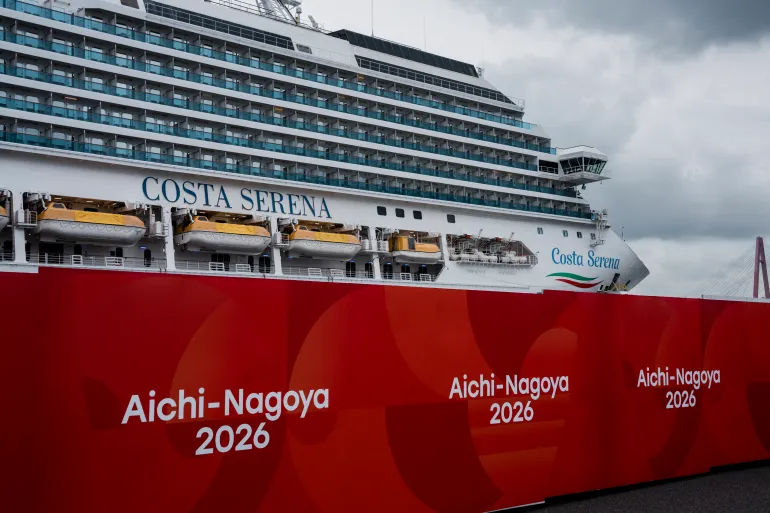 The Costa Serena, a 290-metre-long cruise ship that will be used as an accommodation facility for athletes and officials during the 2026 Asian Games, is docked at the Port of Nagoya [Fred Mery/AFP]
Why will cricketers get the best accommodation at the Asian Games?
Head of Japan’s cricket association, Naoki Alex Miyaji, said in early September that cricket would get better accommodation than other sports.
According to Miyaji, the cricket tournament is being run by the Asian Games organising committee in collaboration with the Asian Cricket Council.
He said that the two bodies had been discussing accommodation options “for a long time”.
“The participating teams in cricket are being offered hotel accommodation,” Miyaji said.
“Many other sports are being accommodated in much more limited facilities, such as a cruise ship or container hotels.”
What other issues have hit the Asian Games?
While the opening ceremony has yet to take place, several events such as basketball, football, cricket, hockey and modern pentathlon have already begun.
On Thursday, Tropical Storm Dujuan was located off Japan’s Pacific coast as of 03:00 GMT and heading northwest towards central Japan, where Nagoya is located.
Last week, torrential rains hit Nagoya and the surrounding areas, forcing schools to close and suspending train services. Several hundred athletes were also forced to leave their accommodation.
Kosei Inoue, Japan’s chef de mission for the Games and a senior executive board member of the JOC, said at a news conference on Thursday that some competitions have already experienced “delays or postponements, and there is also a possibility that a typhoon could approach on September 21”.
“Under these circumstances, we are holding thorough meetings within the JOC to ensure that we are fully prepared and capable of responding appropriately to these situations.”
