


Hungary halts oil deliveries from Russia amid Druzhba pipeline damage
Damage to the Druzhba pipeline has halted oil deliveries from Russia to Hungary, impacting a billion-dollar loan to Ukraine.
The Adria pipeline is projected to transport 14-15 million tonnes of non-Russian crude annually, exceeding Hungary’s current reliance on Russian oil imports.
“The government will continue to do everything in its power to ensure a secure and affordable supply for families,” said Zoltán Kovács, spokesperson for Hungarian Prime Minister Viktor Orbán.
Key developments
Damage to the Druzhba pipeline halted oil deliveries from Russia to Hungary and jeopardised a billion-dollar loan to Ukraine, raising concerns over Hungary’s continued reliance on Russian energy.
Hungarian Prime Minister Viktor Orbán reiterated that Russian crude is essential for energy security, although experts from the Centre for the Study of Democracy indicate that Hungary could diversify its energy sources.
The European Commission has proposed a formal inspection and fact-finding mission into the pipeline incident as Hungary faces accusations of delaying repairs and potential sabotage by Kyiv.
Fact check: Does Hungary have alternatives to the Druzhba pipeline?
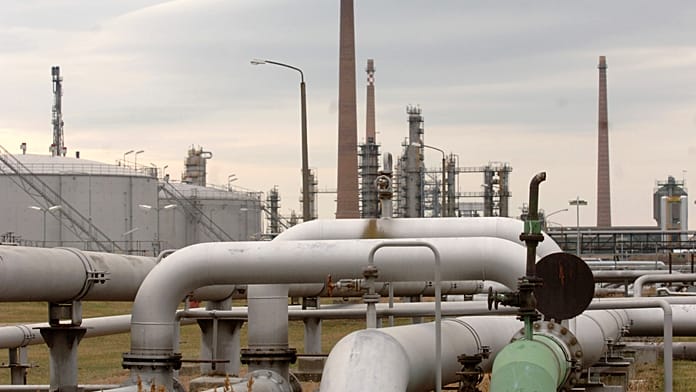
Damage to the Druzhba pipeline, the world’s longest oil conduit and so far exempt from EU sanctions, has halted oil deliveries from Russia to Hungary and threatened to torpedo a billion-dollar loan to Ukraine.
Hungary, meanwhile, has accused Kyiv of sabotage and dragging its heels on repairing the damage. In the midst of the issue, the European Commission has formally proposed an inspection and fact-finding mission into the incident.
The damage to the line, which carries oil from Russia to various points in Eastern European countries, has once again raised eyebrows about why Hungary continues to rely so heavily on Russian energy when so many other EU members have managed to wean themselves off it.
Hungarian Prime Minister Viktor Orbán has long argued that Russian crude is essential for the country’s energy security, and that switching supplies would raise costs and harm efficiency.
However, some experts suggest the picture is more complex. According to the Centre for the Study of Democracy (CSD), while Hungary remains highly reliant on Russian oil, it has ignored warnings to diversify where it gets its energy, has access to viable alternative routes, and continuing to purchase Russian crude has not translated to lower domestic fuel prices for Hungarians on the ground.
EU News’ fact-checking team, The Cube, took a closer look at the claims.
Hungary dependent on Russian oil
Hungary’s primary oil and gas operator, MOL, which refines and produces fuels for Hungary and Slovakia, is the last major buyer of Russian crude in the European Union.
Despite warnings to diversify resources away from Russian oil against the backdrop of the war in Ukraine, the CSD’s analysis suggests Budapest has actually increased its dependence between 2021 and 2025, from 61% to 93%.
Even after the Ukrainian crackdown on pipeline flows targeted deliveries from Russian supplier Lukoil, Hungary avoided following the broader EU trend in making the switch away from Russian crude.
Instead, in September 2025, MOL struck a new crude supply deal that enabled it to take over crude ownership at the Belarus-Ukraine border and continue Lukoil deliveries.
What are Hungary’s alternative oil sources?
It connects the Omišalj Terminal on Croatia’s Krk island in the Adriatic Sea to refineries in Croatia, Slovenia, Hungary, Bosnia and Herzegovina, and Serbia.
According to CSD, transit fees for non-Russian crude imported via this pipeline are lower than those applied to Russian crude oil via the Druzhba pipeline, a difference of €12 per tonne via the Adria pipeline versus €21 per tonne via the Druzhba pipeline.
JANAF insists that the infrastructure has the capacity to meet demand for Hungary and Slovakia.
A spokesperson for the company told The Cube that the pipeline can transport 14-15 million tonnes annually.
“All capacity tests of JANAF’s pipeline system… were carried out in the presence of MOL representatives,” the company said. “The first two tests confirmed that JANAF’s pipeline can meet MOL’s full crude oil requirements.”
JANAF also noted that MOL has used its network for over a decade and is “fully familiar with the capabilities of the pipeline”.
Disputed capacity
Hungary and its state-backed energy company MOL dispute this assessment.
Officials say the Adria pipeline has not been reliably proven to deliver sufficient volumes in practical terms. Oil flows, Hungary says, have typically been closer to 2 million tonnes annually, an amount far lower than JANAF’s projected 14-15.
Data from the Centre for Research on Energy and Clean Air shows that Russian crude is consistently cheaper than alternative supplies. In 2024, Hungary paid on average around €471 per tonne for Russian oil, compared with roughly €564 per tonne for non-Russian crude, a discount of 20%.
Orbán’s spokesperson, Zoltán Kovács, told us that Hungarian refineries are “fundamentally designed to process crude oil from Russian sources”, particularly Russian Urals Crude, on which Hungary has been reliant since the Soviet era.
“In the case of the Adria oil pipeline, it has never been proven that it could consistently and reliably transport sufficient quantities,” he said, citing contradictory results of capacity tests and a lack of clear and reliable information.
But analysts argue that this underscores the risks of relying on a single supplier.
The CSD says that technical limitations of the Adria pipeline are not absolute and that MOL’s refineries have processed non-Russian crude in the past — including during a 2019 disruption to the Druzhba pipeline — in addition to undergoing upgrades to increase flexibility.
Necessity or political choice?
Despite research showing that Russian crude oil is consistently cheaper than other supplies, analysis from the CSD suggests this has not translated into lower domestic petrol and diesel prices on the ground, especially compared to neighbours such as the Czech Republic.
In 2024, pre-tax fuel prices were 18% higher in Hungary than in the Czech Republic and 10% higher for diesel.
The report also notes that countries like Bulgaria and the Czech Republic, which gradually phased out Russian oil, experienced no major supply disruptions and now record some of the lowest fuel prices in the EU.
CSD argues that MOL, which owns all of Hungary and Slovakia’s major refineries, has in fact increased its profits: selling its products at regional market prices, despite buying Russian crude at a discounted price.
“It is fully feasible for both countries to end Russian crude oil imports,” he said.
Hungary stands firm
“In recent years, Hungarian families and businesses have been able to purchase fuel at prices in line with the regional average”, Kovács said.
He added that the Hungarian government’s measures, such as price caps and the release of strategic reserves, have helped shield consumers and that abandoning Russian energy would come at a serious cost.
“The government will continue to do everything in its power to ensure a secure and affordable supply for families,” he said.