


EPP grapples with internal tensions over far-right collaboration allegations
European People’s Party faces internal turmoil over reports of collaboration with far-right groups, raising concerns about future political alignments and voter reactions.
Manfred Weber stated the EPP’s commitment to resist far-right populists, emphasising they are “political enemies” and reaffirming the party’s established “firewall” against cooperation.
Manfred Weber and EPP members are facing mounting pressure to redefine their stance on collaboration with far-right groups amid significant internal dissent over recent allegations.
Briefing summary
The European People’s Party (EPP) celebrated its 50th anniversary in Brussels amid rising concerns about its collaboration with far-right groups. Allegations surfaced regarding the coordination of a migration bill with the far-right Alternative for Germany.
Manfred Weber, EPP leader, reaffirmed the party’s commitment against far-right cooperation, despite internal divisions on the issue. Tensions are rising as some members question the effectiveness of the existing firewall separating the party from extremist factions.
‘A major mistake’, EPP anniversary spoiled by cooperation with far-right in EU Parliament
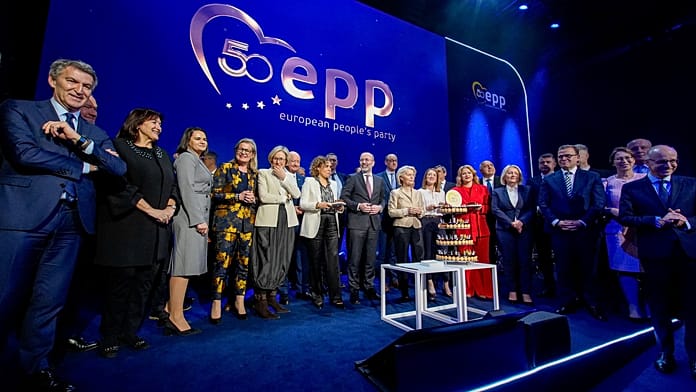
Glasses of champagne were raised at the European People’s Party’s 50th anniversary on Wednesday at a fancy venue in Brussels.
But the specter of the far-right lingered over the cocktail as the EPP mulls over its most fundamental dilemma in decades: what is the future of the European conservatives?
The leadership of Europe’s oldest and most powerful political force is grappling with unease over allegations of coordinating its work in the European Parliament with anti-EU forces via a WhatsApp group.
The episode is significant as it shows an institutionalised cooperation and it suggests the firewall that bans cooperation with parties until recently deemed too toxic to work with in national capitals is breaking in Brussels.
That could have severe implications for future coalition- building in a highly fragmented political landscape that is also becoming too poralised for centrist alliances to hold across Europe and some of its biggest democracies.
“It was a major mistake”, a heavyweight of the party told EU News, granted anonymity. The WhatsApp chat story was discussed on the sidelines of the event, with several members of the party worried about its implications and the message it sends.
“This is a very delicate issue for us: in my country, our voters do not tolerate it” said a former German MEP.
A few seats to his left sat Manfred Weber, the EPP leader, who, in Merz’s view, “has the responsibility” to end any sort of collaboration with the far-right.
“This must have been a field day for him,” said an EPP official, who suggested the relationship between the two has become tense.
Accusations that the EPP party is cozying up to the far-right are nothing new. But the issue took a dramatic turn this week when the German News Agency DPA reported a chatshowing coordination between EPP and far-right groups, including Alternative for Germany’s staff, in drafting a migration bill.
“Merz detests having problems coming from the European Parliament. And this story, for Germans, is a big one,” another person familiar with the matter said.
“We disapprove of what apparently took place at the staff level last week. We do not cooperate with the far-right in the European Parliament”, Merz said on Monday.
Two days later, his words resonated among the glittering panels and the glasses of Prosecco at the anniversary event, especially when Weber himself defined the “main fight” ahead for the EPP, the one against far-right populists.
“Those taking European integration into question are not only competitors, they are our political enemies. And as EPP president, I have defined our firewall,” Weber said, in a signal to the German Chancellor.
A party with a dilemma
But not all the EPP’s representatives agree on where the red line should be drawn.
The “Brandmauer” that excludes any cooperation with the far right in Germany doesn’t resonate in the same way in the rest of Europe, nor in Brussels, despite Weber’s claims.
On paper, the group remains committed to a “centrist majority”, aiming to support Ursula von der Leyen’s Commission and excluding nationalist forces. Quantitative analyses of the votes in the Parliament suggest a convergence with S&D and Renew, EPP’s traditional allies, nine times out of ten.
But votes in the European Parliament, beyond the tally, are considered in political terms too as a key legislative file does not have the same relevance as a non-binding resolution.
Controversial laws allowing deportation centers outside the EU and the possibility to send asylum seekers to countries with which they have no existing link are the result of harder right alignment, as well as a general backtrack on pro-environment legislation, such as deforestation rules, in the name of simplification and competitiveness.
The firewall has already fallen almost everywhere in practical terms. EPP members now have to choose whether to try to rebuild it or accept that it does not exist.