



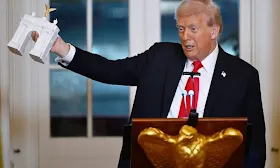
Media Lens: Trump’s proposed triumphal arch construction blocked by judge
A judge blocks Trump’s proposed arch construction.
A second judge has blocked Trump’s proposed arch, stating it is unlikely to succeed in court. This decision has significant implications for ongoing legal and political discussions surrounding the project, according to coverage in the latest US news and US and global politics.
What happened
A second judge has blocked former President Trump’s proposed arch, asserting that it is unlikely to succeed in court. This decision follows earlier legal challenges to the construction of the monument.
The implications of the ruling are significant, particularly for families of military personnel, as the proposed site of the arch is near Arlington National Cemetery. Critics argue that the structure would overshadow the solemn nature of the cemetery and its memorials.
Key facts
- A judge has blocked the construction of Trump’s proposed triumphal arch.
- The judge stated that the project is unlikely to succeed in court.
- This ruling comes shortly after another judge issued a similar decision regarding the arch.
- The proposed arch has been a topic of controversy among the public and officials.
Where coverage differs
- NPR emphasizes the implications of judicial decisions on Trump’s policies, while AP News focuses on the emotional impact of these decisions on families affected by the proposals.
- The Guardian foregrounds the legal challenges against Trump’s architectural plans rather than the public’s reaction to them.
- The Atlantic prioritizes a critical stance on the proposed arch, framing it as a symbolic representation of broader issues.
One story, four angles
NPR – A second judge blocks Trump’s arch, saying it’s unlikely to succeed in court
Publication: NPR | Primary framing pattern: legal | Tone: neutral | Intensity: 5/10 | Sentiment: 0 | Legal precision: high
Expand
Espresso Shot: NPR reports on a second judicial ruling that halts the construction of Trump’s proposed arch, emphasizing the court’s skepticism about the project’s viability. This article foregrounds the legal rationale for blocking the project, tapping into ongoing judicial resistance to Trump’s initiatives.
Publication emphasis: The article centers on a legal decision regarding the cessation of a construction project linked to Trump.
Framing analysis: The main focus is on the legal aspect of the case, while broader implications for Trump’s political agenda are treated as secondary.
Bias: Selection: Focused on legal proceedings. Language: Informative and straightforward. Omission: Limited discussion on public reactions or political implications.
Assessment: The article presents a meticulous legal analysis with a focus on the judicial aspects of Trump’s project.
AP News – For families of the fallen, Trump’s proposed arch casts a shadow over Arlington National Cemetery
Publication: AP News | Primary framing pattern: moral | Tone: somber | Intensity: 7/10 | Sentiment: -2 | Legal precision: moderate
Expand
Espresso Shot: AP News highlights the emotional impact of Trump’s proposed arch on the families of fallen service members by discussing how the project tends to overshadow the sanctity of Arlington National Cemetery. The article emphasizes the moral implications tied to the arch’s construction.
Publication emphasis: The narrative conveys the moral distress associated with the proposed memorial design.
Framing analysis: The primary focus is on the emotional and moral ramifications for families and the cemetery, while the legislative or political context is secondary.
Bias: Selection: Centers on personal and moral narratives. Language: Emotional and evocative. Omission: Less emphasis on legal challenges or government responses.
Assessment: This piece effectively addresses the sensitive moral concerns raised by the proposed construction amidst a hallowed setting.
The Guardian – Construction of Trump’s proposed ‘triumphal arch’ blocked by judge
Publication: The Guardian | Primary framing pattern: legal | Tone: neutral | Intensity: 6/10 | Sentiment: 0 | Legal precision: high
Expand
Espresso Shot: The Guardian reports on a judicial decision to halt Trump’s proposed ‘triumphal arch’, presenting the legal arguments and the judge’s reservations. The article maintains a neutral tone while outlining the specifics of the case.
Publication emphasis: The focus is on the legal dynamics surrounding the construction project.
Framing analysis: The article foregrounds judicial reasoning while providing context about the implications for Trump’s plans, leaving broader political aspects less discussed.
Bias: Selection: Concentrated on court proceedings. Language: Objective and factual. Omission: Limited exploration of public sentiment or reaction to the ruling.
Assessment: The article effectively conveys the legal backdrop without delving into political repercussions.
The Atlantic – Trump’s Arch Must Be Stopped
Publication: The Atlantic | Primary framing pattern: moral | Tone: urgent | Intensity: 8/10 | Sentiment: -4 | Legal precision: moderate
Expand
Espresso Shot: The Atlantic articulates a strong moral opposition to the proposed arch, framing it as an affront to American values and a misuse of resources. The article stresses urgency in halting the project and advocates for preserving the dignity of national memorials.
Publication emphasis: It emphasizes a moral imperative to block the project due to its perceived disrespect.
Framing analysis: The focus lies predominantly on moral grounds, with legal implications presented as supplementary to the main ethical concerns.
Bias: Selection: Strikingly pointed against the project. Language: Passionate and forceful. Omission: Limited discussion on potential legal frameworks or official responses supporting the arch.
Assessment: The article presents a compelling moral argument with a call to action against the proposed project.
Food for thought
NPR presents the strongest legal framing by emphasizing a judge’s decision that Trump’s proposed arch is “unlikely to succeed in court,” focusing on judicial authority and the legal implications. In contrast, AP News utilizes the most escalatory framing by highlighting the emotional weight of the arch’s impact on families of the fallen, stating it “casts a shadow” over Arlington National Cemetery, implying deep personal and collective loss. The Guardian follows suit with a pointed headline about the construction being blocked outright, further enhancing tensions surrounding the proposal’s viability. The facts do not change. What changes is where scrutiny lands.