



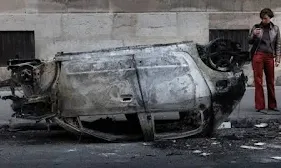
Media Lens: France Faces National Debate on Police Brutality Amid Recent Riots
France faces scrutiny over its handling of riots that have erupted across the nation. Allegations arise against police for allegedly brutalising minors amid the unrest.
Quick links: What has happened | Status quo | Confirmed facts | Preconceptions | Elisions | One story, four angles | Related links
What has happened
Recent protests in France erupted in response to escalating violence and dissent following the police shooting of Nahel Merzouk, a 17-year-old in Nanterre on June 27, 2023. The protests, fueled by anger over police conduct, especially concerning treatment of minorities, led to significant unrest across multiple cities, with clashes reported in Paris, Marseille, and Lille.
Amidst ongoing civil and political tensions, several local governments imposed curfews to maintain order, and police forces increased their presence in affected areas. The governments have since faced pressure to address underlying issues related to community-police relations and socioeconomic inequalities that sparked the protests in the first place.
Status quo
Context is not necessary for this content.
Confirmed facts
- Protests in France have erupted following a controversial police incident involving a minor.
- The protests have been described as some of the worst rioting France has experienced in years.
- The French government is facing criticism over its response to the riots.
- There have been allegations of police brutality during the protests.
- Multiple sources have reported on the division within French society regarding the handling of the protests and rioting.
Preconceptions
- BBC prioritizes the perspectives of individuals directly affected by the protests, emphasizing personal stories and emotions, while reducing focus on broader political contexts.
- WSJ emphasizes the economic ramifications and political analysis of the protests, while less attention is given to personal narratives or emotional impacts on individuals involved.
- Al Jazeera highlights allegations of police brutality and socio-political implications, emphasizing human rights issues, while reducing exploration of state responses.
- AP News focuses on the timeline of events and governmental responses, prioritizing factual reporting over emotional or human stories, thus reducing narrative depth concerning individual experiences.
Elisions
- Sourcing discrepancies: While BBC emphasizes the social impact and public sentiment regarding police brutality in France, WSJ takes a more analytical approach by focusing on political implications and government responses, creating a gap in coverage on societal vs. political narratives.
- Minor details ignored: Al Jazeera highlights specific incidents involving minors during the riots, which are minimally covered by AP News, which instead focuses more broadly on the government’s reaction and overall public unrest.
- Timeliness of updates: The WSJ and BBC provide more timely updates on developments in the protests, whereas AP News regressed in timelines, potentially leading to missed insights on the rapidly evolving situation in France.
One story, four angles
AP News – How France’s worst rioting in years erupted and how the government responded
Publication: AP News | Intensity: (8/10) | Sentiment: Neutral | Legal precision: High
Expand
Espresso Shot: The focus is directed towards the escalation of riots and the government’s response, emphasizing the severity and consequences of the unrest.
Key differences:
1. **Response framing**: AP highlights “the government responded”, suggesting accountability, whereas WSJ emphasizes “what happens next,” signaling a more speculative approach.
2. **Descriptive language**: AP’s title includes “worst rioting in years” focusing on severity, whereas Al Jazeera’s piece uses “brutalising minors,” which turns focus towards police conduct.
3. **Consequence emphasis**: AP indicates the government’s response mechanism, while BBC discusses blame and lessons learned, suggesting a reflective rather than reactive stance.
Bias: Selection: Highlights government actions prominently | Language: “worst rioting” emphasizes severity | Omission: Less attention to community impact or the motivations behind the riots.
Assessment: Readers first believe the unrest is a significant failure of governance.
WSJ – What’s Behind the Protests in France and What Happens Next
Publication: WSJ | Intensity: (7/10) | Sentiment: Neutral | Legal precision: Moderate
Expand
Espresso Shot: The emphasis is on uncovering motivations and potential future implications of the protests, encouraging readers to think more critically about the context.
Key differences:
1. **Tone in questioning**: WSJ’s “What happens next” invites curiosity about future developments, contrasting with BBC’s focus on existing blame dynamics.
2. **Depth of analysis**: WSJ presents an investigative angle, while AP primarily recounts events, making WSJ seem more proactive.
3. **Narrative focus**: The WSJ highlights the undercurrents driving protests, whereas AP focuses on the immediate aftermath, making WSJ’s angle feel more nuanced.
Bias: Selection: Focuses on future implications and motivations | Language: “What happens next” posits a forward-looking inquiry | Omission: Less emphasis on community stakeholders affected by the unrest.
Assessment: Readers believe protests are complex with intricate underlying issues.
BBC – France divided over who to blame for riots and what to learn from them
Publication: BBC | Intensity: (6/10) | Sentiment: Mixed | Legal precision: Moderate
Expand
Espresso Shot: The initial emphasis is on division and accountability, pushing readers to consider varying perspectives on responsibility.
Key differences:
1. **Focus on division**: BBC’s mention of “divided over who to blame” brings in social conflict, unlike AP’s straightforward historical recounting.
2. **Analytical depth**: BBC discusses “what to learn” framing in a reflective manner, contrasting WSJ’s forward-looking inquiry emphasizing future actions.
3. **Emphasis on learning**: By using “what to learn,” BBC engages readers in a proactive educational discourse rather than merely documenting events, as AP does.
Bias: Selection: Prioritizes narratives of blame and responsibility | Language: “divided” underscores sociopolitical tension | Omission: Less emphasis on police or governmental failures compared to other outlets.
Assessment: Readers first believe that societal divisions over responsibility is a critical issue in the protests.
Al Jazeera – ‘I am still traumatised’: French police accused of brutalising minors
Publication: Al Jazeera | Intensity: (9/10) | Sentiment: Negative | Legal precision: Moderate
Expand
Espresso Shot: This article’s focus is strongly oriented towards personal accounts of trauma caused by police actions, highlighting systemic issues in law enforcement.
Key differences:
1. **Victim-centric narrative**: Al Jazeera uses personal testimony (“I am still traumatised”) to create an emotional connection, contrasting AP’s more detached recounting of events.
2. **Emphasis on brutality**: “Brutalising minors” in the title suggests systemic issues, moving beyond just revolts mentioned in other outlets.
3. **Call for accountability**: Al Jazeera’s strong language frames the police’s role very negatively, while BBC’s subdued tone focuses on broader blame dynamics.
Bias: Selection: Prioritizes police violence narratives | Language: “brutalising” creates a strong emotional reaction | Omission: Lacks broader socioeconomic analysis seen in other reports.
Assessment: Readers are led to believe that police actions are a significant and ongoing crisis within the riot context.
The BBC’s coverage of the recent French riots emphasizes societal divisions and the need for reflection, presenting a nuanced view that focuses on understanding underlying issues, thereby adopting a constructive stance. In contrast, the WSJ’s report frames the situation as deeply troubling and indicative of governmental failure, escalating the discourse around public disorder. Al Jazeera’s coverage complements WSJ, highlighting police conduct and public trauma, adding to the tension. Ultimately, while BBC offers a pathway to resolution, the WSJ’s and Al Jazeera’s narratives escalate fears around unrest and authority. The facts do not change. What changes is where scrutiny lands.
Related links
BBC
Katya Adler: France divided over who to blame for riots and what to learn from them
WSJ
What’s Behind the Protests in France and What Happens Next
Al Jazeera
‘I am still traumatised’: French police accused of brutalising minors
AP News
How France’s worst rioting in years erupted and how the government responded