



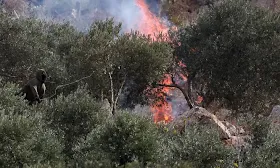
Media Lens: Israeli settlers attack journalist and burn olive trees in West Bank
Israeli settlers attacked journalist Heidi Levine and burned olive trees in the West Bank. The incident highlights ongoing tensions in the region.
Quick links: What has happened | Status quo | Confirmed facts | Preconceptions | Elisions | One story, four angles | Related links
What has happened
In the West Bank, journalist Heidi Levine was attacked by Israeli settlers while covering a protest against the burning of Palestinian olive trees. The incident occurred in the village of Burin, where settlers reportedly set fire to trees, leading to tensions that resulted in the assault on Levine.
Following the attack, Levine sustained injuries and was treated for them at a local hospital. This event has drawn attention to the ongoing conflict in the region, particularly the violence surrounding land disputes and agricultural production.
Status quo
Heidi Levine, a journalist, was attacked by Israeli settlers in the West Bank, resulting in injuries. This incident highlights the ongoing tensions in the region, particularly between settlers and Palestinian residents. The attack on Levine, who was documenting the situation, underscores the challenges faced by journalists in conflict zones. Details about the specific circumstances surrounding the incident are reported by multiple news organizations.
Confirmed facts
- Israeli settlers attacked journalist Heidi Levine in the West Bank.
- During the same incident, settlers burned olive trees.
- The event was reported by multiple news outlets including Reuters and The New York Times.
- The attack on journalist Heidi Levine resulted in injuries.
Preconceptions
- The New York Times prioritizes framing the incident as a broader reflection on Israeli settlers attacking Palestinians, while Reuters centers its coverage more on the journalist’s experiences during the attack.
- NPR emphasizes first-hand accounts and emotional impact, notably through a recount by a Washington Post photographer, whereas The Washington Post focuses on contextualizing the violence within larger narratives of journalist safety and anti-press sentiment.
- Reuters includes detailed descriptions of the physical attack against the journalist and the environmental impact (burning olive trees), while The New York Times highlights the implications of such actions on Palestinian communities.
- The Washington Post highlights the dangers faced by journalists, placing a more significant emphasis on press freedom issues compared to NPR, which focuses more on the personal experience of the attacked journalist.
Elisions
- Reuters and The New York Times highlight the immediate violence of Israeli settlers burning olive trees and injuring journalists in the West Bank, whereas NPR focuses on a specific eyewitness account from a Washington Post photographer, emphasizing the personal impact of the event.
- While the coverage from The New York Times attributes the incident to an organized pattern of aggression against journalists in the region, NPR’s reporting lacks a broader contextual analysis, instead centering on a singular narrative of the photographer’s experience.
- The Washington Post’s article addresses the aftermath and ongoing implications of the violence against not just journalists but Palestinian civilians, whereas Reuters predominantly details the event’s occurrence without delving as deeply into systemic factors leading to such actions.
One story, four angles
The New York Times – Israeli Settlers Attack Palestinians and Washington Post Journalist in West Bank
Publication: The New York Times | Intensity: (8/10) | Sentiment: Negative | Legal precision: Moderate
Expand
Espresso Shot: The headline prompts immediate concern over violence against journalists and civilians, focusing on the gravity of the situation.
Key differences:
– Insight One: NYT emphasizes the attack on a journalist alongside civilians, presenting it front and center, whereas NPR focuses predominantly on the journalist’s recount.
– Insight Two: The NYT uses “attack” in its headline, which conveys an active and violent connotation, compared to more neutral language in other outlets.
– Insight Three: The NYT discusses the broader implications of such attacks on press freedom, adding depth to the narrative, which is less emphasized in competing outlets.
Bias: Selection: Prioritizes journalist safety over civilian narratives. | Language: Uses strong terms like “attack” to emphasize violence. | Omission: Lacks detailed context about the events leading up to the attack.
Assessment: The reader likely perceives the conflict as urgent and violent, heavily affecting journalists on the ground.
NPR – ‘Washington Post’ photographer recounts Israeli settler attack
Publication: NPR | Intensity: (7/10) | Sentiment: Negative | Legal precision: High
Expand
Espresso Shot: The headline highlights a personal narrative from a journalist, drawing attention to individual experiences in the conflict.
Key differences:
– Insight One: NPR’s focus on a photographer’s personal recounting offers an intimate perspective compared to the NYT’s broader report on the incident.
– Insight Two: NPR presents the incident with a focus on storytelling, creating emotional resonance over the statistical details of the attack.
– Insight Three: The NPR title implies a direct witness account, increasing relatability, unlike the NYT’s more comprehensive but detached approach.
Bias: Selection: Chose a personal narrative, potentially sidelining the broader context. | Language: Utilizes emotive storytelling language rather than hard-hitting terminology. | Omission: Minimal details on the systematic implications of such violence on press freedom.
Assessment: The reader is likely drawn into personal experiences, eliciting empathy toward the journalist’s plight over the larger conflict narrative.
Reuters – Israeli settlers burn olive trees, injure journalist in West Bank attack
Publication: Reuters | Intensity: (8/10) | Sentiment: Negative | Legal precision: High
Expand
Espresso Shot: The primary focus is on the physical violence against both the journalist and the environment, highlighting the destructiveness of the attack.
Key differences:
– Insight One: Reuters includes the “burn olive trees” aspect, hinting at agricultural damage alongside human injury, while other outlets don’t emphasize this ecological element.
– Insight Two: The Reuters headline combines both journalistic and civilian impacts, positioning the attack in a multifaceted manner compared to the relational storytelling approach in NPR.
– Insight Three: Reuters maintains a direct, fact-oriented style, potentially appealing to readers seeking clarity over emotive narratives.
Bias: Selection: Combines environmental and human impact, which might skew interpretation toward loss. | Language: Uses direct, impactful phrasing like “burn” and “injure,” which conveys starkness. | Omission: Less focus on the broader implications of such attacks for press safety and freedom.
Assessment: The reader perceives a dual narrative of physical violence against both people and nature, raising immediate alarm.
The Washington Post – Opinion | The dangers that journalists face
Publication: The Washington Post | Intensity: (6/10) | Sentiment: Mixed | Legal precision: Low
Expand
Espresso Shot: The title invites readers to engage with opinions around the risk faced by journalists in conflict zones, creating a reflective space.
Key differences:
– Insight One: The Washington Post positions itself in the opinion genre, which contrasts with the news reporting focus in the other selections.
– Insight Two: The title’s ambiguity leaves it open to interpretation, fostering debate rather than providing a definitive narrative on recent events.
– Insight Three: The commentary format focuses on analytical dialogue about the issue, lacking the immediacy central to the other articles’ reporting approach.
Bias: Selection: Chooses a reflective piece rather than immediate reporting, potentially losing urgency. | Language: Engages with speculative language about implications rather than firm statements. | Omission: Does not incorporate recent specific incidents that reflect the current risks of journalism.
Assessment: The reader is likely drawn into a broader conversation about press freedom, possibly underestimating the immediacy and severity of the current events.
The coverage surrounding journalist Heidi Levine’s attack by West Bank settlers highlights varying frames of analysis. The New York Times presents a more in-depth exploration, focusing on the broader implications of the incident and framing it within the context of ongoing violence, thus adopting a stronger investigative tone. Conversely, NPR’s piece emphasizes personal accounts of the incident, leaning towards an escalatory framing that heightens emotional responses. Overall, while the facts remain constant, the focus of scrutiny shifts depending on the narrative each outlet chooses to emphasize.
Related links
Reuters
Israeli settlers burn olive trees, injure journalist in West Bank attack
The New York Times
Israeli Settlers Attack Palestinians and Washington Post Journalist in West Bank
NPR
‘Washington Post’ photographer recounts Israeli settler attack