



Get you up to speed: Putin admits Ukraine attacks hitting Russian economy, society
President Vladimir Putin acknowledged that recent Ukrainian attacks on Russian infrastructure, including a key oil refinery in Nizhnekamsk, are impacting the Russian economy and society. The confirmed situation includes fuel shortages in Crimea due to Ukraine’s strikes on supply lines, prompting the Kremlin to address the crisis.
The Washington-based Institute for the Study of War has reported that Ukraine’s long-range strike campaign is effectively depleting Russia’s production capacity while also disrupting the transportation of fuel within occupied regions. Kremlin spokesman Dmitry Peskov has acknowledged the ongoing fuel shortages in Crimea and stated that measures are being implemented to address the issue.
President Vladimir Putin has acknowledged the impact of Ukrainian strikes on the Russian economy, asserting that recovery will be swift despite the damage inflicted. In response to escalating fuel shortages in Crimea, Kremlin spokesman Dmitry Peskov indicated that “measures were being taken” to address the situation, highlighting ongoing efforts to bolster air defences as well.
What remains unclear — It is uncertain how effective Russia’s promised measures to address the fuel shortages in Crimea will be.
Putin acknowledges Ukrainian attacks are impacting Russian economy and society
News|Russia-Ukraine warPutin admits Ukraine attacks hitting Russian economy, society
Ukraine has increasingly targeted Russian refineries, depots and pipelines, as well as fuel supplies in Crimea.
By AFP, Reuters and The Associated PressPublished On 12 Jun 202612 Jun 2026
President Vladimir Putin has acknowledged that the recent surge in Ukrainian attacks is inflicting damage on the Russian economy and society.
Putin’s remarks on Friday followed weeks of intensifying Ukrainian strikes on Russian infrastructure, including a Kyiv-claimed attack on a key oil refinery in Russia’s Nizhnekamsk the previous night. However, the Kremlin chief insisted that the surge in strikes will not succeed in creating division and that the economy will quickly bounce back.
Ukraine’s attacks, which have hit refineries, depots and pipelines deep into Russia – all vital to the country’s lucrative oil and gas exports – appear to be exacting a growing toll as the war drags on and Moscow’s advances on the front line in eastern Ukraine slow.
Putin declared confidence that the onslaught would not affect Moscow’s determination to continue with its invasion of its neighbour.
“As for the economy: they are certainly causing us damage, but we are recovering quickly,” said Putin in comments carried by Russia’s state-owned TASS news agency. He added that the strikes are intended to “sow confusion” in society.
But he insisted that the strikes will not succeed “in either dividing society nor in causing us economic harm – at least not in the way they are aiming for”.
Ukraine says its strikes are fair retaliation for Russia’s daily barrage of drones and missiles sent to devastate Ukrainian towns and cities.
As he seeks to maintain the authorities’ narrative that the “special military operation” remains highly successful despite the growing evidence felt inside Russia, Putin promised that Russia’s military will escalate attacks on “the enemy’s infrastructure” to “discourage them from attacking our civilian facilities”.
The Russian leader also said Moscow must improve its air defences – the second such call this month.
In addition to long-range attacks on Russian infrastructure, Ukraine has targeted supplies into Russian-occupied Crimea, including fuel trucks, triggering the worst fuel crisis on the Black Sea Peninsula since it was illegally annexed by Russia in 2014.
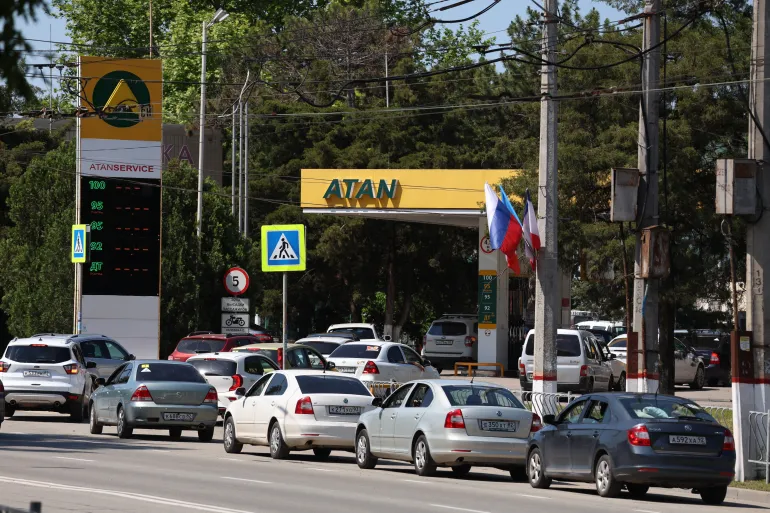 Cars line up at a petrol station in Simferopol, Crimea, June 12 [AP Photo]
The Washington-based Institute for the Study of War noted the synergy between Ukraine’s longer-range attacks and those disrupting supplies to Crimea and other occupied regions.
“The long-range strike campaign is therefore reducing Russia’s production capacity, while the midrange strike campaign is hurting Russia’s ability to transport the gasoline Russia is still able to produce,” it said in an analysis.
Kremlin spokesman Dmitry Peskov acknowledged the Crimean fuel shortages earlier this week and promised that “measures were being taken” to deal with them.
Putin recently rejected the prospect of face-to-face talks with Ukraine’s President Volodymyr Zelenskyy to end the war.
Ukrainian commander-in-chief Oleksandr Syrskii has said that Ukraine had reclaimed more of its territory than it lost during May, reversing a Russian trend of monthly net gains.