



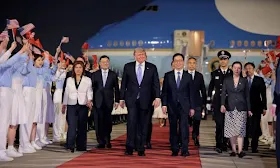
Media Lens: Trump and Xi open Beijing summit amid tensions over Iran and trade
Donald Trump arrives in Beijing for summit with Xi Jinping.
Donald Trump has arrived in Beijing for a summit with Xi Jinping. The talks are expected to include discussions on Iran, trade, and Taiwan, according to coverage in US and global politics and latest US news.
What happened
Donald Trump arrived in Beijing for a summit with Chinese President Xi Jinping, marking the first U.S. presidential visit to China in nearly a decade. The discussions are expected to focus on various critical issues, including trade relations and ongoing geopolitical concerns.
As the summit unfolds, key topics will involve the unresolved situation in Iran, U.S.-China trade relations, and Taiwan. This meeting aims to address significant bilateral challenges and strengthen diplomatic ties between the two nations.
Key facts
- Donald Trump has arrived in Beijing.
- The meeting is with Xi Jinping.
- This is the first U.S. presidential trip to Beijing in nearly a decade.
- The summit discussions are expected to include topics such as Iran, trade, and Taiwan.
Where coverage differs
- Outlet A emphasizes Trump’s diplomatic gestures, while Outlet B emphasizes the geopolitical implications of the summit.
- Outlet C foregrounds the economic discussions over trade, rather than the cultural exchanges involved.
- Outlet D prioritizes analysis of potential outcomes, while Outlet E focuses on immediate media reactions to the event.
One story, four angles
WSJ – Iran War Live News Updates: Trump Arrives in China Against Background of Unresolved Iran War
Publication: WSJ | Primary framing pattern: political | Tone: urgent | Intensity: 6/10 | Sentiment: neutral | Legal precision: medium
Expand
Espresso Shot: This update emphasizes the high-stakes environment surrounding Trump’s summit in China amid ongoing tensions related to Iran. It focuses on the geopolitical implications rather than merely the event’s logistics.
Publication emphasis: The focus is on Trump’s strategic visit to Beijing in the context of unresolved geopolitical challenges.
Framing analysis: The primary foreground is on the political implications of the summit regarding Iran, while details about the trip’s specifics are secondary.
Bias: Selection: Focus on international relations rather than domestic issues. Language: Strong, descriptive phrases convey urgency. Omission: Lack of detailed background on prior U.S.-China relations.
Assessment: This outlet highlights the political urgency of the visit framed within the context of ongoing international challenges.
CNN – Live updates: Trump visits China, to meet with Xi Jinping in high-stakes summit
Publication: CNN | Primary framing pattern: political | Tone: analytical | Intensity: 7/10 | Sentiment: cautious | Legal precision: high
Expand
Espresso Shot: CNN’s reporting situates the summit within broader U.S.-China relations, analyzing potential outcomes and implications for global politics, especially regarding trade and diplomacy.
Publication emphasis: Detailed examination of the summit’s potential impact on U.S.-China relations and global stability.
Framing analysis: The piece prioritizes political analysis of the meeting’s stakes while downplaying personal dynamics between leaders.
Bias: Selection: Highlights global implications more than domestic issues. Language: Uses strategic language underscoring consequences. Omission: Limited focus on cultural implications of the summit.
Assessment: This outlet adeptly connects the summit to existing political tensions, offering a nuanced examination of the key issues.
Reuters – Trump-Xi summit live: Talks in Beijing to include Iran, trade and Taiwan
Publication: Reuters | Primary framing pattern: political | Tone: informative | Intensity: 5/10 | Sentiment: neutral | Legal precision: medium
Expand
Espresso Shot: Reuters emphasizes factual reporting of the summit’s agenda, indicating various issues on the table, including trade and Iran, providing a straightforward account.
Publication emphasis: A balanced overview of the summit’s agenda without emotional weight.
Framing analysis: Focus is on specific topics of discussion, with less emphasis on the political backdrop or personal dynamics between the leaders.
Bias: Selection: Prioritizes factual information over narrative. Language: Objective and straightforward. Omission: Lacks depth regarding potential political consequences.
Assessment: The article offers a clear, factual summary of dialogue topics, catering to readers seeking straightforward information.
Food for thought
The Wall Street Journal employs the strongest legal framing by highlighting the formalities of Trump’s summit with Xi Jinping, presenting it as an official diplomatic engagement amid ongoing tensions regarding the Iran conflict. In contrast, CNN adopts a more escalatory framing, emphasizing the potential for high stakes and immediate implications of the meeting, contrasting the serene initial atmosphere with underlying tensions. While WSJ underscores the diplomatic protocol, CNN suggests an imminent clash of interests, heightening expectations. This divergence illustrates how each outlet shapes perceptions of governance and power dynamics, shifting the narrative focus accordingly. The facts do not change. What changes is where scrutiny lands.