



Get you up to speed: Brazil judge bars law that could reduce Bolsonaro’s 27-year prison sentence
Brazilian Supreme Court Justice Alexandre de Moraes has barred the implementation of a law that could reduce former President Jair Bolsonaro’s 27-year prison sentence. The law’s suspension will remain in effect until the Supreme Court convenes a full hearing to consider challenges to its constitutionality.
In Brazil plaintiffs have requested the court to overturn the law, asserting it violates constitutional principles.
Meanwhile, Bolsonaro’s lawyers have filed a new appeal, describing his conviction as a “miscarriage of justice.”
Brazil’s Supreme Court Bars Law That Could Reduce Bolsonaro’s Sentence
News|Jair Bolsonaro Brazil judge bars law that could reduce Bolsonaro’s 27-year prison sentence
Brazilian Supreme Court Justice Alexandre de Moraes suspends use of law to reduce prison sentences, pending further review.
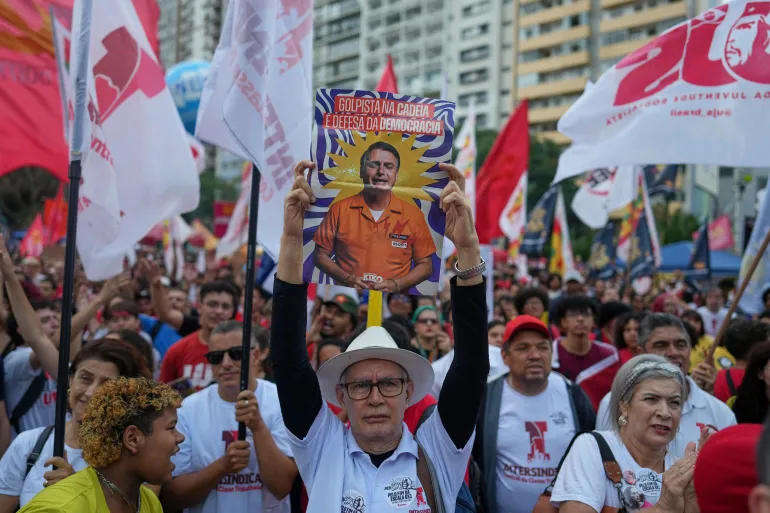 A man holds a picture of former Brazilian President Jair Bolsonaro wearing a prison uniform during a May Day rally demanding greater labour rights, in Sao Paulo, Brazil, on May 1, 2026 [Andre Penner/AP Photo]
Brazilian Supreme Court Justice Alexandre de Moraes has barred the implementation of a law that could dramatically reduce the prison sentence of former President Jair Bolsonaro for involvement in a coup plot after his loss in the 2022 election.
De Moraes ordered the law’s suspension on Saturday until the Supreme Court can convene a full hearing to consider appeals challenging its constitutionality.
Bolsonaro’s conviction for involvement in a plot to remain in office after losing to left-wing rival Luiz Inacio Lula da Silva in 2022 has become a cause celebre for the country’s political right, which has pushed for Bolsonaro’s release from prison.
The Supreme Court sentenced the former far-right president to 27 years in prison in September, but a law passed by Brazil’s conservative-majority Congress in December would apply to Bolsonaro and others convicted in the plot, paving the way for reductions in their sentences.
President Lula vetoed the bill in January, but a vote led by Bolsonaro’s allies in Congress overrode the veto in late April.
Plaintiffs have subsequently asked the Supreme Court to overturn the bill, stating it is unconstitutional.
Lawyers for those convicted must file individual requests for sentence reduction. The ruling by de Moraes essentially suspends such requests until the court has had the opportunity to decide on the law’s constitutionality.
Lawyers for the 71-year-old Bolsonaro filed a new appeal to the Supreme Court on Friday, asking it to overturn what they called a “miscarriage of justice”.
Bolsonaro’s conviction and sentencing remain a matter of controversy in Brazil, where his allies have decried it as a political witch-hunt.
Opponents have welcomed it as a necessary form of accountability, from which not even former presidents are exempt.