



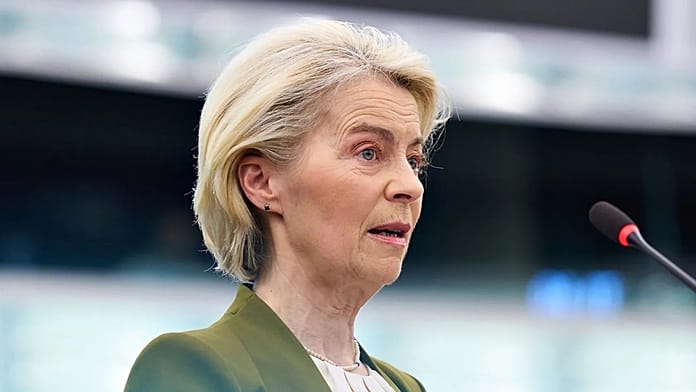
TL:DR – Ursula von der Leyen discusses “Made in Europe” preference ahead of summit
• Ursula von der Leyen stated that a “Made in Europe” preference in public contracts is a “fine line to walk” on Wednesday in Strasbourg.
• Von der Leyen highlighted that European preference could strengthen production but must align with international obligations.
• Emmanuel Macron called the European preference a “defensive measure” to protect industry ahead of Thursday’s summit.
• Strong resistance against the preference was expressed by Sweden’s Ulf Kristersson, advocating for competition based on quality and innovation.
• The informal summit on Thursday aims to facilitate discussions on the European preference without formal decisions.
European preference is ‘necessary’ but a ‘fine line to walk’, warns von der Leyen
Establishing a “Made in Europe” preference in public contracts is a complex issue, according to Ursula von der Leyen, President of the European Commission, who addressed the matter on Wednesday morning in Strasbourg. Her comments come ahead of an informal European Union leaders’ summit where this contentious topic is scheduled to be discussed.
The significance of von der Leyen’s remarks lies in the ongoing debate about increasing public spending across the bloc and the potential consequences for domestic production versus foreign competition.
This comes amid growing economic pressures, punitive US tariffs, and aggressive Chinese trade practices. In some ways all these new EU developments are about creating an alternative to The United States, a criticism that has been levied at the EU for not leading on the initiative sooner.
Ursula von der Leyen stated, “I believe that in strategic sectors, European preference is a necessary instrument that will contribute to strengthen Europe’s own production base.” However, she cautioned that “it is a fine line to walk,” underscoring the need for proposals to be supported by robust economic analysis and compliant with international obligations.
Potential Benefits and Concerns
French President Emmanuel Macron has long advocated for the “Buy European” clause, describing it as a “defensive measure” against nations that “no longer respect” trade rules. He emphasised that while Europe must protect its industry, the approach should not be protectionist: “We must focus on certain strategic sectors, such as clean tech, chemicals, steel, automotive, and defence. Otherwise, Europeans will be left behind.”
In contrast, the proposal faces strong opposition from leaders in the Netherlands, Nordic countries, and Baltic states. Swedish Prime Minister Ulf Kristersson expressed scepticism about the effectiveness of such measures, stating, “We need to be able to compete because of quality and because of innovation, not because we try to protect the European markets.”
MEP Saskia Bricmont criticises EU-US trade agreement as total capitulation
Germany Advocates for Broader Inclusion
Meanwhile, Germany has proposed a broader approach known as “Made with Europe”, which would apply to “like-minded” partners and countries that have established trade deals with the EU. T
he upcoming summit at the Alden Biesen castle in eastern Belgium is designed as an informal retreat for leaders to engage in an open discussion on these issues, without the expectation of formal conclusions or decisions.
According to a senior EU official, the European preference will be a key topic of discussion at the summit, noting that there is growing interest among leaders to debate this concept, although opinions may vary significantly. The summit represents a departure from past discussions, with increased consensus on the importance of the debate surrounding European preference policies.
“