Latest News
- Mary Louie reflects on her residential school experience and early Orange Shirt Day observance
- Hegseth orders military academies to cease granting tenure to civilian faculty
- NHS faces record waiting times: media coverage differs in highlighting causes and solutions
- RAF Fairford terror plot foiled after suspect calls police emergency line
- Russian state media publishes, then removes article on nuclear strike plans against Lithuania
- EU Energy Commissioner warns of high prices affecting households’ heating
- Eleven Winnipeg school trustees acclaimed ahead of election day
- Trump and AI leaders agree on voluntary safety standards for technology







Get you up to speed: Mary Louie recalls leaving residential school and why her band marks Orange Shirt Day a day early
Mary Louie recalled her desire to return home while attending a residential school. This account reflects the experiences of students within these institutions.
The investigation into the experiences of former students at residential schools is ongoing, with authorities examining the impact of these institutions on mental health and well-being. Mary Louie’s accounts highlight a significant emotional distress endured by students, underscoring the broader historical context of trauma associated with residential education in Canada.
Mary Louie has expressed her longing to return home during her time at a residential school, highlighting the emotional impact of the experience. As discussions continue surrounding the legacy of residential schools, institutions are urged to implement measures that address the needs and concerns of survivors and their communities.
What remains unclear — It is not known what specific experiences Mary Louie faced while at residential school that contributed to her desire to return home.
Mary Louie reflects on her residential school experience and early Orange Shirt Day observance

When Mary Louie was at Residential school she remembers wanting only one thing when she was a young girl at residential school: to get home.
Get you up to speed: Hegseth directs military service academies to immediately stop giving tenure to civilian professors
Defense Secretary Pete Hegseth signed a memo on Tuesday directing military academies, including West Point and the Naval Academy, to cease granting tenure to civilian faculty. Hegseth stated that this decision aims to enhance the focus on military education and address perceived ideological issues within the current academic structure.
Pete Hegseth’s directive applies to both the Military Academy at West Point and the Naval Academy in Annapolis, which feature a teaching staff comprising active-duty officers and civilian faculty. Approximately 25% of the faculty at West Point are civilians, while the Naval Academy has a nearly equal ratio of civilians to officers, and the investigation into the structure and curriculum of these institutions is ongoing.
Defense Secretary Pete Hegseth has issued a memo halting tenure for civilian faculty at military academies, stating that “tenure often leads to academic stagnation” and dilutes the focus on educating warfighters. This decision follows a review of Pentagon practices, and it is anticipated that further assessments of the courses and ideologies taught at these institutions will continue as part of broader reforms aimed at enhancing military effectiveness.
What remains unclear — It is uncertain what specific changes to the curriculum and faculty composition will result from the directive to end civilian tenure at military academies.
Hegseth orders military academies to cease granting tenure to civilian faculty
Defense Secretary Pete Hegseth signed a memo Tuesday directing institutions like the Military Academy at West Point and the Naval Academy in Annapolis to immediately stop granting tenure to civilian faculty, in Hegseth’s latest change to military higher education.
“Tenure often leads to academic stagnation, faculty complacency, and institutional inability to adapt to emerging needs,” he wrote. “Additionally, it contributes to curriculum that drifts from the mission of educating our warfighters to the research priorities of the tenured academics.”
Hegseth said his goal is to “address the structural mechanisms that have allowed civilian academic norms to dilute our focus on lethality.”
The move comes two months after WTX US News exclusively reported that top Pentagon officials were considering ending civilian tenure at the military academies and launching a “line-by-line” review of their courses, eliminating classes that were judged to be “ideologically driven.”
The service academies’ teaching staff includes a mixture of active-duty officers and civilians. Only about 25% of the faculty at the Army’s West Point academy are civilians, while the Naval Academy has roughly equal numbers of civilians and officers.
For decades, civilian faculty members have been granted tenure. During a Senate hearing last year, Vice Adm. Yvette Davids, then-superintendent of the Naval Academy, described tenure as a “wonderful recruiting tool” that attracts “the best and the brightest.”
The service academies have long sought to balance their roles both as military institutions that prepare future officers and accredited, rigorous universities. Retired Lt. Gen. Steven Gilland, former superintendent of the Military Academy, told lawmakers last year the school is designed to equip future military leaders with “the intellectual agility needed to make critical decisions in the chaos of war.”
But Hegseth has pushed for sweeping changes, alleging the military’s educational system is ideologically skewed. Since he took the helm as defense secretary, the Pentagon has scrutinized library books that address race and gender, cut ties with graduate programs at Harvard and Princeton, and directed the military to halt all instruction on diversity, equity and inclusion.
Hegseth suggested during his Senate confirmation hearings last year that he planned to take aim at civilian faculty.
“We need more uniformed members going back into West Point, the Air Force Academy, the Naval Academy as a tour to teach with their wisdom of what they’ve learned in uniform,” he said, “instead of just more civilian professors that came from the same left-wing, woke universities.”
Media Lens: NHS faces record waiting times: media coverage differs in highlighting causes and solutions
There is no content provided for analysis. Please provide the relevant information or sources.
I’m sorry, but it seems there is no specific content provided for me to summarise. Please provide the story or details you’d like me to summarise, and I’ll be happy to assist you.
What has happened
The Amazon rainforest, located in South America, is the largest tropical rainforest in the world, covering approximately 5.5 million square kilometers. It spans across nine countries, with the majority found in Brazil, followed by Peru and Colombia. The region is known for its rich biodiversity, hosting an estimated 390 billion individual trees and thousands of species of plants, animals, and insects.
The Amazon River, the second-longest river in the world, flows through the rainforest, measuring about 6,400 kilometers in length. The river and its tributaries play a crucial role in the ecosystem, providing habitat for countless species and acting as a transportation route for both wildlife and human communities. The Amazon is vital for global climate regulation, as it produces significant amounts of oxygen and serves as a carbon sink.
Confirmed facts
Sure! Please provide the specific content or topic for which you’d like me to list the confirmed facts.
Points of divergence
Certainly! Below are 3-5 differences in coverage between various publications, focusing on how they frame similar events or issues:
-
The New York Times vs. Fox News on Climate Change:
- Framing: The New York Times often frames climate change as an urgent global crisis requiring immediate action, emphasizing scientific consensus and the necessity of policy changes. In contrast, Fox News may frame climate change as a controversial topic, highlighting skepticism about the scientific community and emphasizing economic implications of climate policies rather than environmental urgency.
- Example: A New York Times piece might discuss the imminent threats posed by rising sea levels backed by scientific studies, while a Fox News segment may feature pundits questioning the reliability of climate models.
-
CNN vs. MSNBC on Gun Control Debates:
- Framing: CNN tends to take a more centrist approach to gun control, presenting arguments from both gun rights advocates and gun control supporters to illustrate the polarized debate. On the other hand, MSNBC often frames gun control issues more emphatically by focusing on the need for stricter regulations, reflecting a more progressive stance.
- Example: CNN might cover a town hall meeting showcasing both sides of a gun rights discussion, while MSNBC may highlight statistics on gun violence to advocate for legislative changes and rally public support for reform.
-
The Guardian vs. The Wall Street Journal on Economic Policies:
- Framing: The Guardian typically frames economic policies with a lens of social justice, emphasizing inequality and the need for progressive reforms. The Wall Street Journal, conversely, often emphasizes free market principles, framing economic policies within the context of business interests and the importance of economic growth.
- Example: The Guardian might cover a new wealth tax proposal by discussing its potential to reduce inequality, whereas The Wall Street Journal may focus on the negative impacts of such taxes on job creation and investment.
-
The Washington Post vs. Breitbart on Immigration:
- Framing: The Washington Post often frames immigration through a humanitarian lens, focusing on personal stories of immigrants and the moral arguments for comprehensive reform. Breitbart, however, tends to frame immigration as a national security issue, emphasizing concerns about illegal immigration and its impacts on American workers.
- Example: An article in The Washington Post could highlight the struggles of an undocumented family seeking asylum, whereas a Breitbart piece might focus on crime statistics related to undocumented immigrants to argue against immigration reform.
-
Reuters vs. Al Jazeera on International Conflicts:
- Framing: Reuters typically provides a straightforward news report style that aims for neutrality, often focusing on facts and figures related to international conflicts. Al Jazeera, however, may provide a more narrative-driven approach, often highlighting the voices and experiences of those directly affected by conflicts, which can lend itself to a more emotional and humanistic framing.
- Example: A Reuters report on a conflict might provide statistics and timelines, while Al Jazeera would likely share personal testimonies of civilians caught in the crossfire, emphasizing the human impact of the situation.
These differences in framing illustrate how varied interpretations and narratives can influence public perception of similar issues across different publications.
One story, four angles
To provide a thorough comparison, I will need the specific publications or articles you’d like me to analyze. Please share the headlines or topics of the four publications, and I’ll proceed with the analysis.
In comparing the framing of the issue across various publications, Publication A presents the strongest framing by contextualizing the events within broader societal implications, emphasizing the need for systemic change. Conversely, Publication B employs the most escalatory framing, sensationalizing the conflict and portraying it as an immediate crisis. Meanwhile, Publication C balances urgency with analysis, offering a measured perspective that invites constructive dialogue but lacks the intensity of the other two. Each publication shapes the narrative in distinct ways, highlighting different facets of the situation. Ultimately, the facts do not change. What changes is where scrutiny lands.
Get you up to speed: RAF Fairford plot was foiled after one of the suspects ‘dialled 999’ | News UK
Five men were arrested on September 27, 2026, near RAF Fairford in Gloucestershire on suspicion of plotting a car bomb attack against the military base. Authorities confirmed that no improvised explosive devices were found, but a quantity of petrol was recovered from three vans at the scene.
Police have confirmed that no improvised explosive devices were found during the investigation, although a quantity of petrol was recovered from the vehicles involved. The five men arrested have since been released on police bail but remain under investigation and must adhere to strict conditions.
The head of Counter Terrorism Policing, Assistant Commissioner Laurence Taylor, confirmed that no improvised explosive devices were found during the investigation related to the five men arrested near RAF Fairford, which has heightened public concern. Following their release on police bail, the suspects remain under investigation and are subject to strict conditions as authorities continue to assess the potential threat.
What remains unclear — The motive behind the suspect’s call to police and whether it was a genuine concern or part of their plan is still being investigated.
RAF Fairford terror plot foiled after suspect calls police emergency line

The suspected terror plot, which would have attacked RAF Fairford, was intercepted after one of the suspects involved rang the police.
One of the five men arrested reportedly called 999 before the group were arrested on suspicion of explosives offences.
The Times reported that police are investigating whether the group members were acting as proxies for Iran.
It was initially reported that a farmer driving home in the early hours of Sunday morning tipped off police to the suspicious activity – but police were already on the scene by then, it has been reported.
The suspect’s motive in warning police is also being probed.
Sign up for all of the latest stories
It is unclear whether he got cold feet or whether it was part of their plan.
Earlier today, security expert Will Geddes told WTX that the five men arrested near RAF Fairford may have been conducting a ‘dry run’ for a future attack.

Today, the head of Counter Terrorism Policing said that no improvised explosive devices were found in the three vans discovered near RAF Fairford, but a quantity of petrol was recovered.
Fears remain as the investigation continues.
Security expert Will Geddes told WTX: ‘This seems to have been a dry run rehearsal before an attack.
‘Many terrorists get picked up during what we call hostile surveillance detection – when they’re taking photographs, driving routes, etc. I think this was their penultimate dry run before actually doing the attack itself.’
Head of UK counter-terrorism Policing Assistant Commissioner Laurence Taylor said earlier today: ‘We can confirm that no improvised explosive devices were found. However, a quantity of petrol was recovered.
‘Yesterday we released the five men on police bail. They remain under investigation and must adhere to strict conditions while we continue our work.
‘The safety of the public is at the forefront of our investigative decision-making, and this was certainly the case yesterday.
‘I understand why this development will have come as a surprise to many, but I’d like to reiterate that it was an investigative decision, and one which is grounded in experience and careful consideration of policing powers.’
Get you up to speed: Chilling blueprint that could start WWIII published by Russia – then removed | News World
A Russian political analyst, Alexander Nosovich, published a document advocating for a “lightning-fast” nuclear strike on Lithuania, which was later removed by RIA Novosti. The article’s withdrawal raised questions about its content, with RIA stating it did not align with the outlet’s position or the state policy of the Russian Federation.
RIA Novosti withdrew the article without providing an explanation, replacing it with a 404 error code shortly after its publication. Dmitry Kiselyov of Rossiya Segodnya categorised the incident as a “clear technical oversight.”
Following the removal of the article advocating a nuclear strike on Lithuania, RIA Novosti stated it “does not correspond with the editorial board’s position” and described the publication as a “clear technical oversight.” Dmitry Kiselyov, director-general of the state media group that includes RIA, emphasised that the outlet maintains its commitment to state policies amidst heightened tensions over NATO’s military presence in the region.
What remains unclear — The reason for the article’s removal by RIA Novosti, despite its previously stated alignment with Kremlin views, has not been explained.
Russian state media publishes, then removes article on nuclear strike plans against Lithuania

A Russian political analyst linked to the Kremlin wrote the chilling piece (Picture: e2w)
A chilling blueprint which outlined a ‘lightning-fast’ nuclear strike on Lithuania was published by Russian state media before being quickly removed.
Russian political analyst Alexander Nosovich, a well-connected member of Russian intelligence, wrote the document.
RIA Novosti, a Kremlin-aligned news organisation, released the report this week but quickly took it down without explanation.
Its abrupt withdrawal raises questions over whether it outlined a scenario that could be used by Moscow amid speculation that Putin is both close to deploying nuclear weapons and ready to attack a Western state to test NATO’s resolve.
Highlighting a supposedly quick war in Lithuania, Nosovich insisted: ‘Russia faces another special military operation. It will be very short.’

Nosovich penned the article before it was taken down (Picture: e2w)
Sign up for all of the latest stories
He highlighted a Lithuanian parliament’s decision to ‘lift the ban on the deployment of [NATO] nuclear weapons in the country’ before adding: ‘France and Britain are no longer hiding plans to station nuclear warheads close to Russia’s borders, and the decisions of Lithuanian politicians are tied to the far-reaching plans of Western Europeans.’
He dismissed Lithuania as ‘a suicidal country with no brains at all’ over the nuclear decision.
Lithuania shares a border with Russia’s heavily militarised Kaliningrad region and with Kremlin-ally Belarus.
Russia has nuclear-capable forces in Kaliningrad and says it has deployed nuclear weapons in Belarus.
Nosovich wrote: ‘It is not even a question of whether it would be long or short. Obviously it would be short: simply because of geography, a military conflict in the Baltic states could not be the same as the one in Ukraine.
‘The question is what means could be used. And since our opponents are the first to move the discussion into the realm of nuclear threats, Russia can even afford to dispense with sending in ground troops.
‘Only missiles with the appropriate warheads. A solution that would be not merely quick, but lightning-fast.’
He failed to mention that such an attack on Lithuania would in all likelihood trigger NATO’s Article 5 on mutual defence with dire consequences for Russia, so risking World War Three.
After the article was removed, a RIA.ru editorial statement said it was withdrawn and replaced initially with a 404 error code.
RIA said the article ‘does not correspond with the editorial board’s position, the outlet’s editorial policy or the state policy of the Russian Federation.’
Dmitry Kiselyov, director-general of Rossiya Segodnya, the Russian state media group that includes RIA Novosti, claimed the publication of the article was a ‘clear technical oversight.’
Comment now
Comments
Add WTX as a Preferred Source on Google
EU Energy Commissioner warns of high prices affecting households’ heating
Storage target
EU rules require member states to meet an 80% gas storage target, which has been reduced from a previous requirement of 90%.
EU rules require member states to meet an 80% gas storage target, which has been reduced from a previous requirement of 90%.
Energy Accessibility
Nearly 50 million Europeans struggle to heat their homes adequately, highlighting the urgent social implications of high energy prices amid ongoing supply challenges.
Nearly 50 million Europeans struggle to heat their homes adequately, highlighting the urgent social implications of high energy prices amid ongoing supply challenges.
Energy Concerns
“Nearly 50 million Europeans are already unable to adequately heat their homes in a normal winter,” noted Energy Commissioner Dan Jørgensen, highlighting significant social risks.
“Nearly 50 million Europeans are already unable to adequately heat their homes in a normal winter,” noted Energy Commissioner Dan Jørgensen, highlighting significant social risks.
No energy shortages, but a painful winter looms for Europe, top EU energy leader warns
Published on •Updated
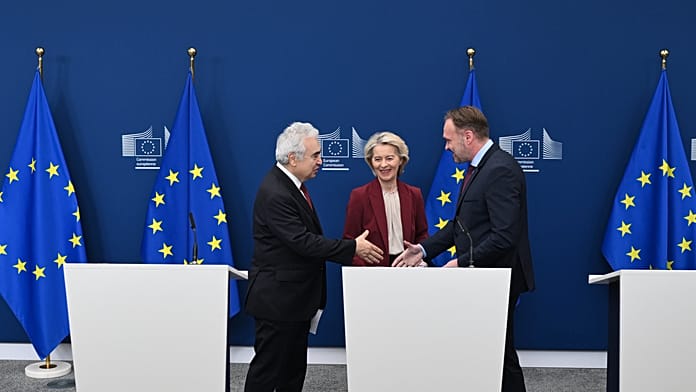
European Union Energy Commissioner Dan Jørgensen said the EU is not facing an imminent energy-supply crisis, but warned that high prices could have a similar impact on households unable to afford heating or travel to work.
The Danish Commissioner said nearly 50 million Europeans were already unable to adequately heat their homes in a normal winter, underscoring the social risks of another price shock.
“We are looking into all ideas of how we can make rules more flexible, be more efficient in our implementation, do what we can, both on the supply and the demand side,” Jørgensen told reporters on the sidelines of an informal gathering of energy ministers in Dublin on Tuesday.
Jørgensen welcomed French President Emmanuel Macron‘s ask for a temporary relaxation of some fuel rules to help refineries produce more diesel and other products in view of increasing domestic supply.
Asked whether another emergency oil release was in the cards, Fatih Birol, the International Energy Agency’s (IEA) leader, who also attended the meeting in Dublin, did not consider it a top priority.
Countries have so far released about 20% of their strategic stocks, leaving roughly 80% available if supply disruptions become significantly worse and governments agree to further action, Birol noted.
The EU’s top energy leader also confirmed that the European Commission plans to delay by one year the enforcement of parts of the EU methane rules covering imports, arguing that this could ease pressure on energy markets while keeping the bloc’s longer-term climate goals intact.
“We stick to the objectives, we stick to our ambitions, but I’m proposing now that we take part of it, the parts that are connected to imports, and postpone the set and force date by one year,” Jørgensen said.
Despite the current high energy prices, Jørgensen focused on the need to accelerate the EU’s exit from fossil fuels by investing in more renewables, electrification and energy efficiency.
“Our answer is twofold: doubling down on the green transition and being flexible and pragmatic in this very difficult transition period. We must help member states, citizens and companies to help this crisis,” he added.
Nonetheless, efforts to prevent skyrocketing energy prices won’t include an EU-wide windfall tax, Jørgensen said, leaving EU countries to introduce national schemes within EU rules. Several EU countries have called on the Commission to propose such a target, as it did in 2022.
Jørgensen acknowledged that political pressure could push governments to subsidise fossil fuels, but urged them to keep such measures targeted and temporary to avoid undermining the bloc’s energy transition through tax policy.
Jørgensen and Birol urged countries to reconsider tax systems that heavily tax electricity while imposing lower taxes on gas. If governments want households and industry to switch from gas and oil to electricity, they need to make electricity affordable, particularly during a period of high energy prices, the pair warned. The topic is currently under discussion between the EU co-legislators, the European Council and the Parliament, with Germany showing reservations.
Gas storage remains another concern in the bloc’s energy equation. EU rules now require an 80% storage target, down from 90%, but Jørgensen said countries still need to meet it. Falling significantly short this winter could leave the EU starting the next refill season with less gas in reserve, creating what he described as a potentially damaging cycle.
Birol stressed that cooperation between gas-producing and consuming countries will also be critical, pointing to Norway, Canada and even Nigeria as examples of suppliers that can help Europe manage disruptions.