
Latest News
- El-Sayed and Rogers exchange sharp attacks in final Michigan Senate debate
- Doorman criticises court sentence after attacker avoids jail for assault
- Arsonist sentenced to three and a half years for setting fire to cafe over mayonnaise dispute
- Meta faces class action lawsuit in Australia over alleged harm to children
- Wainwright community holds prayer vigil to support those affected
- Kansas Senate candidates debate amid tightening race, Marshall labels Hamilton a typical Democrat
- Snake found on Japan Airlines plane prompts cancellation of flight
- Europa League — Thursday’s 22nd Oct fixtures



For the 376th consecutive day, the israelis continue to pound, target & massacre civilians in Gaza — 65 people killed in just the last 24 hours

I wasn’t selected to speak in the Urgent Question on Gaza today.
What I was going to ask is: when will the government end its complicity in Israel’s genocide against the Palestinian people? When will it implement sanctions, withdraw diplomatic support and suspend ALL arms sales?
Get you up to speed: In final Michigan Senate debate, El-Sayed ties Rogers to Trump, while Rogers says El-Sayed is untrustworthy
Republican Mike Rogers and Democrat Abdul El-Sayed faced off during their final debate in Southfield, Michigan, on 21 October 2026, amid a heated Senate race. The debate featured accusations from El-Sayed that Rogers is a “sock puppet” for Donald Trump, while Rogers claimed El-Sayed is untrustworthy and too extreme for the electorate.
The debate between Mike Rogers and Abdul El-Sayed took place on October 21, 2026, at WXYZ-TV in Southfield, Michigan, marking the conclusion of their final face-off ahead of the upcoming midterm elections. Both candidates are positioning their platforms in opposition to one another, with Rogers warning of the financial implications of El-Sayed’s policies and El-Sayed accusing Rogers of aligning too closely with Donald Trump.
Following the debate, Mike Rogers expressed confidence, stating “there are so many Democrats who are coming out today and saying they can’t vote for Abdul El-Sayed because he’s too extreme.” The race’s significance is underscored by its proximity to the November midterms, with both parties keenly focused on voter sentiment regarding President Trump’s influence and economic concerns.
What remains unclear — It is not clear how much support El-Sayed’s Medicare for All plan has among voters or its expected cost.
El-Sayed and Rogers exchange sharp attacks in final Michigan Senate debate
Republican Mike Rogers and Democrat Abdul El-Sayed clashed onstage Wednesday during the second, and final, debate in the increasingly bitter Michigan Senate race. El-Sayed repeatedly argued his opponent is and would be a “sock puppet” for President Trump in the Senate, while Rogers cast his opponent as untrustworthy and trying to run from past, further-left positions.
The neck-and-neck race is one of the nation’s most closely watched contests in the November midterms and could help determine which party wins control of the Senate. Democrats hope to take advantage of Mr. Trump’s unpopularity and voters’ frustration with inflation and the Iran War. Republicans have sought to capitalize on divisions between progressives like El-Sayed and more moderate Democrats on Middle East policy and Medicare for All.
Robin Buckson-Pool / Getty Images 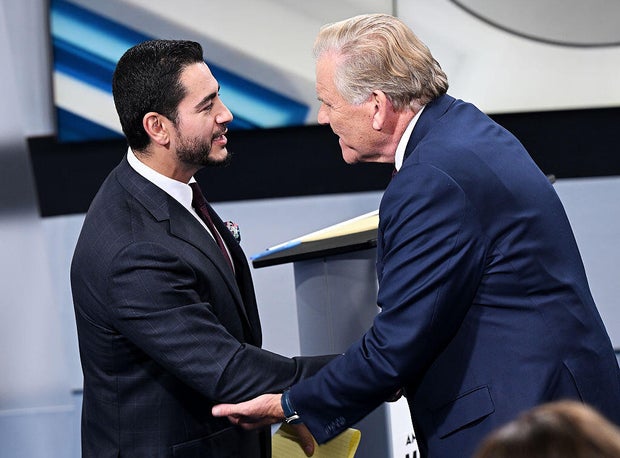
El-Sayed called Rogers’ platform a “MAGA vision” and argued the former congressman “stand[s] hip-to-hip with Donald Trump on all of his worst policies, the policies that are raising the price of your gas, making it impossible to afford your groceries.” The Democratic former health official responded to attack lines by inviting the audience to play “MAGA bingo.”
“He’s going to bend to Donald Trump because he is a sock puppet for the man,” said El-Sayed.
Rogers pushed back at one point, saying: “He wants to make this about Donald Trump. The bingo game ought to be: ‘How many times can he put Trump in any answer?'”
Asked by reporters after the debate if he’s planning to attend Mr. Trump’s Michigan rally on Sunday, which El-Sayed brought up, Rogers said he’d go but didn’t know all the final details yet.
During the debate, Rogers argued El-Sayed has not been honest about his platform, accusing him of engaging in a “pattern of deception.”
“Think about this: there are so many Democrats who are coming out today and saying they can’t vote for Abdul El-Sayed because he’s too extreme,” Rogers said. He also claimed he’s “doing exceptionally well with Jewish Democrats who are literally afraid,” alluding to some community members’ reluctance to support El-Sayed, a frequent critic of the Israeli government.
The debate was somewhat tamer than the two candidates’ first faceoff earlier this month, which featured insults and interruptions in virtually every answer. But it was still testy.
One of the more contentious moments came after Rogers tried to link El-Sayed to the Muslim Brotherhood and suggested he had the same supporters as terror groups like Hamas — allegations El-Sayed has vehemently pushed back against.
Earlier this month, several news outlets reported on social media posts by El-Sayed’s half sister suggesting the Democratic candidate’s mother had supported the Muslim Brotherhood, an Islamist group and political movement founded in her home country of Egypt.
El-Sayed has disavowed any connection to the organization, and has noted that he wasn’t raised by his birthmother since his parents divorced when he was young. Rogers said El-Sayed was trying to make himself look like “a victim.”
“You can grin and you can smile and you can talk real pretty, but I’m going to tell you what, that is a risk to our national security,” Rogers said. He told reporters after the debate that he questions whether El-Sayed can get a security clearance if elected.
El-Sayed called the allegations “shameful.”
“He keeps raising this question about this association with an organization I’ve never been a part of, because [of] my mom, who’s a nurse in Missouri?” the Democrat said. “It doesn’t make any sense, and it’s actually really quite beneath you, Mike.”
El-Sayed pressed Rogers on the Iran war, pointing to the conflict as the cause of high consumer prices and casting the Republican as a hawk who has “a war for everything.”
“We need a War Powers Resolution, rather than a senator who is going to stand hip-to-hip with Donald Trump on this war that made no sense when it started and certainly makes no sense now,” El-Sayed said when asked how he would bring costs down.
Rogers has called on the war to end, but also said on the debate stage that if Iran is allowed to control the Strait of Hormuz or build a nuclear weapon that gas could rise even higher.
The moderators asked El-Sayed whether he views Iran as a significant threat to U.S. national security. It was a variation on a question during the first debate, when El-Sayed was asked whether Iran or Israel is a bigger threat, which he called a “ridiculous hypothetical.”
El-Sayed said Wednesday that “there’s no doubt that Iran has posed a threat,” but he argued “that threat had been contained” by the Obama-era deal that limited Iran’s nuclear program. Mr. Trump ended that deal during his first term in office.
Rogers said Iran is “absolutely” a threat and argued El-Sayed’s previous answers on Iran were “an absolute nonstarter if you’re going to send somebody … to the United States Senate.”
Meanwhile, Rogers pushed El-Sayed on some of his progressive policy views, including his support for Medicare for All, a single-payer healthcare plan.
“Money in your pocket? You’ll be lucky to have a damn pair of pants when you’re done,” said Rogers, arguing El-Sayed’s policies would require significant tax hikes.
El-Sayed responded by saying: “Right now, the folks pulling the money out of your pocket are the big corporations who are buying his campaign.” Asked by WTX US News after the debate about how much the plan would cost, El-Sayed argued if implemented it’d be less expensive than the costs of healthcare currently, and said the platform has bipartisan support.
On tariffs, El-Sayed criticized Mr. Trump’s tariffs but said he is open to some import duties. He said, “You don’t give all the chemo all at once, all at the same time.”
Rogers called the president’s tariffs a “mixed bag,” questioning the trade war with Canada but saying the “reshoring of manufacturing is underway.”
Get you up to speed: Bouncer fuming after attacker gets ‘slap on wrist’ while his life is in tatters | News UK
Jonathon Proctor, a doorman, was injured during an altercation with Craig Rimmer at the Old Cigar and Olive in Folkestone, Kent, on November 23, 2024. Rimmer was sentenced to pay £2,000 in compensation and spared jail after changing his plea to guilty of actual bodily harm.
Jonathon Proctor is scheduled to undergo surgery for a knee injury that includes a tear in his meniscus and ACL. Craig Rimmer, who has previously been convicted of relevant offences, received a six-week compensation order totalling £2,000 but has avoided further punishment according to the presiding judge.
Jonathon Proctor has expressed his anger at the justice system after Craig Rimmer, who inflicted a serious knee injury, received a £2,000 compensation order without serving jail time. Proctor’s future remains uncertain as he now faces knee surgery due to a tear in his meniscus and ACL, which he asserts has effectively ended his career as a doorman.
What remains unclear — It is not specified when Jonathon Proctor will undergo the operation on his knee or the expected recovery time.
Doorman criticises court sentence after attacker avoids jail for assault
A doorman injured while breaking up a fight has blasted the justice system after his attacker got off with ‘a slap on the wrist’ while his life has been left in tatters.
Jonathon Proctor, 33, was thrown to the floor by Craig Rimmer while escorting him out of the Old Cigar and Olive in Folkestone, Kent, on November 23, 2024.
He suffered a serious knee injury in the fall and still needs crutches nearly two years on. Unable to work since, he is also having to rely on benefits to get by.
Jonathon said he was hoping to face Rimmer in court after he was charged with ABH over the incident.
But he ended up changing his plea when Jonathan wasn’t at court and was sentenced without him being there to see.
Sign up for all of the latest stories
Rimmer was spared jail and ordered to pay £2,000 in compensation.
‘It still makes me so angry,’ Jonathon said.
‘I waited a year, over a year, for literally just to be able to sneak into court at the very last moment, change his plea, and get a £2,000 compensation order – it hurts.
‘It was absolutely ridiculous.’


At the hearing, the court heard that Rimmer, a father-of-three who works as a foreman for construction firm Balfour Beatty, had three ‘relevant’ convictions but had ‘not been in trouble since 2011’.
Defending, Rimmer’s barrister said that ‘he commands an impressive salary, that this could best be met by a fine’.
Sentencing, the judge told Rimmer he didn’t think he ‘deserved or needed to be punished any further’ for his offending and made an order for compensation.
The judge then wished Rimmer luck in getting back to Great Yarmouth.
Jonathon says he feels like Rimmer has got off with a ‘slap on the wrist’ while he still deals with pain related to his injuries.

He said: ‘It’s arrogance for me. Door staff go to work to make sure people like him can have a good night.
‘What I don’t anticipate is having my career destroyed by him.
‘It makes me really angry.
‘My career, my whole entire career has now gone – my knee is unlikely to get back to full strength.
‘I very much doubt I’ll ever be in a mental state or physical state to go back on the doors.
‘What he’s effectively done is destroyed a good portion of what I can do now.’
Jonathon now faces an operation on his knee after a scan revealed a tear in his meniscus, or knee cartilage, and ACL.
